How to Learn AI From Scratch in 2026: The Only Roadmap You Need
69% of business leaders say AI literacy is now critical for their teams' daily tasks, according to DataCamp's State of Data & AI Literacy Report 2026. And yet, most beginners still have no idea where to start.
Every week someone asks me: "I want to learn AI. What do I do first?" And every week, the internet gives them the same unhelpful answer: start with Python, then linear algebra, then machine learning theory, then...
No. That's the technical career track. It takes a year minimum and terrifies most people out of ever starting.
The real answer in 2026 is: it depends on what you actually want from AI. There are two completely different paths. I'll show you both, tell you which one fits you, and give you the exact roadmap to follow from day one.
Why Learning AI in 2026 is Different
You no longer need a GPU cluster, a PhD, or a Stanford course to get started with AI. In 2026, Google Colab gives you free T4 GPU access, Kaggle offers P100s for up to 30 hours per week, and state-of-the-art models like GPT-4o and Gemini 1.5 Pro are one API call away.
The barrier is not technical anymore. It is structural. The question is not "can I learn AI?" The question is "what order do I learn it in?"
Here is the most important thing I can tell you: AI skills now show up in 11.7% of all job postings in India, up from 8.2% just a year ago. That number will only go higher. Every month you wait makes the competition steeper.
The encouraging part? Most of your competition is starting with the wrong approach: random YouTube videos, scattered tutorials, and no real structure. A clear roadmap beats raw effort almost every time.
The Two Paths: AI Power User vs AI Builder
Before you pick a course or read a single tutorial, you need to answer one question: what do I actually want to do with AI?
There are two distinct paths, and they lead to completely different outcomes.
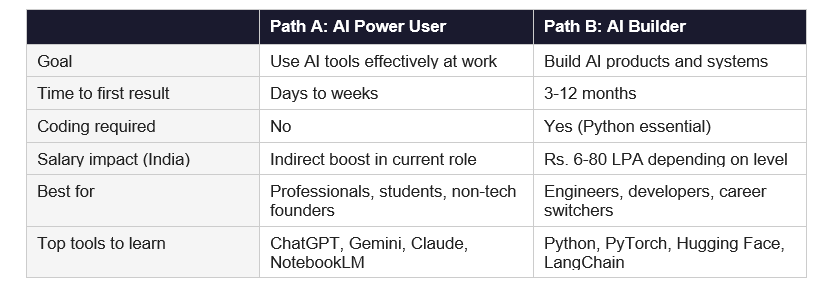
My honest take: most people should start with Path A and add Path B skills selectively. The ego move is to want to "learn AI properly" and start with Python. The smart move is to start using AI tools today, get actual results, and then build technical depth in the areas that matter for your specific goals.
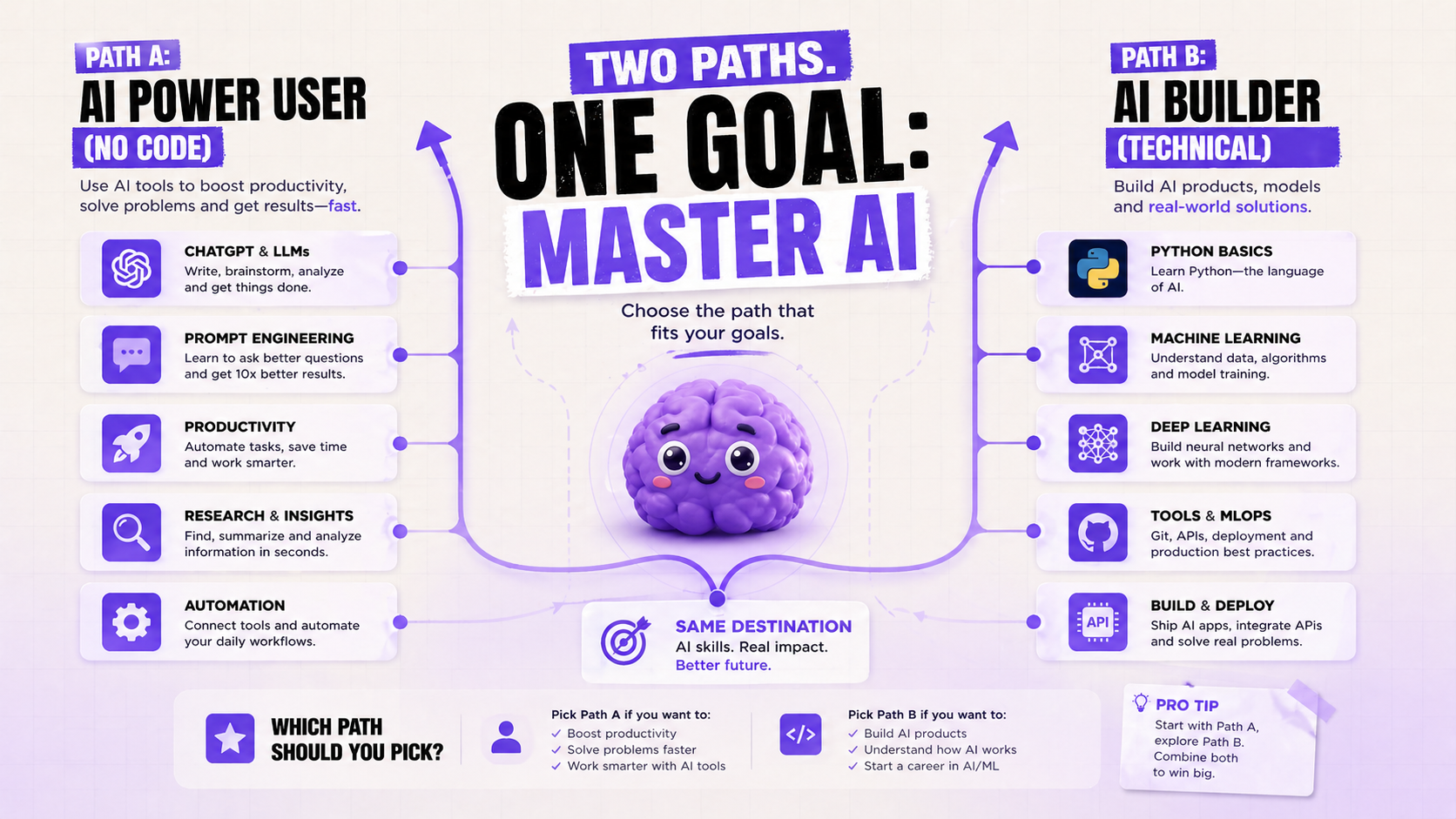
Path A: The AI Power User Roadmap (No Code)
This path gets you productive with AI in days, not months. It is for anyone who wants to stop feeling left behind and start using AI to actually do things faster.
Week 1-2: Learn the fundamentals
Start with Google's AI Essentials course on Coursera. It is 5 courses, entirely beginner-friendly, and teaches you how AI works without requiring any technical background. Taught by Google experts, it covers prompting, productivity, and responsible AI. The certificate is employer-recognized. Cost is about $49/month after a 7-day free trial.
Alternatively, Andrew Ng's "AI For Everyone" on Coursera has over 1 million learners globally and is often free via financial aid. It walks non-technical professionals through what AI is, what it can and cannot do, and how to think about AI strategy.
Week 3-4: Master the tools
• ChatGPT (OpenAI) for writing, analysis, research, and brainstorming
• Gemini (Google) for workspace integration and document analysis
• Claude (Anthropic) for long-form thinking, coding help, and nuanced tasks
• NotebookLM (Google) for turning your own documents into AI-searchable knowledge bases
• Perplexity for AI-powered research and real-time web answers
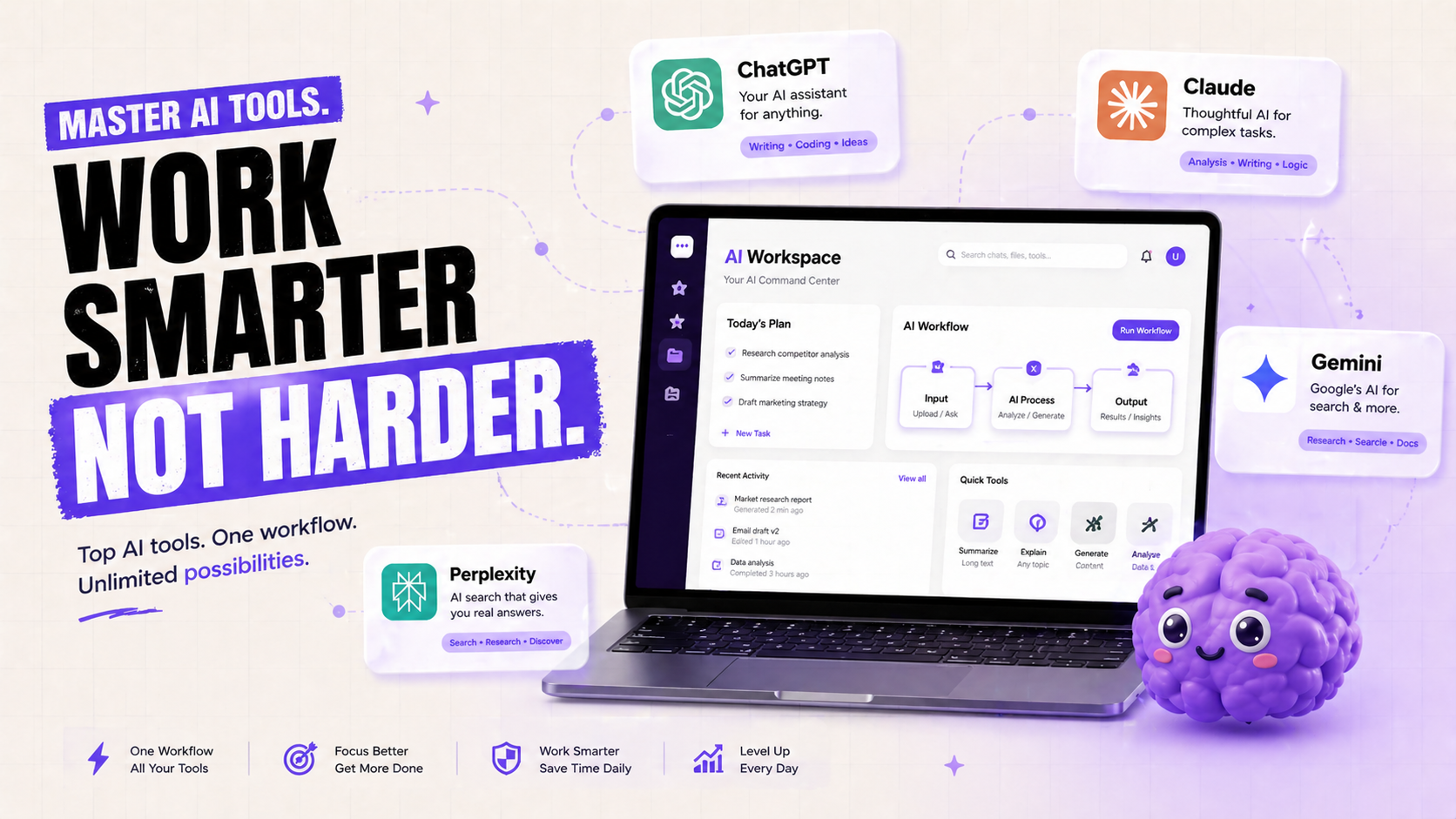
Spend 30 minutes daily just using these tools on real work. Summarize your meeting notes. Draft emails faster. Research a topic. The fastest way to get good at AI tools is to use them on problems you actually have.
Month 2: Prompt Engineering
Prompt engineering is the skill of communicating effectively with AI models. Clear, specific instructions get 10x better results than vague ones. Vanderbilt University's "Prompt Engineering for ChatGPT" on Coursera (rated 4.8 with 9,000+ reviews) is one of the best resources for this.
A good prompt has context, a specific task, a format instruction, and a persona. "Write a marketing email" is bad. "You are a senior copywriter at a B2B SaaS company. Write a 150-word cold email for a CFO about reducing invoice processing time by 60% using AI automation." is good.
Path B: The AI Builder Roadmap (Technical)
This path is for people who want to build AI products, work in AI-related jobs, or genuinely understand how these systems work under the hood. It requires a time commitment and real effort. But the financial payoff is significant.
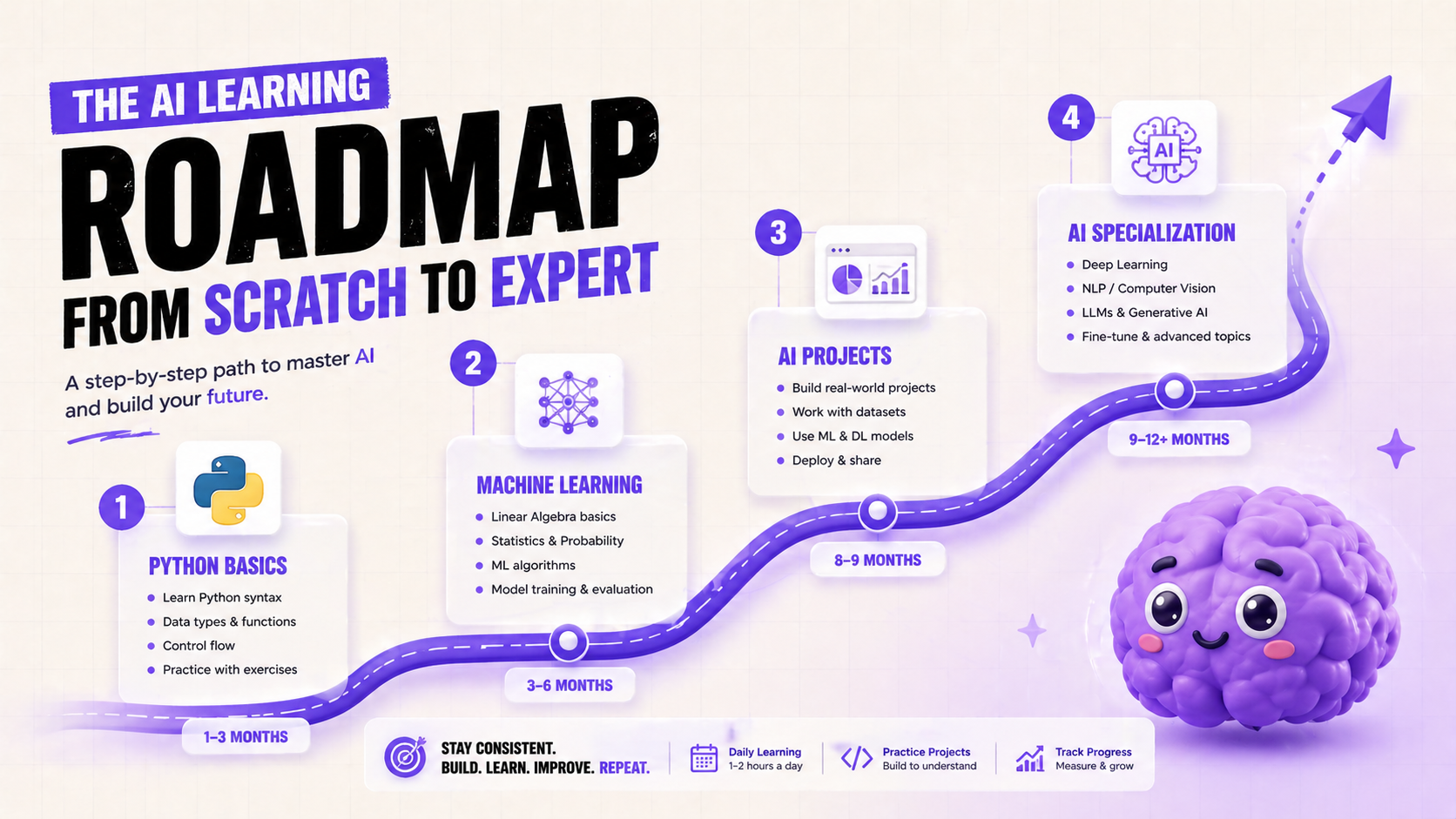
Months 1-3: Python foundation
Python is the single most important skill for AI. Every AI library, framework, and tool is built for Python first. If you cannot write clean Python code, stop everything else and learn it.
Start with "Python for Everybody" by Charles Severance (available free on Coursera audit mode). Work through every exercise. Type the code, do not copy-paste it. This phase typically takes 2-3 months of daily practice for complete beginners.
Parallel to this: get comfortable with Git and GitHub. Every project you build needs a repository. This is non-negotiable for getting hired.
Months 4-6: Core Machine Learning
Andrew Ng's Machine Learning Specialization on Coursera covers supervised learning, unsupervised learning, and neural networks. It uses Python and scikit-learn. Ng explains concepts at the right level of depth without drowning you in academic notation.
By end of month 6, you should be able to train, evaluate, and improve basic ML models. Build 2-3 small projects: a spam classifier, a price predictor, a simple recommendation system.
Months 7-9: Specialize
Pick one of these tracks based on where you want to work:
NLP / LLM Engineering: Hugging Face Transformers, LangChain, RAG pipelines, prompt engineering APIs
Computer Vision: PyTorch, CNNs, image classification, object detection
Generative AI: OpenAI API, fine-tuning, agents, function calling
MLOps: Model deployment, monitoring, cloud platforms (AWS/GCP/Azure)
Generative AI and LLM engineering carry the highest salary premium right now. Companies are paying a 25-40% premium over generalist ML engineers for this specialization in 2026.
The Best Free AI Courses in 2026
Paid courses are great, but you can get genuinely far with free resources. Here are the ones I would actually recommend, not just list for the sake of it.
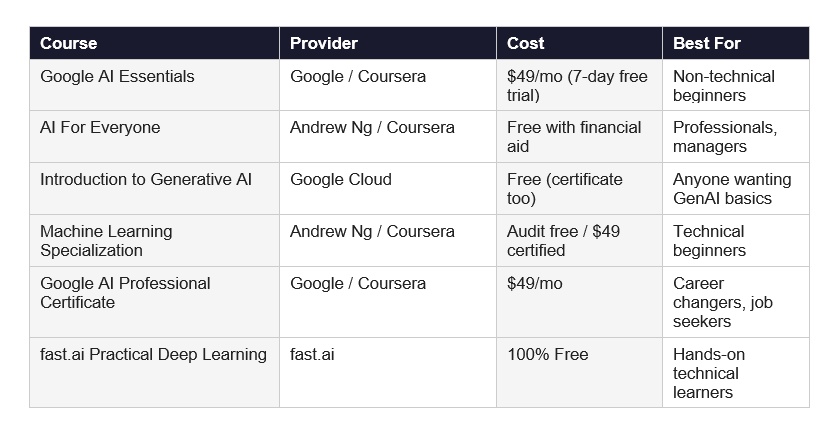
Hot take: Google's free "Introduction to Generative AI" on Google Cloud Skills Boost is the single best 45-minute course for a complete non-technical beginner. It is free, gives you a Google-issued certificate, and explains how LLMs work in plain English. Start there before anything else.
How Long Does It Take to Learn AI?
Honest answer: it depends on what "learn AI" means to you. Here is a realistic breakdown.
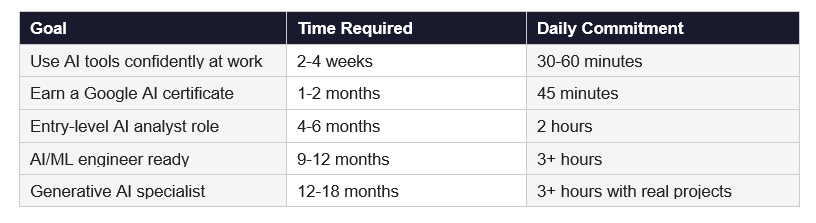
The research from TechnoEdge's 2026 career guide confirms: 4-8 months is the realistic timeline to become job-ready if you follow a proper roadmap and dedicate daily time. Skipping days kills momentum faster than any other factor.
I have seen people spend 3 years "learning AI" and never ship anything. And I have seen people go from zero to a working AI project in 6 weeks with daily focused practice. The difference is not talent. It is structure and consistency.
The Biggest Mistake Beginners Make (And It Is Not What You Think)
Every AI beginner I meet makes the same mistake. They try to learn everything at once.
They start a Python course, drop it for a YouTube video on neural networks, then buy an online AI bootcamp they never finish, then wonder why they still cannot do anything with AI six months later.
The contrarian truth: you do not need to master calculus before writing your first Python script. You do not need to understand transformers before using ChatGPT effectively at work. Learn as you build, not before you build.
Pick one path. Follow it for 30 days before changing anything. The structured roadmap approach, even an imperfect one, beats random learning by a massive margin.
One more thing nobody talks about: consistency beats intensity every time. 20 minutes of focused AI practice every morning beats a 5-hour weekend cramming session. Your brain needs repetition, not volume. Build the habit first, then increase the depth.
Frequently Asked Questions
Q: Can I learn AI on my own without a degree?
Yes, absolutely. AI has some of the most accessible self-learning resources of any technical field. Google's AI Professional Certificate, Andrew Ng's courses on Coursera, and fast.ai all assume no prior university education. Many AI engineers working at product companies in India started with online courses and self-built projects, not CS degrees. What matters is your portfolio and what you can demonstrate.
Q: How do I start learning AI for beginners in 2026?
Start with Google's free "Introduction to Generative AI" on Google Cloud Skills Boost. It takes about 45 minutes, is free, and gives you a digital certificate. Follow it with Google AI Essentials on Coursera for practical tool use. If you want the technical path, then Python is your first serious step: start with "Python for Everybody" by Charles Severance, which is free on Coursera audit mode.
Q: What are the 4 types of AI?
The 4 types of AI by capability are: (1) Reactive Machines, which respond to inputs without memory (like chess engines); (2) Limited Memory, which use historical data to make decisions (like self-driving cars and recommendation systems); (3) Theory of Mind, which understand emotions and intentions (still largely theoretical); and (4) Self-Aware AI, which have consciousness (does not exist yet). Current tools like ChatGPT and Gemini fall under the Limited Memory category.
Q: Is Google's AI course free?
Google offers several free AI courses. The "Introduction to Generative AI" on Google Cloud Skills Boost is completely free and includes a digital badge. Google AI Essentials on Coursera has a 7-day free trial. The Google AI Professional Certificate costs around $49/month on Coursera but can be accessed via financial aid. All course content is available to audit for free; you pay only for the graded certificate.
Q: How long does it take to learn AI from scratch?
For non-technical learners targeting productive AI tool use: 2-4 weeks of focused daily practice. For an entry-level AI analyst role: 4-6 months of structured learning. For an AI/ML engineer position: 9-12 months of consistent effort with Python, ML fundamentals, and real projects. According to TechnoEdge's 2026 AI career guide, the average fresher reaches job-ready level in 4-8 months following a structured roadmap.
Q: What is AI salary in India for freshers in 2026?
AI fresher salaries in India in 2026 typically range from Rs. 5 LPA to Rs. 12 LPA. IT services companies like TCS and Infosys start freshers at Rs. 5.8-8 LPA. Product companies and AI-first startups pay Rs. 8-15 LPA for freshers with strong portfolios and Generative AI skills. GenAI specialists with real project exposure earn Rs. 8-12 LPA even at entry level, significantly above generalist IT roles. Salary growth in AI is averaging 15-20% year-on-year.
Q: What is the 10-20-70 rule for AI?
The 10-20-70 rule for AI implementation says: 10% of success comes from the algorithm or model, 20% comes from the data quality and preparation, and 70% comes from organizational change management and adoption. It is a framework popularized in enterprise AI to explain why most AI projects fail at the deployment stage, not the technical stage. Understanding this rule helps non-technical professionals contribute meaningfully to AI projects without writing a single line of code.
Q: What are the best free AI courses for beginners in 2026?
The top free AI courses for beginners in 2026 are: (1) Google Cloud's Introduction to Generative AI, free with a certificate; (2) Andrew Ng's AI For Everyone on Coursera, often accessible via financial aid; (3) fast.ai's Practical Deep Learning for Coders, 100% free for technical learners; (4) Microsoft AI learning hub on Microsoft Learn, no prior experience required; (5) Google AI Essentials on Coursera, with a 7-day free trial. All of these are beginner-friendly and do not require a programming background to start.
Start Today, Not Next Monday
Daily AI learning beats weekend cramming. Every single time. Pick one course from this guide, block 20 minutes in your calendar tomorrow morning, and start. The best AI learners in 2026 are not the smartest ones. They are the most consistent ones.
Unrot teaches AI in 5 minutes a day. No jargon, no fluff, just the concepts that actually matter, delivered in bite-sized pieces that actually stick.
References
1. DataCamp: State of Data & AI Literacy Report 2026
2. Coursera: Google AI Professional Certificate
3. Google Grow with Google: AI Courses and Tools
4. Taggd: AI Engineer Salary in India 2026
5. TechnoEdge: Complete AI Career Roadmap for Freshers in 2026
6. KDnuggets: How to Become an AI Engineer in 2026
7. BuildFastWithAI: AI Jobs in India Salary 2026
8. Syracuse University: How to Learn AI in 2026