

AI News This Week: July 13-19, 2026
This was the week the balance of power in AI visibly shifted. Google's most anticipated launch of the year got delayed again and its stock dropped. A free Chinese model beat the best paid models at coding. China's president launched a global AI organization with 29 member countries. And Apple quietly became the most valuable company on Earth. If you only have five minutes to catch up on the whole week, this is the one to read.
The Week in One Paragraph
Google failed to ship Gemini 3.5 Pro for the second time, and Alphabet lost about 4 percent of its value. Into that gap, Moonshot AI's Kimi K3 launched as the largest open model ever built and immediately took the number one spot on a major coding leaderboard, with its weights going free on July 27. Xi Jinping used his first World AI Conference keynote to create WAICO, a Shanghai-headquartered AI governance body with 29 founding countries. Apple got approval to launch its AI in China using Alibaba's models, then passed Nvidia to become the world's most valuable company. Anthropic filed confidentially to go public at a possible trillion-dollar valuation. Underneath it all, free open models kept winning and compute stayed the industry's tightest constraint.
The 10 Biggest AI Stories of the Week, Ranked
These are ranked by how much they actually change things, not by the day they happened.
1. Google's Gemini 3.5 Pro flopped again, and the stock fell
The most anticipated launch of the summer did not happen. Google delayed Gemini 3.5 Pro for a second time on July 17 after the rebuilt model reportedly fell short on coding and reasoning in testing, and Alphabet shares dropped about 4 percent. Google had already scrapped its first version in June and restarted training from scratch, so this was the do-over that also did not clear the bar. No official model details have been published, so every leaked spec stays unconfirmed.
This tops the list because it changes the story people tell about Google. Being late is survivable; being late and still behind Anthropic's Fable 5 and OpenAI's GPT-5.6 on coding is what turns a delay into a question about whether Google can still win the frontier. The fair counterweight is that refusing to ship something broken is the right call, and Google's research bench and Search reach remain enormous.
2. Kimi K3 launched free and immediately beat the paid models at coding
Moonshot AI dropped Kimi K3 late on July 16, a 2.8-trillion-parameter model that is the largest open-weight release in history, and within hours it hit number one on the Frontend Code Arena with a 76 percent win rate, beating Anthropic's Fable 5. It scored 88.3 on the Terminal-Bench coding test and ranks ninth on general chat, marking it as a coding and agent specialist. Its weights go free on July 27.
This is the week's most consequential model story, because a free model beating a top paid one at real coding tasks undermines the core pricing argument of the entire closed-model industry. The timing, hours before Google's expected launch and China's big AI speech, was not luck.
3. China launched WAICO, a global AI organization with 29 countries
Xi Jinping delivered his first-ever World AI Conference keynote on July 17 and announced the World Artificial Intelligence Cooperation Organization, headquartered in Shanghai, with 29 founding members including Pakistan, Russia, and Kazakhstan. He called AI development a symphony of global cooperation rather than a solo performance by one country, championed open-source AI, and pledged help to developing nations while criticizing US technology restrictions.
A named organization with a headquarters and 29 signatories is real diplomacy, not conference talk, and the West has no equivalent on the table. Google's own AI chief called for a US-led coalition the same week, which quietly concedes the gap.
4. Apple passed Nvidia as the world's most valuable company
Apple overtook Nvidia to reach roughly $5 trillion in market value, ending Nvidia's reign as the defining stock of the AI boom. It capped a strong week in which Apple also secured Chinese regulatory approval to launch Apple Intelligence and was reported to be hunting chip acquisitions for its own AI server silicon.
The signal matters more than the ranking, which can flip on any strong earnings day. Investors rewarding the company that puts AI in front of billions of users, over the company that supplies the chips, suggests distribution is reasserting itself as the durable source of value.
5. Anthropic filed to go public at a possible trillion-dollar valuation
Anthropic filed a confidential S-1 for a potential IPO by late 2026, backed by multibillion-dollar credit lines, with investor interest that could value it above $1 trillion. The company is the AI revenue leader at roughly $47 billion annualized and reportedly profitable, and it also topped this week's independent AI safety index and was reported to have hired Andrej Karpathy.
Anthropic had the best all-around week of any company: revenue leader, safety leader, talent magnet, and now IPO-bound. It is also in early talks to lease about $10 billion of computing power from Meta, a rival, which tells you how tight compute has become.
6. Apple Intelligence cleared China, but only by using Alibaba's models
China's internet regulator registered Apple Intelligence on July 15, clearing the way for Apple's AI features in its second-biggest market, powered by Alibaba's Qwen models with Baidu also involved. China requires all AI models to be domestically registered and approved, which foreign models do not pass.
This is the clearest evidence yet that AI is splitting into two separate stacks, one Western and one Chinese, with a hard regulatory border between them. When even Apple has to run a Chinese model to operate in China, market access starts to matter as much as model quality.
7. TSMC posted a monster quarter and added $100 billion for Arizona
TSMC, which manufactures nearly every advanced AI chip, reported quarterly profit up 77 percent to about $22 billion on revenue of $40.2 billion, raised its spending forecast to $60-64 billion, and added $100 billion to its Arizona expansion, bringing planned US investment to $265 billion.
Factories follow orders, not hype, so a 77 percent profit surge is the strongest evidence that the AI buildout is accelerating rather than cooling. The Arizona commitment is also the biggest hedge yet against the industry's dangerous concentration in Taiwan.
8. The open-model wave became the week's real story
Beyond Kimi K3, the week brought Mira Murati's Thinking Machines releasing Inkling, a 975-billion-parameter open model on a reported $2 billion seed round, DeepSeek seeking over $70 billion at a $74 billion valuation with its stable V4 due July 24, and PrismML's Bonsai 27B squeezing a 27-billion-parameter model onto an iPhone at 3.9 gigabytes.
Four of the month's most important releases are free to download, and one now comes from a marquee American founder. The argument that open models are the cheap alternative died this week; they are competing at the top.
9. OpenAI offered the US government a $42.6 billion stake
OpenAI proposed giving the US government a 5 percent stake, worth roughly $42.6 billion, as part of an idea to route 5 percent of leading AI firms' equity into a public fund modeled on Alaska's oil wealth fund. Sam Altman pitched it directly to the Trump administration, and any deal that size would likely need an act of Congress.
It is either the most forward-thinking idea in AI policy or the most sophisticated lobbying of the year, and probably both. It also arrives as OpenAI fights Apple's trade-secret lawsuit and a publisher sanctions motion, ahead of its own IPO.
10. AI labs got graded on safety, and nobody did well
The Future of Life Institute's 2026 AI Safety Index gave its highest grade, a C+, to Anthropic, with OpenAI and Google DeepMind at C, Meta at D+, and xAI, DeepSeek, and Mistral effectively failing. The report found several labs had quietly walked back earlier safety commitments.
A C+ as the best grade in the industry is a damning result, and it landed the same week xAI was sued over Grok-generated child-exploitation material and San Francisco ordered Apple and Google to pull 13 AI nudify apps. Safety was not an abstract debate this week.
Winners and Losers of the Week
Some weeks are mixed. This one had a very clear scoreboard.
Winners
Moonshot AI: launched the largest open model ever and took the top coding spot within hours, on the exact day its biggest rival stumbled.
Apple: cleared China, passed Nvidia to become the world's most valuable company, and is building toward its own AI server chips.
Anthropic: revenue leader, top safety grade, reported Karpathy hire, and a confidential IPO filing at a possible trillion-dollar valuation.
The open-weight camp: Kimi K3, Inkling, DeepSeek, and Bonsai 27B all landed in one stretch, shifting the argument from price to capability.
TSMC: 77 percent profit growth and a $265 billion US investment plan, collecting from every side of every AI price war.
Losers
Google: a second Gemini delay, a 4 percent stock drop, and its biggest moment of the year handed to rivals. Its AI Mode expansion and Gemini Notebook upgrade were real wins, but they were drowned out.
OpenAI: Apple's trade-secret lawsuit, a publisher motion seeking sanctions over withheld training data, and the shutdown of its Atlas browser, all before an IPO.
xAI: a failing grade on the safety index and a lawsuit over child-exploitation material generated by Grok.
Nvidia: lost the most-valuable-company crown to Apple, even as chip demand stayed red hot.
The 3 Patterns That Actually Mattered
1. Free models stopped being the budget option
For two years the trade was simple: paid models were better, free ones were cheaper. Kimi K3 beating Fable 5 at coding, while promising free weights within ten days, breaks that trade. Add Murati's 975-billion-parameter Inkling, DeepSeek's stable V4 arriving July 24, and a 27-billion model running on an iPhone, and the pressure on paid pricing becomes structural rather than temporary.
My take: if free models keep topping the charts, every closed lab has to answer a question it has avoided all year: what exactly am I paying for? Expect price cuts.
2. AI split into two separate worlds
Apple had to use Alibaba's models to enter China. China metered Nvidia H200 imports while showcasing Huawei's homegrown compute. Xi launched a Shanghai-headquartered governance body with 29 members while the West's answer was a call for a coalition that does not exist yet. The technical, regulatory, and diplomatic borders all hardened in the same seven days.
My take: the single global internet assumption that tech grew up on is over for AI. Companies operating worldwide now run two stacks, and that is expensive and permanent.
3. Compute stayed the real bottleneck
Google rationed Gemini access to Meta because it ran short of capacity. Anthropic opened talks to rent about $10 billion of compute from Meta, a direct competitor. Meta committed $50 billion to a single Louisiana data center in a project that could exceed $250 billion. TSMC raised spending twice. Everything else in AI is downstream of who has chips and power.
My take: the labs that own their compute set the pace. Everyone renting is one capacity crunch away from a delayed roadmap, which is exactly what happened to Meta this week.
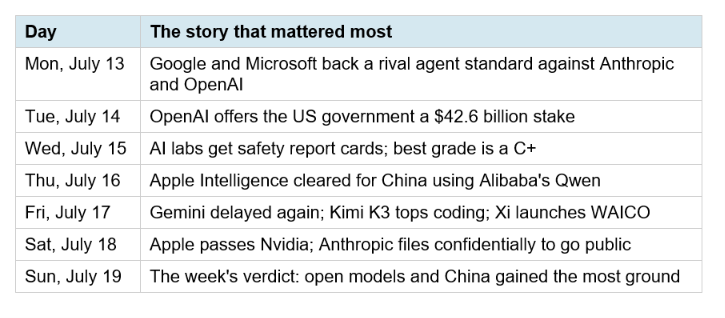
The Week at a Glance
What to Watch Next Week
Four things are already on the calendar, and they follow directly from this week.
July 20: the World AI Conference in Shanghai wraps up, and whatever WAICO announces about members and structure will show whether it is a real institution or a stage.
July 24: DeepSeek V4's stable release lands, forcing developers off preview builds and giving enterprises the stability they have been waiting for to move production workloads to open models.
July 27: Kimi K3's open weights go free. This is the big one. A model that just beat paid rivals at coding becomes downloadable by anyone, and the reaction will tell us how fast the open wave really moves.
Whenever it is ready: Google's next Gemini 3.5 Pro attempt. After two delays, the third try carries enormous weight, and the market has already priced in some doubt.
The through-line to watch is simple. If free models keep winning benchmarks and enterprises keep migrating to them, the economics of the entire AI industry get rewritten in the second half of 2026. That is the story I will be tracking every day next week.
Frequently Asked Questions
Q: What was the biggest AI news this week?
Google delaying Gemini 3.5 Pro for a second time on July 17, which sent Alphabet shares down about 4 percent, while Moonshot AI's free Kimi K3 model launched and immediately took the number one coding spot. The two events together marked a visible shift in momentum toward open models.
Q: Did Gemini 3.5 Pro launch this week?
No. Google delayed it again after the rebuilt model reportedly fell short on coding and reasoning in testing. Google has published no official model card, pricing, or benchmarks, so all leaked specifications remain unconfirmed. This was the second delay after Google scrapped the original base model in June.
Q: What is Kimi K3 and why does it matter?
Kimi K3 is Moonshot AI's 2.8-trillion-parameter model launched July 16, the largest open-weight release ever. It reached number one on the Frontend Code Arena with a 76 percent win rate, beating Claude Fable 5, and scored 88.3 on Terminal-Bench. Its weights become free to download on July 27, 2026.
Q: What is WAICO?
WAICO is the World Artificial Intelligence Cooperation Organization, announced by Xi Jinping at the Shanghai World AI Conference on July 17, 2026. It is an intergovernmental body headquartered in Shanghai with 29 founding countries including Pakistan, Russia, and Kazakhstan, created to shape global AI governance.
Q: Is Apple now the most valuable company?
As of July 17, 2026, Apple overtook Nvidia to become the world's most valuable company, approaching a $5 trillion market value. Rankings shift with daily trading, but the change signals investors rewarding companies that deliver AI to users over those supplying the underlying chips.
Q: Is Anthropic going public?
Anthropic filed a confidential S-1 for a potential IPO by late 2026, with investor interest that could value it above $1 trillion. It is the AI revenue leader at roughly $47 billion annualized, reportedly profitable, and also topped this week's independent AI safety index.
Q: Why are free AI models suddenly winning?
Chinese labs and well-funded startups have poured resources into open-weight models, and this week Kimi K3 beat a top paid model at coding while Thinking Machines released a 975-billion-parameter open model. Free models now compete on capability, not just price, which pressures the entire paid-AI business model.
Q: What AI news should I expect next week?
Three dated events: the Shanghai World AI Conference closes July 20, DeepSeek's stable V4 release lands July 24, and Kimi K3's open weights go free July 27. Google's next attempt at launching Gemini 3.5 Pro is also expected but has no confirmed date.
Read the Daily Editions From This Week
Every story above was covered in more detail on the day it happened:
• Top 10 AI News: July 18 2026 Daily Roundup
• Top 10 AI News: July 17 2026 Daily Roundup
• Top 10 AI News: July 16 2026 Daily Roundup
• Top 10 AI News: July 15 2026 Daily Roundup
• Top 10 AI News: July 14 2026 Daily Roundup
• Top 10 AI News: July 13 2026 Daily Roundup
• Top 10 AI News: July 12 2026 Daily Roundup
One week produced a delayed flagship, a free model that beat paid ones, and a new global AI institution. Five focused minutes a day is how you keep up with all of it without giving up your evenings.
References
• Xinhua: Xi Calls for Equitable Global AI
• Fortune: Xi Offers AI Olive Branch in
• VentureBeat: Moonshot AI Releases Kimi
• TechCrunch: Apple Intelligence Approved
• Tech Startups: Top Tech News Today, July
• CNBC: Anthropic in Early Talks With Meta
.png)