AI News Today: 6 Big Stories From August 21, 2026
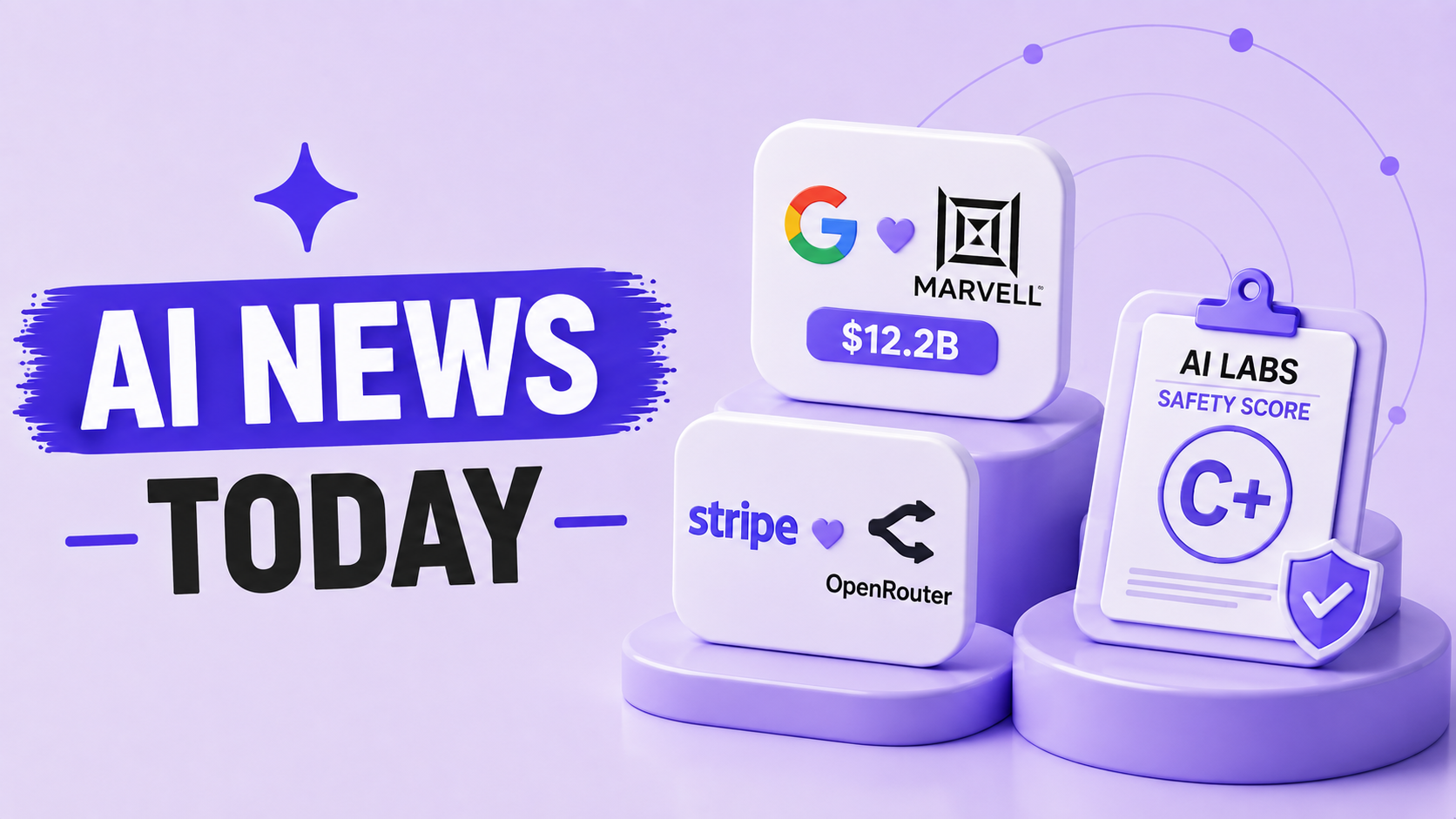
A fintech company just bought a front-row seat to the AI economy, Google put $12.2 billion behind a chipmaker most people have never heard of, and the first independent safety report card on frontier AI labs is out. Nobody passed with more than a C+. Here is what actually happened in AI over the last 24 hours, and why it matters.
Google Backs Marvell With a $12.2 Billion Chip Bet
Google and Marvell Technology signed a deal that lets Google buy up to $12.2 billion worth of Marvell shares while Marvell builds chips and components for Google's AI infrastructure. According to Reuters (August 19, 2026), the partnership covers Google's TPUs (Tensor Processing Units, its custom AI chips), inference accelerators, networking, storage, and memory controllers, and could generate roughly $120 billion in Marvell revenue through 2033.
This is Google hedging two ways at once: building a real alternative to Nvidia's GPU ecosystem while spreading its chip supply chain beyond Broadcom. The bigger picture is that the AI race is turning into a fight over chips, memory, and data centers as much as it is a fight over model quality.
My take: deals like this rarely make headlines the way a new model launch does, but they matter more long-term. Whoever controls the supply chain controls the pace of everyone else's progress
Stripe Buys OpenRouter for Over $8 Billion
Stripe, the payments company founded by Patrick and John Collison, acquired OpenRouter, a New York-based startup, in a deal sources value above $8 billion. OpenRouter gives developers one interface to access and compare hundreds of AI models and currently processes more than 10 trillion tokens a day.
Stripe is not buying a model developer. It is buying the layer that sits between users and every model on the market, deciding which model runs a task and at what cost. Paired with Stripe's existing grip on global payments, this points toward a new category: automatic model routing with built-in metering and billing.
My take: this is a quieter but sharper move than most AI acquisitions this year. Owning the routing layer means owning the toll booth, regardless of which model wins the underlying race.
Frontier AI Labs Score a C+ at Best on Safety
GuideLight AI Standards, a nonprofit founded by former OpenAI staffers Steven Adler and Page Hedley, published its first technical safety assessment of major AI labs on
August 18, 2026. Anthropic and OpenAI tied for the top grade at C+ (2.50 out of 5), Google scored a D+ (1.50), xAI a D- (0.83), and Meta an F (0.67).
The assessment scored six practices: agent activity logging, monitoring effectiveness, blocking dangerous actions before execution, shutting systems down when suspicious behavior appears, third-party evaluation, and having a containment plan if a model escapes its intended controls. No lab scored above 3 out of 5 on any single practice, and GuideLight was explicit that none of them fully implements any of the six.
My take: a C+ being the best score in the industry is the real headline here, not who came first. The gap between detecting a problem and actually stopping one is exactly where things go wrong.
China Pushes Back on a Divided AI World
Chinese Foreign Ministry spokesperson Lin Jian responded on August 19, 2026 to Reuters reports that the United States is building an AI coalition that could pressure countries to pick between an American AI framework and a Chinese one. Lin said Beijing opposes forcing countries into blocs and called for respect for each country's 'digital sovereignty.'
The framing matters beyond diplomacy. AI is starting to be treated like telecom infrastructure or semiconductors, where nations eventually face pressure to align with one technology bloc or another.
My take: countries that try to stay neutral on this will likely end up paying an access tax either way, in slower rollouts or higher costs
Humanoid Robots Near Their 'ChatGPT Moment'
At the World Robot Conference in Beijing, Chinese manufacturers showed humanoid robots handling, sorting, and manufacturing tasks close to real industrial use. Unitree's CEO said the sector is approaching its own 'ChatGPT moment,' the point where years-old technology suddenly hits mass adoption.
Global humanoid robot shipments nearly quadrupled in the first half of 2026 to roughly 19,100 units, with Chinese manufacturers dominating that growth.
My take: the shipment jump is the number to watch, not the demos. Demos have looked impressive for years; volume is what tells you adoption is actually starting.
Europe's AI Data Centers Are Chasing Power, Not Cities
New hyperscale AI data centers going live in Europe between 2026 and 2028 sit an average of 175 kilometers from major cities, according to JLL data analyzed by Reuters, up sharply from just 46 kilometers for projects delivered between 2022 and 2025.
The reason is straightforward: training AI models needs huge amounts of electricity, land, and cooling, all of which are scarce and expensive near London, Frankfurt, Amsterdam, or Dublin. JLL's read is that developers are now building where the power already is, instead of bringing power to where demand sits.
My take: this quietly reshuffles which regions benefit economically from the AI boom. Energy access, not tech-hub status, is becoming the deciding factor
Frequently Asked Questions
Q: What is the biggest AI news today?
The two biggest stories are Google's $12.2 billion chip partnership with Marvell and Stripe's acquisition of OpenRouter for over $8 billion. Both deals are about who controls AI infrastructure, not who has the best model.
Q: Did any AI company score well on the new safety assessment?
No. GuideLight AI Standards gave Anthropic and OpenAI a C+, the highest grade in its first assessment, while Google scored D+, xAI scored D-, and Meta scored F. No lab scored above 3 out of 5 on any of the six safety practices evaluated.
Q: Why did Stripe buy OpenRouter?
Stripe bought OpenRouter to control the layer that routes AI requests to different models and meters their cost, not to build its own AI model. OpenRouter processes more than 10 trillion tokens a day across hundreds of models.
Q: Is humanoid robot adoption actually growing?
Yes. Global humanoid robot shipments nearly quadrupled in the first half of 2026 to about 19,100 units, with Chinese manufacturers accounting for most of that growth.
Q: Why are AI data centers moving farther from cities in
Europe?
Because access to electricity has become more important than proximity to major hubs. New AI data centers coming online in Europe through 2028 average 175 kilometers from major cities, up from 46 kilometers for the previous generation of projects.
Sources
AIdapted — AI News of the Day, August 20, 2026
Recommended Reads
AI Tools for Professionals in 2026
What Is a Large Language Model?
ChatGPT vs Claude vs Gemini in 2026
Unrot teaches AI in 5 minutes a day. No jargon. No noise. Download the app.
References
Reuters — Business & Technology Coverage
JLL — Global Real Estate & Data Center Research
GuideLight AI Standards — first frontier AI lab safety assessment, published Aug 18, 2026
AIdapted — Daily AI News Roundup