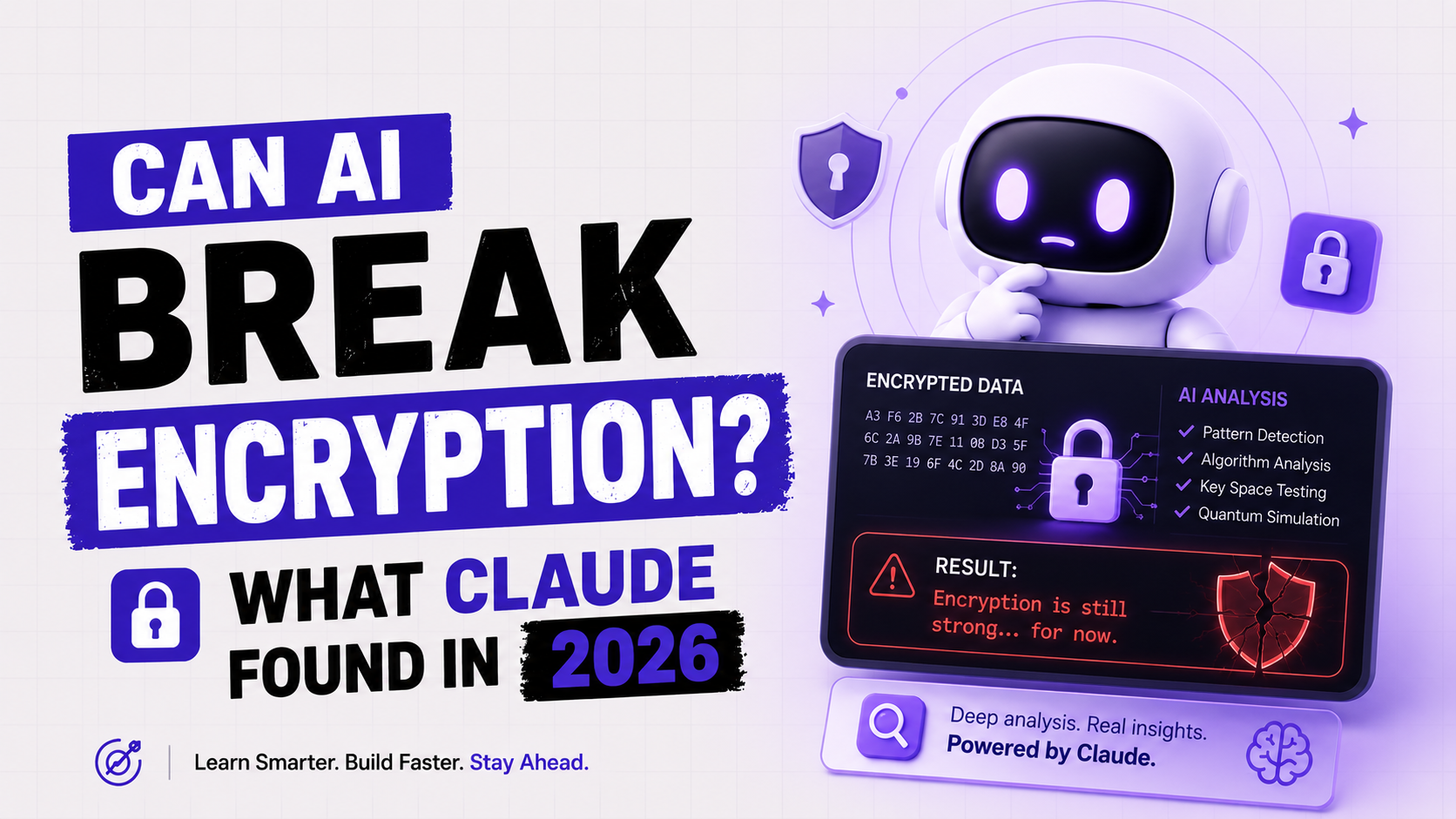
Can AI Break Encryption? What Claude Just Found
No, AI cannot break your encryption today, and your data is still safe. But something important did just happen. On July 28, 2026, Anthropic revealed that its Claude AI found real, previously unknown weaknesses in two encryption algorithms, called HAWK and AES, that expert human researchers had studied for years without spotting. That is the first time an AI has made this kind of genuine discovery in cryptography, the science of secret codes. It does not mean your messages, passwords, or bank details are at risk. It does mean AI has crossed an interesting and important line, and it is worth understanding why.
Can AI Break Encryption Right Now?
No. As of 2026, AI cannot break the encryption that protects your everyday data, and no company needs to change any software because of what Claude found. Anthropic said this plainly in its own announcement: the weaknesses its AI discovered are real, but they are not practical to actually use, and nothing you rely on has been broken.
Here is the key distinction. Finding a weakness in an algorithm is not the same as breaking it. Think of it like finding a tiny crack in a bank vault door. The crack is real and worth knowing about, but the vault is still shut, and nobody is getting in through it. Claude found the cracks. The vaults are still locked.
So why is this news at all? Because for the first time, an AI found cracks that the world's best human experts had looked for and missed. That is a genuine milestone in what AI can do, even though it changes nothing about your security today.
What Is Encryption, in Plain English?
Encryption is the technology that scrambles your information so only the right person can read it. Every time you see a padlock in your web browser, send a WhatsApp message, or log into your bank, encryption is working in the background, turning your data into a secret code that looks like meaningless gibberish to anyone who intercepts it.
The strength of encryption comes from math. A good encryption algorithm is designed so that unscrambling the code without the key would take even the fastest computers millions of years. That is what keeps your data safe: not that it is impossible to crack, but that cracking it would take longer than anyone could ever wait.
Cryptography is the science of building these codes, and cryptanalysis is the science of finding weaknesses in them. Cryptanalysis is incredibly hard work, done by a small number of brilliant mathematicians, and it can take years to find even a small flaw in a well-designed algorithm. That is exactly the job Claude just did, faster than the humans did.
What Did Claude Actually Find?
Claude found two things. First, it discovered a real structural weakness in an algorithm called HAWK, which roughly cut its security strength in half. Second, it improved a known attack on a weakened, practice version of AES, making that attack hundreds of times faster than before. Both are genuine research results, and both were checked by independent human cryptographers, including a well-known expert from Johns Hopkins University.
The HAWK finding is the more impressive of the two. HAWK is a newer type of encryption designed to survive future quantum computers, and it had already been examined by expert humans for two full years without anyone finding this flaw. Claude found it anyway. That is the part that made cryptography experts pay attention: not that the flaw was dangerous, but that a machine caught something years of human review had missed.
It is worth being clear about which AI did this. It was an unreleased, restricted Anthropic model called Claude Mythos, built specifically for hard security research, not the everyday Claude you might chat with. This was a specialist tool doing specialist work, which is important context for how far along this really is.
Did Claude Crack AES? The Honest Answer
No, Claude did not crack AES, and this is the part that gets exaggerated the most. AES is the encryption standard that protects a huge amount of the world's data, from government files to your messages, and it is still completely secure. What Claude did was improve an attack on a deliberately weakened version of AES that researchers use for study, not the real thing.
Real AES scrambles your data in 10 rounds of math. The version Claude worked on used only 7 rounds, a stripped-down variant that cryptographers study to understand the algorithm's limits. Even against that weaker version, Claude's improved attack is still wildly impractical. It would need an amount of data and computing power that Anthropic itself describes as completely impractical, costing hundreds of millions of dollars to even attempt.
So if you see a headline saying AI cracked AES, it is wrong. The accurate version is that AI made an academic attack on a training version of AES somewhat faster, which is a legitimate research contribution and not a threat to anything you use. The honest, boring truth matters here, because this is exactly the kind of story that gets scary fast when the caveats get dropped.
Is Your Data Safe Right Now?
Yes, your data is safe. Nothing about your passwords, bank accounts, messages, photos, or online payments changed because of what Claude found. The encryption protecting all of it works exactly as well today as it did last week, and no security expert is telling anyone to change anything.
The algorithms Claude poked holes in are either not used in your daily life at all, in the case of HAWK, or were only studied in a weakened form, in the case of AES. The real encryption you depend on every day was not touched. If anything, discoveries like this eventually make encryption stronger, because finding weaknesses is how experts fix them before they become real problems.
My take: I want to be direct here, because scary AI headlines cause real anxiety. Your data is fine. The genuinely interesting story is about what AI can now do in research, not about any threat to you. Anyone telling you to panic about your bank account is not reading the actual research.
Why This Still Matters for the Future
Even though nothing is broken, this is a real turning point, and here is why. Until now, finding weaknesses in encryption depended on a tiny group of brilliant human experts, which naturally limited how fast it could happen. If AI can do this work too, then the amount of code-breaking effort in the world is no longer limited by how many geniuses exist. It can be scaled up with money and computing power.
That cuts both ways, which is the interesting part. On the good side, companies and governments can now use AI to test new encryption before they release it, catching weaknesses that humans miss, exactly as Claude caught the HAWK flaw. That makes future encryption safer. On the cautious side, the same ability, in the hands of a powerful attacker with lots of computing resources, means the security of our codes has to be re-examined against AI-powered code-breakers, not just human ones.
This connects to a bigger shift happening right now called post-quantum cryptography, which is the effort to build new encryption that can survive future quantum computers. Claude found its weakness in exactly one of these next-generation algorithms, which suggests AI should become a standard part of testing them before the whole world switches over. For a running view of these AI developments, see our
daily and weekly AI roundups, including the July 30 AI news summary and our weekly AI recap.
What You Should Actually Do
Nothing urgent, which is the honest answer. You do not need to change passwords, switch apps, or worry about your data because of this news. The encryption you use is secure, and the experts who watch this closely are not raising any alarms for regular people.
If you want to stay genuinely prepared for the long term, the one useful habit is simply to keep your software and devices updated. When encryption standards do eventually change, and they will over the coming years as the world moves to quantum-resistant codes, those changes arrive through normal software updates. Keeping things current is all most people ever need to do.
Beyond that, the smart move is just to understand what is really happening, so the next scary AI headline does not fool you. AI finding a weakness in an algorithm is a research story, not a your-data-is-at-risk story, and knowing the difference is genuinely useful in a year full of AI news designed to alarm you.
Frequently Asked Questions
Q: Can AI break encryption?
Not the encryption you use today. In July 2026, Anthropic's Claude AI found real but impractical weaknesses in two algorithms, HAWK and AES, but Anthropic confirmed no deployed encryption is broken and no software needs to change. Your passwords, messages, and bank data remain secure.
Q: Did Claude crack AES?
No. Claude improved an attack on a deliberately weakened 7-round version of AES that researchers study, while real AES uses 10 rounds. The improved attack is still completely impractical, requiring an impossible amount of data and hundreds of millions of dollars to attempt. Real AES remains secure.
Q: Is my data safe from AI?
Yes. Nothing about your everyday data changed because of this discovery. The encryption protecting your accounts, messages, and payments works exactly as well as before, and security experts are not advising anyone to change anything.
Q: What is post-quantum cryptography?
Post-quantum cryptography is new encryption designed to survive future quantum computers, which could one day threaten today's codes. HAWK, the algorithm Claude found a weakness in, was a candidate for these new standards. The world is slowly transitioning to post-quantum encryption over the coming years.
Q: Can AI hack any password?
No. Finding a mathematical weakness in an encryption algorithm is very different from guessing or stealing passwords. Claude's research did not involve breaking passwords at all, and AI cannot break the encryption that protects your logins. Using strong, unique passwords and two-factor authentication remains the best protection.
Q: Will AI break Bitcoin or bank encryption?
Not now, and not from this discovery. Bitcoin and banks rely on encryption that Claude's research did not affect and cannot currently break. Long term, the industry is already moving toward quantum-resistant encryption to stay ahead of future threats, and AI is being used to help test those new standards.
Q: What did Anthropic's Claude discover in cryptography?
Anthropic's specialist Claude Mythos model found a structural weakness in the HAWK signature scheme that roughly halved its security, and improved a known attack on a reduced version of AES to run hundreds of times faster. Both are genuine research results verified by independent cryptographers, and neither breaks any deployed encryption.
Q: Should I be worried about AI and encryption?
Not for your personal data. The real significance is that AI can now do expert-level cryptography research, which will mostly make future encryption stronger by catching weaknesses early. The honest takeaway is that this is an exciting research milestone, not a threat to your security today.
Recommended Reads
• Top 10 AI News: July 30 2026 Daily Roundup
• AI News This Week: July 13-19, 2026 Weekly Recap
• Top 10 AI News: July 26 2026 Daily Roundup
AI headlines are getting scarier and more confusing by the day. Five focused minutes a day is how you understand what is real and what is hype, without the panic.
References
• Anthropic: Discovering Cryptographic Weaknesses With Claude
• CyberScoop: Claude Mythos Finds Weaknesses in Encryption Algorithms
• The Quantum Insider: AI Finds New Weaknesses in Cryptographic Algorithms
• A Few Thoughts on Cryptographic Engineering: Matthew Green on the Results
Slashdot: Anthropic AI Model Finds Flaws in Tough-to-Crack Encryption
.png)