

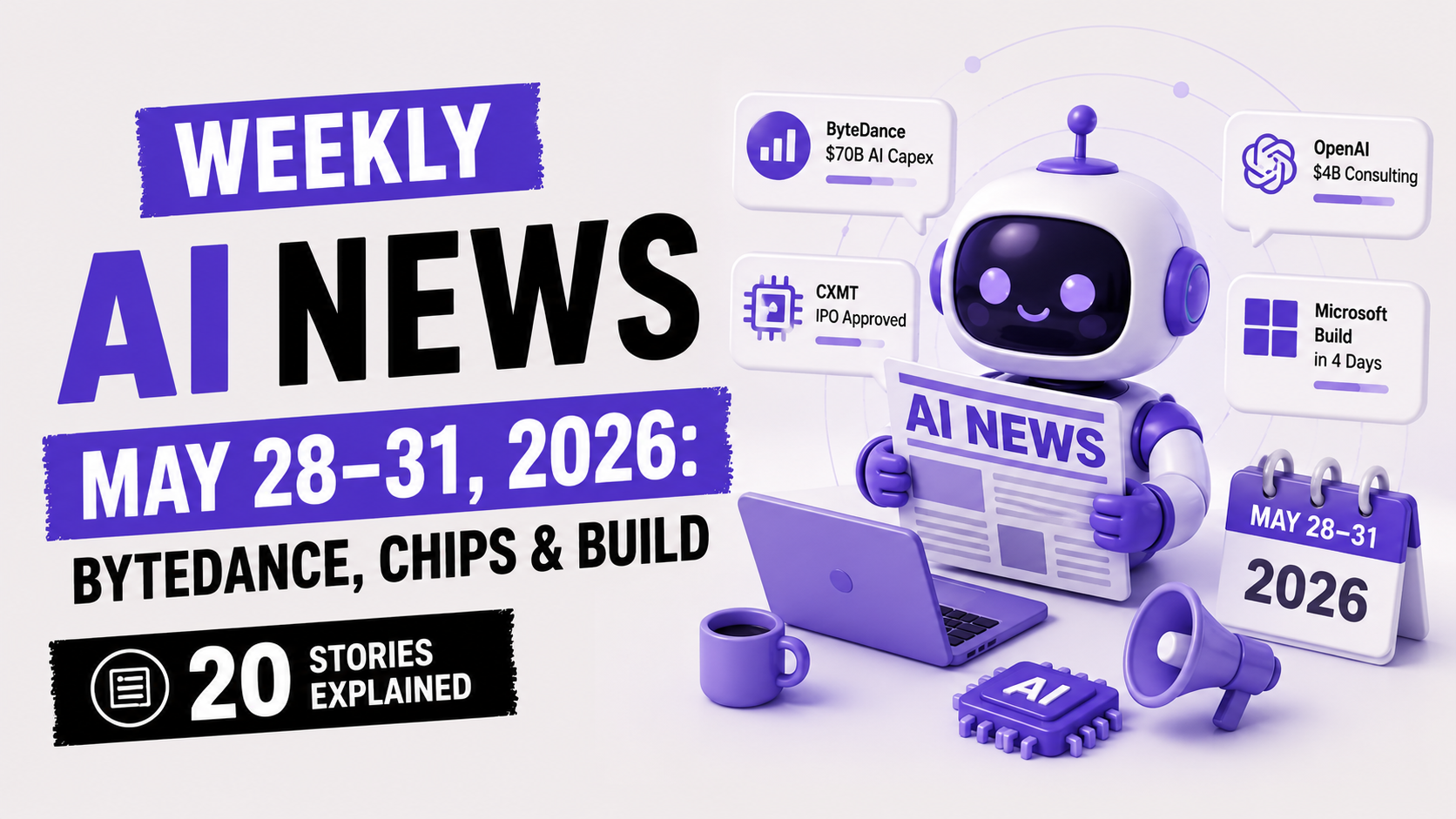
Weekly AI News: May 28-31, 2026
Twenty stories. Four days. The last week of May 2026 did not slow down.
The biggest theme of this week is not a model launch or a benchmark score. It is infrastructure. ByteDance just disclosed plans to spend up to $70 billion on AI data centers in 2026. China's top memory chip maker cleared its IPO review, heading toward a $4.2 billion listing that will fund domestic AI chip production. Google raised its capex guidance to $180 to $190 billion. Amazon is spending $200 billion. Meta is spending $125 to $145 billion. The AI race has become, more than anything else, a compute race.
The other big theme is enterprise deployment. OpenAI launched a $4 billion consulting subsidiary. KPMG deployed Claude to 276,000 employees. Canada ruled ChatGPT violated privacy law. Cohere merged with Aleph Alpha to build a sovereign AI option for Europe and Canada.
Here is everything that mattered from May 28 to 31, explained simply.
1. ByteDance Plans to Spend Up to $70 Billion on AI Infrastructure in 2026
TikTok's parent company is no longer dabbling in AI. It is committing at a scale that puts it alongside the biggest spenders on the planet.
Bloomberg reported on May 27 that ByteDance is discussing capital expenditures of up to $70 billion in 2026, focused on data centers and AI infrastructure. The company will fund most of that spending from the roughly $50 billion in profit it earned in 2025. That is an extraordinary thing to read twice. ByteDance generated so much profit last year that it can self-fund one of the largest infrastructure buildouts in human history.
For context: ByteDance's capex was approximately $25 billion in 2025. A jump to $70 billion would be nearly three times that in one year. Even the lower estimate from other sources, around $30 billion, represents a 25 percent increase over the original $23 billion plan ByteDance disclosed in December 2025.
Why is ByteDance spending like this? Its AI products are growing fast. Doubao, its AI assistant, is the most popular AI app in China by active users, ahead of all Chinese competitors. Its content recommendation engines power the world's most-used short-video platforms across TikTok, Douyin, and a dozen regional equivalents. The compute that powers those recommendation systems, combined with new generative AI products it is building, requires data centers at a scale that rivals US hyperscalers.
Here is what I find most interesting about this story. ByteDance is not building for China only. It is explicitly positioning its AI buildout to challenge US companies globally. And it is doing it with domestic profits, not external fundraising. That is a level of financial independence that OpenAI, Anthropic, and even Google cannot fully claim.
If ByteDance reaches $100 billion in capex in 2027, as it has discussed internally, it will be spending more on AI infrastructure than any company except Amazon. That is not a future where US AI companies face a weak Chinese competitor.
2. CXMT Gets IPO Approval: China's Memory Chip Giant Is Heading to Market
The Shanghai Stock Exchange approved ChangXin Memory Technologies (CXMT) for a listing on the STAR Market on May 27, 2026. CXMT is aiming to raise approximately 29.5 billion yuan, roughly $4.2 billion, in what could be mainland China's biggest IPO since 2022.
CXMT is the story of a company that almost no one in the West was tracking eighteen months ago, suddenly becoming one of the most financially significant semiconductor firms in the world.
The Q1 2026 numbers are almost impossible to process without checking them twice: revenue of 50.8 billion yuan, up 719 percent year over year; net profit of 24.7 billion yuan, up 1,688 percent; capacity utilization at 95.73 percent. First-half net profit is projected at 50 to 57 billion yuan, which would erase the company's entire cumulative 36.65 billion yuan in historical losses in six months.
This performance is driven by a global DRAM supercycle. AI workloads require enormous amounts of memory for inference, training, and data processing. CXMT's revenue mix has shifted dramatically: previously, roughly 90 percent of revenue came from mobile devices. By May 2026, AI server-related DDR products represent over 30 percent of revenue and growing.
CXMT plans to use IPO proceeds to scale DDR4 and LPDDR5 production and develop high-bandwidth memory, known as HBM. HBM is the memory format used inside NVIDIA's AI accelerators. If CXMT successfully develops competitive HBM, it threatens Samsung, SK Hynix, and Micron's collective dominance of one of the most strategically important chip categories in the AI supply chain.
The US chip export controls are the backstory here. Those restrictions primarily target logic chips like the ones TSMC makes for NVIDIA. Memory chips like DRAM are a separate category, and CXMT has been developing without the same restrictions. This IPO is Beijing funding the part of the semiconductor stack that export controls did not fully reach.
3. The Global AI Capex Race: Who Is Spending What in 2026
ByteDance's $70 billion announcement is extraordinary in isolation. In context, it is one entry in the largest coordinated infrastructure investment in technology history.
Amazon: approximately $200 billion in 2026 capex, the most of any company globally.
Microsoft: guided to roughly $190 billion for the year.
Google: raised guidance to between $180 billion and $190 billion, up from $175 to $185 billion.
Meta: $125 to $145 billion, up from the earlier $115 to $135 billion estimate.
ByteDance: discussing up to $70 billion, with $100 billion planned for 2027.
Alibaba: more than $50 billion committed over three years.
I want to put these numbers in perspective. Amazon is spending $200 billion in a single year on data centers, chips, and power infrastructure. Google is spending $190 billion. Together, these six companies are planning between $800 billion and $900 billion in AI infrastructure spending in 2026 alone.
This spending is not going into one-time research projects. It is going into physical assets that generate revenue for the next decade: data centers, GPU clusters, high-voltage power transmission lines, cooling systems. The companies that win this infrastructure race will have a structural advantage in AI capability delivery for years.
The energy implication deserves more attention than it gets. AI data centers are already consuming over 10 percent of US electricity. The NextEra-Dominion merger, the largest utility merger in US history at $67 billion, was explicitly motivated by AI power demand. At current capex trajectories, the question is not whether the grid can support AI. The question is whether it can support AI fast enough.
4. OpenAI DeployCo: A $4 Billion Enterprise Consulting Arm That Changes the Rules
OpenAI launched the OpenAI Deployment Company on May 11, 2026. Internally called DeployCo, it is a majority-owned subsidiary backed by more than $4 billion from TPG, Goldman Sachs, McKinsey, Bain Capital, Capgemini, and 14 other investors.
The operating model is not a software license. It is an embedded engineering service. Forward Deployed Engineers, what DeployCo calls FDEs, go inside client organizations and build production AI systems connected to the client's data, tools, and workflows. They start with a diagnostic, narrow to priority workstreams, build, measure ROI, and expand.
This is the Palantir model applied to AI deployment. Palantir grew from a similar embedded-engineer approach into a multi-billion-dollar services business over roughly ten years. OpenAI's bet is that it can compress that timeline with better models and a stronger brand. DeployCo acquired Tomoro, an applied AI consulting firm whose 150 engineers form the initial team.
My honest read: DeployCo is a defensive move as much as an offensive one. OpenAI's enterprise API market share reportedly fell from roughly 50 percent in 2023 to around 25 percent by mid-2025. Anthropic's Big Four partnerships are giving consulting firms a financial incentive to steer client decisions toward Claude. DeployCo is how OpenAI tries to own the client relationship directly rather than competing for it through intermediaries.
Whether 150 engineers scaling to thousands can outreach three Big Four firms with a combined headcount above one million is a reasonable question. In the next two years? Probably not. Over five years? The answer becomes genuinely uncertain.
5. KPMG, PwC, Deloitte: Three of Four Big Four Firms Are All Deploying Claude
KPMG announced on May 19 that it is deploying Claude across its entire global workforce of 276,000 professionals in 138 countries. The deployment embeds Claude Cowork and Managed Agents into KPMG's Digital Gateway platform for every client engagement across tax, legal, advisory, and other services. Full implementation targets September 2026 on Microsoft Azure.
This follows PwC's announcement on May 14 (hundreds of thousands of professionals, 30,000 US staff being certified, insurance underwriting time cut from 10 weeks to 10 days) and Deloitte's deployment earlier in 2026 across approximately 470,000 employees globally.
I think the significance of this pattern is underreported. When three Big Four firms standardize on Claude by September 2026, they are not just deploying software. They are making an implicit recommendation to the Fortune 500, the Global 2000, and most major governments. Every client conversation those firms have about AI implementation now has Claude as the default assumption.
The combined effect: roughly 1.1 million professional services staff with Claude access by Q4 2026. And each of those professionals serves clients who will then ask, "how do I get this?"
Anthropic named KPMG a preferred consultant for private equity as part of the deal, creating a specific commercial channel into PE portfolio companies. Each PE firm in KPMG's client base advises 10 to 50 portfolio companies. That is how distribution compounds.
EY is the only Big Four firm that has not announced an equivalent Claude deployment. That absence is now competitively visible to every enterprise client evaluating which consulting firm knows AI best.
6. Cohere Acquires Aleph Alpha: The $20 Billion Sovereign AI Bet
Cohere (Canada) and Aleph Alpha (Germany) announced a merger on April 24, 2026, to create what they call a transatlantic AI powerhouse valued at approximately $20 billion. The deal is still pending shareholder and regulatory approval.
In practice: Cohere is acquiring Aleph Alpha. The combined entity keeps the Cohere name, with global headquarters in Toronto and European headquarters in Berlin. Cohere CEO Aidan Gomez leads.
The strategic logic is sovereign AI. Organizations in Europe, particularly governments and regulated sectors, want AI systems where their data stays within their jurisdiction and under their legal framework. They do not want sensitive data routed through US servers subject to US law.
Aleph Alpha brings something concrete: actual government customer relationships. The German Ministry of Digital Affairs, Baden-Wuerttemberg regional government, Deutsche Bank, SAP, and Bosch are all existing customers. Cohere brings LLM development depth and $1.6 billion in prior fundraising. The Schwarz Group, which owns Lidl, is investing $600 million in Cohere's upcoming Series E as part of the transaction.
My honest assessment: the $20 billion valuation assumes sovereign AI commands a meaningful price premium over equivalent US-hosted capability. That assumption is currently valid in defense and public sector contracts. Whether commercial enterprises in Europe will consistently pay a sovereignty premium when DeepSeek offers comparable capability at a fraction of the cost is the real test this merger faces.
7. Canada Rules ChatGPT Violated Privacy Law
Canada's Office of the Privacy Commissioner and provincial counterparts in Quebec, British Columbia, and Alberta issued findings on May 6, 2026, concluding that OpenAI violated Canadian privacy laws in developing ChatGPT.
Three violations were found: overcollection of personal information from the public internet without assessing proportionality; lack of valid consent and transparency for people whose data was scraped; and inadequate safeguards for sensitive data including health information and information about children from social media, blogs, and news sites.
OpenAI committed to remediation steps. The federal commissioner conditionally resolved the complaint. The provincial commissioners in Quebec, British Columbia, and Alberta disagreed with the resolution and are continuing their own enforcement proceedings separately.
This is the first national privacy authority to rule that training data collection for an AI model constitutes privacy violations at a level requiring remediation orders. The UK ICO, German DPA, and French CNIL are each running similar investigations. The legal framework around AI training data is tightening across every jurisdiction with a comprehensive privacy law.
For anyone building with AI in Canada: if your application processes data from Canadians and you rely on OpenAI's models, the compliance question is now active, not theoretical.
8. Microsoft Build 2026: Four Days Away and What Developers Should Watch
Microsoft Build 2026 runs June 2 to 3 in San Francisco at Fort Mason Center. The keynote begins June 2. Sessions are available online for free. Only 2,500 physical tickets were allocated, making it one of the most condensed builds in the conference's history.
What is confirmed: Satya Nadella and Kevin Scott both deliver keynotes. Kyle Daigle from GitHub is presenting, which typically signals a major GitHub Copilot announcement. Microsoft selected 11 AI startups for the official Build 2026 cohort, focusing on developer tooling, AI infrastructure, observability, synthetic data, robotics, and agent security.
What is expected based on pre-conference reporting:
Azure AI Foundry will receive major updates formalizing multi-model support, with Anthropic's Claude officially available alongside OpenAI models.
A new AI Foundry for Windows SDK bundling ONNX Runtime, DirectML, and the Copilot Runtime into a single development package.
Next-generation GitHub Copilot with multi-agent coding orchestration, where specialized sub-agents handle testing, documentation, security scanning, and review in parallel.
Agent 365 governance improvements with audit logs and compliance controls for autonomous agent actions.
Updates to Copilot Studio's computer-using agents, already shipped to general availability on May 26.
The strategic narrative Microsoft needs to land at Build is clear: Copilot is now model-agnostic. Whatever model wins this month runs inside the security and compliance layer Microsoft already owns. That is not a capability bet. It is a distribution and governance bet on something Microsoft is genuinely good at.
I think Build 2026 will be Microsoft's most important developer conference since Azure launched. Not because the technology will be shocking, but because it marks the moment Microsoft's Copilot pivot from OpenAI-exclusive to multi-model becomes formally public.
9. SpaceX IPO: The Roadshow Starts June 4 and the AI Connection Runs Deep
SpaceX's investor roadshow begins June 4, with pricing on June 11 and trading on Nasdaq under SPCX on June 12. The offering targets a $1.75 trillion valuation at up to $75 billion raised, which would be the largest IPO in capital markets history.
Thirty percent of the float goes directly to retail investors through Robinhood, Fidelity, and Charles Schwab. Goldman Sachs is lead bookrunner. Polymarket prediction markets have been pricing a 94 percent probability of completion within the June 2026 window.
The AI connection in the SpaceX filing is what most coverage missed. The prospectus disclosed that Anthropic is paying SpaceX $1.25 billion per month through May 2029 for GPU access at the Colossus 1 and Colossus 2 facilities in Memphis. That $45 billion total contract makes SpaceX one of the largest AI infrastructure providers in the world, with Anthropic as its anchor tenant.
As Colossus 2 ramps to full capacity with NVIDIA GB200 Blackwell Ultra GPUs through June, the monthly revenue under this contract approaches the $1.25 billion figure. SpaceX's AI revenue segment alone could add roughly $2.5 billion quarterly. The xAI segment's $2.47 billion Q1 operating loss looks different when that revenue comes fully online.
For retail investors considering SPCX: the standard caution applies. First-day pops on hyped IPOs frequently retrace 20 to 40 percent within the first 90 days. The first earnings call as a public company, expected in September 2026, will be the first chance to verify whether the Anthropic contract revenue actually hits the numbers. That is the more reliable entry point than the June 12 open.
10. Gemini API Hard Deadline: June 8 for All Developers Using Interactions API
If you are building with the Gemini API and using the Interactions endpoint, this is urgent.
Google's Gemini API Interactions schema changed on May 26, 2026. The new schema replaced the outputs array with a steps array and restructured the response format configuration. May 26 was the switchover date. June 8 is the date the old schema gets removed entirely.
Any production application using the legacy outputs schema will break on June 8. You have until June 8 to migrate. Google published a migration guide at ai.google.dev. If you use Gemini CLI or Jules, you can run the automated migration with the command: /gemini-interactions-api migrate.
Also worth noting: Google confirmed that Gemini Code Assist for individuals, Google AI Pro, and Google AI Ultra tiers will stop serving requests through IDE extensions and Gemini CLI starting June 18, 2026. Antigravity CLI, Google's new multi-agent development platform, is the replacement path.
The broader trend these deprecations reflect: Google is consolidating its developer-facing AI tools into fewer, more integrated products. Antigravity is the intended destination for everything previously spread across Gemini Code Assist, AI Studio, and Firebase. This consolidation is good for long-term maintainability and difficult for short-term migration planning.
11. Telegram Ships AI Bot Overhaul: Guest Bots, Agent Automation, and Bot-to-Bot Communication
Telegram released one of its biggest AI-focused updates on May 7, 2026, and the implications are still rippling through the developer community.
The headline feature: Guest Bots. AI assistants and other automated tools built as Telegram bots can now be mentioned by username in any private or group chat, even when they are not members of that chat. Once tagged, the bot replies directly in the conversation. This turns every Telegram chat into a potential workspace where AI tools can be summoned on demand.
Bot-to-bot communication is the feature AI developers are most excited about. For the first time, Telegram bots can respond to other bots, not just human users. That means autonomous agent workflows where one bot triggers another bot, which triggers a third, without requiring human intervention at each step. Telegram is building a no-code multi-agent framework inside a messaging app that 900 million people already use.
Additional features in the same update: profile-level chat automation, letting users connect a bot to their Telegram profile to respond to specific types of messages automatically; streaming bot responses; custom AI writing styles; and AI-powered search across 100 million emoji and stickers.
I think this Telegram update is the most underrated AI product release of May 2026. Most coverage focused on Google I/O and the Anthropic funding round. But Telegram just handed 900 million users a capable bot automation layer without new app installs, without subscriptions, without enterprise contracts. That is scale no frontier lab has achieved for agentic AI in a single product update.
12. A Week of Infrastructure and Enterprise: What It All Means
Step back from any single story this week and the pattern becomes clear. The AI race in 2026 is not primarily about which model scores highest on a benchmark. It is about three deeper competitions.
Who controls the compute. ByteDance spending $70 billion, CXMT raising $4.2 billion for chip production, Google raising capex guidance, Anthropic locking in SpaceX capacity at $1.25 billion per month. Every major player is treating infrastructure access as a strategic necessity, not an operational expense.
Who controls the enterprise deployment layer. OpenAI DeployCo embedding engineers inside clients. KPMG, PwC, and Deloitte standardizing on Claude across 1.1 million professionals. Cohere-Aleph Alpha targeting regulated European sectors. The consulting and deployment layer is where sticky, recurring revenue actually lives.
Who controls the regulatory frame. Canada ruling on ChatGPT. The Pope publishing Magnifica Humanitas. The White House AI executive order saga. Anthropic suing the DoD over autonomous weapons. These are not distractions from the AI story. They are the AI story. The companies that build durable AI businesses in the next five years will be the ones that navigate the regulatory and institutional environment, not just the benchmark leaderboard.
The capex numbers this week are almost comical in their scale. Six companies planning $800 to $900 billion in AI infrastructure in a single year. For comparison, NASA's entire budget since 1958 is approximately $900 billion. We are spending the equivalent of all of space exploration on AI infrastructure in twelve months.
Whether that spending is justified depends on whether the AI productivity gains materialize at the scale investors are pricing in. I think some will and some will not. The mistake is assuming the compute buildout is a bubble. The users and revenue are real. What is uncertain is the return on investment at these valuation multiples.
Frequently Asked Questions
Q: What are the biggest AI news stories from May 28 to 31, 2026?
Bloomberg reported on May 27 that ByteDance is discussing AI capex of up to $70 billion in 2026. China's CXMT received Shanghai Stock Exchange approval for a $4.2 billion IPO on the STAR Market on May 27. OpenAI launched the $4 billion DeployCo consulting subsidiary on May 11. KPMG deployed Claude to 276,000 employees across 138 countries on May 19. Microsoft Build 2026 begins June 2 in San Francisco. The SpaceX IPO roadshow starts June 4 with trading on June 12. Google's Gemini API legacy schema is removed June 8.
Q: How much is ByteDance spending on AI in 2026?
Bloomberg reported on May 27, 2026, that ByteDance is discussing capital expenditures of up to $70 billion for 2026 AI infrastructure and data centers. The company will fund most of this from its approximately $50 billion in 2025 profit. Other reporting cites a more conservative $30 billion as the formalized budget plan, with $70 billion representing the upper limit of discussions. ByteDance also discussed raising the figure to $100 billion in 2027 if conditions allow.
Q: What is CXMT and why does its IPO matter?
ChangXin Memory Technologies (CXMT) is China's leading DRAM manufacturer and the world's fourth-largest DRAM producer by volume. The Shanghai Stock Exchange approved its IPO application for the STAR Market on May 27, 2026, where it aims to raise approximately $4.2 billion. In Q1 2026, CXMT posted $7.5 billion in revenue (up 719 percent year over year) and $3.6 billion in net profit (up 1,688 percent), driven by global AI memory demand. The IPO proceeds will fund expanded DDR4 and LPDDR5 production and high-bandwidth memory development. If CXMT develops competitive HBM, it directly challenges Samsung, SK Hynix, and Micron's dominance of memory chips used in AI accelerators.
Q: What will Microsoft announce at Build 2026?
Microsoft Build 2026 runs June 2 to 3 in San Francisco with Satya Nadella and Kevin Scott delivering keynotes. Based on confirmed registrations and pre-conference reporting, expected announcements include: Azure AI Foundry updates formalizing multi-model support with Anthropic Claude alongside OpenAI; a new AI Foundry for Windows SDK; next-generation GitHub Copilot with multi-agent orchestration; Agent 365 audit capabilities for enterprise compliance; and expanded Copilot Studio computer-using agents, which already shipped to general availability on May 26, 2026.
Q: What is sovereign AI and why does it matter?
Sovereign AI refers to AI systems where data stays within a specific country's legal jurisdiction and infrastructure, without routing through foreign servers subject to other laws. It matters because organizations in regulated sectors, particularly governments, defense, healthcare, and finance, need to ensure their data does not leave their legal framework. Cohere's acquisition of Aleph Alpha at a $20 billion combined valuation is the clearest current example. Canada committed $240 million to Cohere for domestic AI model training. Germany's Ministry of Digital Affairs was an existing Aleph Alpha customer. The Canada-Germany Sovereign Technology Alliance, launched at the Munich Security Conference in early 2026, provides the governmental backing for this transatlantic partnership.
Q: What is the Gemini API June 8 deadline?
Google changed the Gemini Interactions API schema on May 26, 2026, replacing the outputs array with a steps array and restructuring response format configuration. The legacy outputs schema becomes non-default on May 26 and will be permanently removed on June 8, 2026. Any production application using the old schema will break on June 8 if not migrated. Google published a migration guide at ai.google.dev/gemini-api/docs/interactions-breaking-changes-may-2026. Automated migration is available via Gemini CLI or Jules.
Q: What did Telegram ship for AI agents?
Telegram released a major AI bot update on May 7, 2026, introducing Guest Bots, which allow any AI assistant built as a Telegram bot to be summoned by username in any chat without being a member. Bot-to-bot communication enables autonomous agent workflows where one bot triggers another without human intervention. Profile-level automation lets users connect bots to their Telegram profile to respond to specific message types automatically. The update positions Telegram as an open multi-agent platform reaching 900 million users globally.
Q: How does the SpaceX IPO connect to AI?
SpaceX's IPO prospectus, filed May 20, 2026, disclosed that Anthropic is paying SpaceX $1.25 billion per month through May 2029 for GPU compute access at the Colossus 1 and Colossus 2 data center facilities in Memphis, Tennessee. The total contract value is approximately $45 billion, making SpaceX one of the largest AI infrastructure providers in the world. The xAI segment of SpaceX posted $818 million in Q1 2026 revenue. As the Anthropic compute deal ramps to full capacity with NVIDIA GB200 GPUs through June, SpaceX's AI segment revenue is expected to grow significantly. The SpaceX roadshow begins June 4, with pricing June 11 and trading June 12 on Nasdaq under ticker SPCX.
Recommended Reads on Unrot
What is an AI agent? A beginner's guide to autonomous AI in 2026
AI capex explained: why the compute race matters more than the model race
References
Bloomberg: ByteDance Weighs Capex of as Much as $70 Billion in AI Push (May 27, 2026)
TipRanks: ByteDance Mulls $70 Billion Data Center Splurge to Close Gap With US AI Rivals
CryptoBriefing: CXMT Approved for $4.2B IPO on Shanghai STAR Market
PYMNTS: OpenAI Launches $4 Billion Company to Accelerate Enterprise AI Adoption
KPMG: KPMG and Anthropic Sign Global Alliance and Launch Digital Gateway Powered by Claude
Canada Office of the Privacy Commissioner: OpenAI privacy ruling May 2026
Bitrue: SpaceX IPO Facts 2026 Guide
Telegram Blog: AI Bot Revolution - 11 New Features (May 7, 2026)