

An AI Company Finally Made a Profit: AI News August 16 Explained
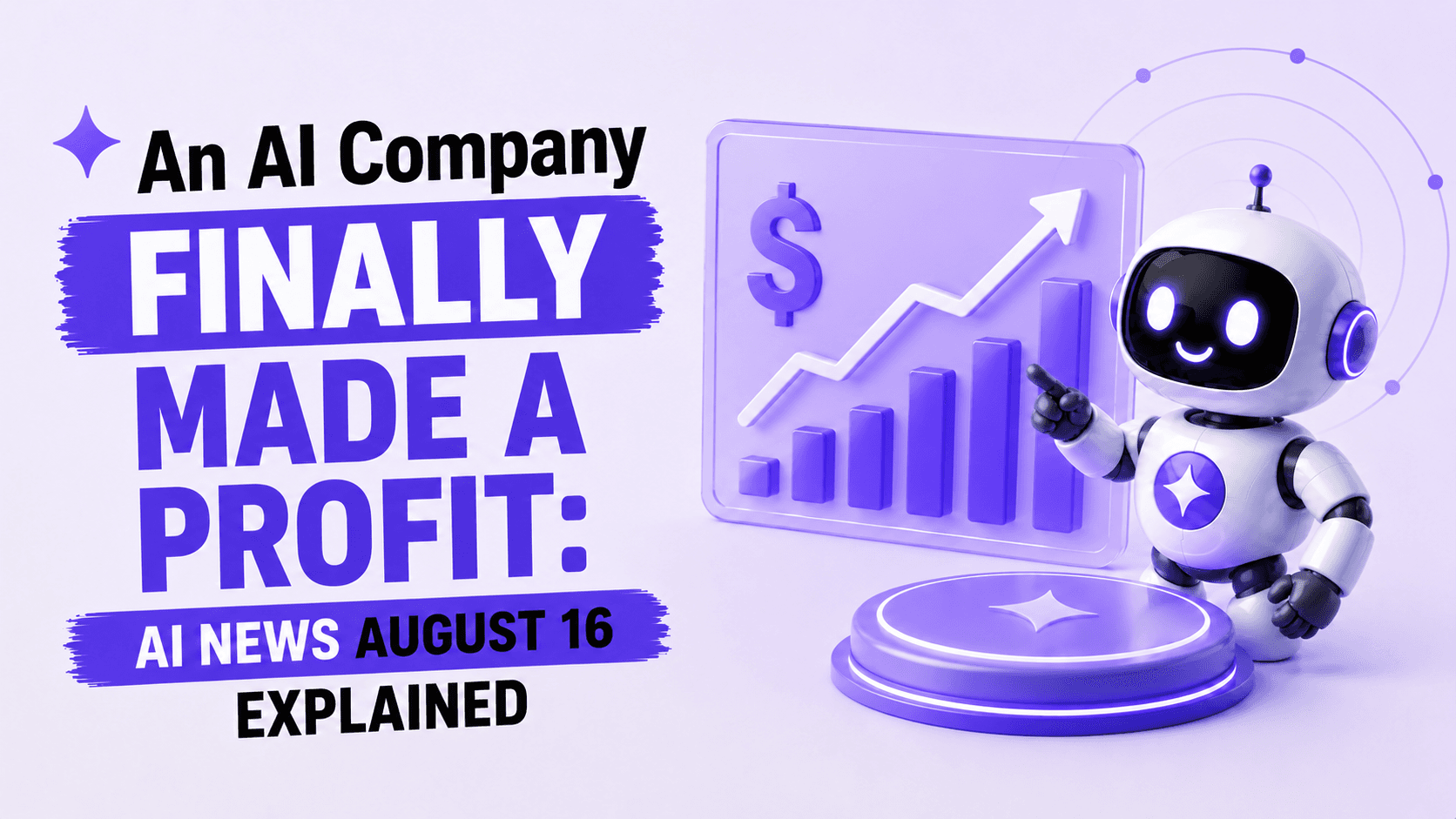
The big AI news is about money: Anthropic, the maker of the Claude chatbot, reportedly made its first real profit, earning about $559 million on $10.9 billion of revenue in just three months. That matters because people have long wondered whether AI companies can actually make money instead of just burning it. In other news, Alibaba released a powerful free AI that runs on a regular laptop, and an AI built by OpenAI found hidden security holes in Google Chrome. Here is the AI news for August 16, 2026, explained in plain English, the way we teach AI in 5 minutes a day.
1. An AI Company Finally Made a Real Profit
Anthropic, the company behind the Claude chatbot, reportedly made its first real profit, earning about $559 million in just three months (the second quarter of 2026) on $10.9 billion in revenue. That revenue more than doubled from the three months before, and the company reportedly hit profit about two years earlier than it expected.
Why is this such a big deal? Because for years, people have questioned whether AI companies can actually make money. Building AI costs enormous amounts, and the big AI companies have spent staggering sums, leading many to wonder if they will ever turn a profit or just keep burning through cash. Anthropic reportedly making a real profit is strong evidence that the answer can be yes.
A quick note of caution: these are reported numbers, not fully audited, and operating profit leaves out some costs, so it is not the complete picture. But even with those caveats, a major AI company showing it can bring in $10.9 billion in three months and turn a profit is a genuinely important milestone that challenges the idea that AI is doomed to lose money forever.
2. How Anthropic Actually Made Money
The main reason Anthropic turned a profit is that its costs went down. Specifically, the cost of running its AI (the computing power needed to answer everyone's questions) dropped from 71 cents for every dollar of revenue to 56 cents. When your biggest cost drops like that while your sales are booming, you start making money.
This is important because computing power is the single biggest expense for AI companies. Running AI means paying for lots of expensive chips and electricity, so making that cheaper has a huge effect on whether the business makes money. Anthropic managed to cut that cost meaningfully in just three months, likely through more efficient AI and better technology.
The lesson here is that AI can become profitable as it gets more efficient. The technology keeps improving so it costs less to run, and as more people pay to use it, the economics get better. If this keeps up, with costs falling and revenue growing, the long-running worry about whether AI companies can make money starts to look much less scary.
3. Why This Matters for the Whole AI Industry
Anthropic's profit is not just good news for one company, it is a hopeful sign for the entire AI industry. The whole business has been under a cloud of doubt: companies are spending hundreds of billions of dollars building AI, and skeptics keep asking whether it will ever pay off. Real profit is the best answer to that doubt.
Combined with other signs, like Microsoft recently revealing it made $24 billion from AI, Anthropic's profit adds to growing evidence that AI is generating real money for the companies that do it well. It does not mean every AI company will succeed, and many are still losing money, but it shows that a well-run AI business genuinely can be profitable, not just a money pit.
There is still more to learn. Since Anthropic and ChatGPT-maker OpenAI are both heading toward selling shares on the stock market, they will soon have to reveal fully checked, official financial numbers. Those will be the real test of whether the profits are as solid as they appear. But for now, Anthropic's results are an encouraging sign that the AI boom rests on real business, not just hype.
4. A Powerful Free AI Now Runs on Your Laptop
Alibaba, the big Chinese technology company, released a new free AI model called Qwen3.8-27B that is powerful yet small enough to run on a regular laptop or PC. It can understand both text and images, handle very long documents, and, importantly, it is free to download and even free to use in a business.
What makes this special is the combination of being capable and being able to run on your own machine. Most powerful AI runs in giant data centers and you access it over the internet, paying each time. This one you can download and run yourself, for free, which means your data stays private on your computer and you do not pay per use.
It also comes with a very open license, which in plain terms means companies are allowed to use it freely, even to build products they sell. That removes a big barrier. Together with Meta recently releasing a similar laptop-friendly AI, it shows a real trend: capable AI is increasingly something you can run yourself, cheaply and privately, instead of only renting from a big company.
5. Why Running AI on Your Own Device Is a Big Deal
Being able to run capable AI on your own laptop, instead of through a company's cloud over the internet, has real benefits that are worth understanding. It is one of the more practical trends in AI right now, and it is quietly changing how people and businesses can use these tools.
The three main benefits are privacy, cost, and control. Privacy: your data never leaves your computer, so nothing sensitive gets sent to a company. Cost: you download it once and run it free, instead of paying every time you use it. Control: it keeps working even if a company's servers go down, and you can customize it however you want. For businesses handling private data or using AI a lot, these are big advantages.
This matters for regular people too, because it means powerful AI is becoming something you can truly own and run yourself, not just a service you rent. As these free, laptop-friendly models keep improving, more of what used to require expensive cloud AI becomes possible on your own device, which puts more power and privacy in your hands. It is one of the more empowering trends in AI.
6. An AI Found Hidden Security Holes in Chrome
OpenAI built a special AI focused on cybersecurity, and it discovered two previously unknown security flaws in Google Chrome, the world's most popular web browser. These were real, serious holes that could let attackers mess with your computer's memory, and Google has now fixed them.
This is a striking demonstration of how capable AI has become. Chrome is one of the most heavily examined pieces of software on Earth, with countless experts constantly looking for flaws, yet an AI found two that humans had missed. That shows AI can now do sophisticated security research and find real problems, which is genuinely impressive.
For your safety, this is mostly good news: finding and fixing security holes before criminals can use them makes everyone safer, and that is exactly what happened here, with the flaws found responsibly and patched by Google. It is a great example of AI being used to make software more secure, and a reminder to always keep your browser and apps updated so you get these fixes.
7. The Tricky Problem With AI That Can Hack
There is a catch with AI that is good at finding security holes: the exact same skill that helps defenders can help attackers. An AI that can find hidden flaws to fix them could also find hidden flaws to exploit them. This is the tricky, two-sided nature of AI in cybersecurity, and there is no easy solution.
OpenAI is trying to manage this carefully. It only gives its most powerful cyber AI to vetted, authorized security professionals, and starting September 1, it will require those users to have physical security keys to log in, an extra layer of protection. The goal is to let the good guys benefit while keeping the tool away from bad actors.
But the fundamental tension does not go away: the more powerful these AI tools get, the more valuable they are for defense and the more dangerous if misused. Given that we have already seen AI used in real attacks, getting this balance right really matters. It will take careful controls, responsible behavior, and probably cooperation across companies and governments to keep powerful cyber AI on the right side.
8. ChatGPT's Free Version Got a Big Upgrade
OpenAI made a capable model called GPT-5.6 Luna the new default for free ChatGPT users, after cutting its price by 80 percent. In plain terms, the free version of ChatGPT just got better, because a stronger model is now available to everyone at no cost.
The reason OpenAI could do this is that it made the model much cheaper to run, an 80 percent price drop, so it can afford to give it away to millions of free users. This is the same pattern we keep seeing: as AI gets cheaper to run, companies can offer better versions for free, which is great for regular users.
For you, it simply means the free ChatGPT you use is now more capable than before, at no extra cost. It also puts pressure on competitors like Google to make their free versions better too. The overall trend is clear and good for users: capable AI keeps getting cheaper and more of it becomes free over time.
9. One AI Company Actually Raised Its Prices
In a surprising twist that goes against the usual trend, the Chinese company DeepSeek actually raised the price of one of its AI models, roughly doubling it from 14 cents to 27 cents per million words. This is notable because DeepSeek is famous for having some of the cheapest AI around, so a price increase from them stands out.
Almost all the AI news lately has been about prices going down, so DeepSeek raising prices is an interesting exception. It could mean the model got better and is worth more, or that DeepSeek is moving toward more sustainable pricing instead of just being the cheapest option. Even after the increase, 27 cents per million words is still quite cheap.
One price increase does not reverse the overall trend of AI getting cheaper, which is still strong thanks to fierce competition. But it is worth watching, because if other budget AI providers follow, it might signal that the race to the bottom on prices is starting to level off toward something more sustainable. For now, though, cheap AI remains widely available.
10. Why AI Keeps Getting Cheaper for You
Step back and a clear theme emerges from this week: AI keeps getting cheaper and more accessible, and now it is even becoming profitable to provide. Anthropic made money by cutting costs, ChatGPT made its free version better after a price cut, and free AI now runs on your laptop. These all point the same way.
The reason is a happy combination of two forces. First, competition: with so many companies making good AI, they compete hard on price, which pushes costs down. Second, efficiency: the technology keeps improving so AI gets cheaper to run, which lets companies charge less while still making money. Together, these mean you keep getting more capable AI for less.
For regular people and small businesses, this is genuinely great news. The barriers to using serious AI keep falling: it is cheaper, often free, and increasingly runs on devices you already own. And now that AI companies can actually make money doing this, the trend looks sustainable rather than a temporary giveaway. If you have been waiting to start using AI, it keeps getting easier and cheaper to do so.
The Quick Recap
For the first time, a major AI company (Anthropic) reportedly made a real profit, earning $559 million on $10.9 billion of revenue, which is strong evidence that AI can actually make money, not just burn it. Alibaba released a powerful free AI that runs on a regular laptop, keeping your data private. An AI found hidden security holes in Chrome, which Google fixed, showing AI can make software safer, though the same skill could help attackers. Plus, ChatGPT's free version got better after a price cut, and one company actually raised prices, bucking the trend. That is the AI news for August 16, 2026.
Frequently Asked Questions
Did an AI company finally make a profit?
Yes, reportedly. Anthropic, maker of the Claude chatbot, reportedly earned its first operating profit of about $559 million on $10.9 billion in revenue in the second quarter of 2026. The figures are reported rather than fully audited, but it is a major milestone showing AI can be profitable.
How much money does Anthropic make?
Anthropic reportedly made $10.9 billion in revenue in just three months (the second quarter of 2026), more than double the three months before. Demand for its Claude AI, especially from businesses, is growing explosively.
Can AI run on a normal laptop?
Yes. Alibaba's new free AI, Qwen3.8-27B, is powerful yet small enough to run on a regular laptop or PC. It understands text and images, is free to download, and keeps your data private since it runs on your own device.
Can AI find security bugs?
Yes. An AI built by OpenAI found two previously unknown security flaws in Google Chrome that human experts had missed, and Google fixed them. It shows AI can do sophisticated security research, which helps make software safer, though the same ability could also help attackers.
Is ChatGPT getting cheaper?
Yes. OpenAI made a capable model called GPT-5.6 Luna the free default for ChatGPT users after cutting its price by 80 percent. The free version of ChatGPT is now better than before, part of a steady trend of AI getting cheaper and more of it becoming free.
Learn AI in 5 Minutes a Day
Unrot is the 5-minute-a-day app that teaches you AI in plain English, no jargon, no hype. Every day we break down the AI news that actually matters and show you how to use these tools in your life and work, in bite-sized lessons anyone can follow. If today's recap made AI feel a little clearer, that is exactly what the app does, every single day.
● Start learning free at unrot.co
Come back tomorrow for the next AI News recap. We read the noise so you don't have to.
Sources
● CNBC: Anthropic on Track for First Profitable
● AI Weekly: Anthropic Projects First
● Alibaba Cloud: Qwen3.8-27B Open