


How to Detect AI-Generated Text and Images in 2026
A Stanford-affiliated study found that AI detectors falsely flagged 61.3 percent of TOEFL essays written by non-native English speakers as AI-generated. Real students, real writing, wrongly accused more often than not. Meanwhile, a leading detector caught only 31.7 percent of text from GPT-5. So the tools accuse innocent humans over half the time and miss most of the actual AI. That is the uncomfortable reality of AI detection in 2026.
Whether you are a teacher checking an essay, a hiring manager reading a cover letter, or just someone trying to tell if a viral photo is real, you have probably wished for a button that says AI or not AI. That button exists. It is also unreliable enough to ruin a reputation, and trusting it blindly is worse than having no button at all.
This guide gives you the honest picture. How AI detection actually works for both text and images, why the detectors fail, the checks that genuinely still help, and the shift that matters most in 2026: from trying to detect AI after the fact to verifying content with built-in labels like watermarks. By the end you will know how to check something responsibly, and when to admit you simply cannot be sure.
Can You Actually Detect AI Content? The Honest Answer
You can sometimes detect AI content, but never with certainty, and the tools are far less reliable than they claim. There is no method, human or machine, that identifies AI text or images correctly every time, and anyone selling you 100 percent accuracy is selling a fantasy.
The core problem is a moving target. Detectors work by spotting the statistical patterns older AI models left behind, the tell-tale predictability of machine-written text. But every new model generates less predictable, more human-like output, which erases exactly the patterns detectors rely on. Detection is always chasing a version of AI that no longer exists.
This creates two kinds of failure, and both are serious. A false positive wrongly flags human work as AI, which can wreck a student's grade or a writer's reputation. A false negative misses real AI content, which lets it pass as genuine. In 2026, detectors produce both errors often enough that a single detector score should never be treated as proof of anything.
An AI detector gives you a guess dressed up as a verdict. Treat the number as a hint, never as evidence.
So why bother learning this at all? Because the goal is not certainty, it is informed judgement. Used well, the methods below raise or lower your confidence sensibly and stop you from making a confident mistake in either direction. That is genuinely valuable, even without a magic button.
How AI Text Detectors Work (and Why They Fail)
AI text detectors work by measuring how predictable a piece of writing is, on the theory that AI writes more predictably than humans. They scan for smoothness and statistical regularity, then output a probability that the text is machine-made. It sounds scientific, and it is deeply flawed.
Their accuracy depends heavily on length and on which AI wrote the text. Independent testing in 2026 found detection accuracy around 65 to 72 percent at 50 words, rising to 88 to 93 percent at 250 words, then plateauing. That already means short pieces are close to a coin flip. Worse, detectors do far better on older models than new ones: one leading tool caught 85 percent across a range of models but only 31.7 percent of GPT-5 output and 7.3 percent of a smaller GPT-5 variant.
Two facts make the tools nearly unusable as proof:
Editing defeats them. Running AI text through a paraphrasing or humanizing tool dropped one detector's accuracy from about 95 percent to 40 percent. A few minutes of editing erases the signal.
They punish non-native writers. The Stanford-affiliated study found 61.3 percent of non-native English essays falsely flagged, because simpler, more regular sentence patterns look machine-like to a detector.
There is a reason human-sounding AI is so hard to catch, and it comes down to how these models work. A large language model is trained specifically to produce natural, human-like text, so as the models improve, the very thing detectors look for keeps disappearing. The better AI gets, the worse detection gets, by design.
For what it is worth, the most accurate detectors in 2026 include Originality.ai, which leads one major benchmark at around 85 percent average accuracy, and GPTZero, which has among the lowest false-positive rates at about 1 percent. Even the best, though, should be one input among several, never the final word.
The Real Signs of AI-Written Text
The most reliable signal that text is AI-written is not a detector score but a pattern of blandness: writing that is fluent, generic, and strangely empty of specific detail or genuine voice. Humans who read a lot of AI output learn to feel this, and research confirms frequent users are surprisingly accurate at spotting it.
Things that should raise your suspicion:
• Vagueness at length. It says a lot of words while committing to few specifics, no exact names, dates, numbers, or lived detail.
• Even, tireless tone. Every paragraph is the same polished temperature, with none of the rhythm shifts, asides, or rough edges of a real person.
• Safe, hedged everything. It rarely takes a strong position, favoring balanced on one hand, on the other hand phrasing throughout.
• Repetitive scaffolding. Overuse of tidy transitions and list-like structure, the same shape applied to every section.
• Confident errors. It states something false with total smoothness, because the model is predicting plausible text, not checking truth.
That last point connects to a deeper issue. AI writes fluent nonsense because it generates likely-sounding words rather than verified facts, which is why it sometimes invents things entirely. Our guide on why AI makes up facts explains that behavior, and spotting a confident falsehood is often a better AI tell than any detector.
The honest caveat: none of these are proof. Plenty of humans write blandly, and the best AI writing has genuine voice. These signs shift your suspicion, they do not settle it, and using them to accuse someone is a mistake.
How to Spot AI-Generated Images: The Reliability Ladder
The best way to check if an image is AI-generated is to work down a reliability ladder, starting with the most trustworthy method and ending with the least. In 2026, that order is: content credentials, then invisible watermarks, then detection tools, then your own eyes, then reverse image search.
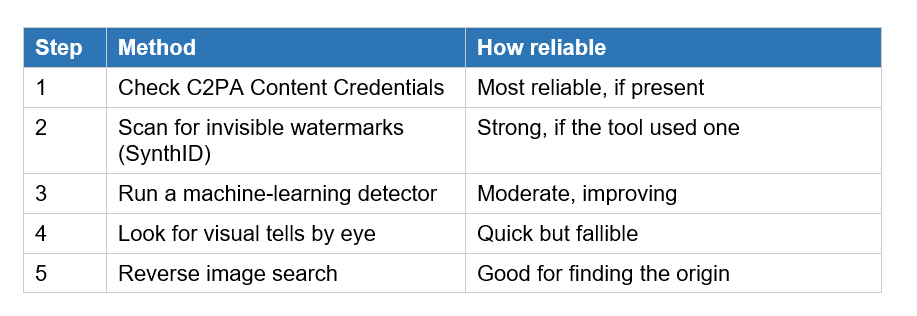
Start at the top because the higher rungs carry actual evidence, not guesses. Content credentials and watermarks are built into the file at creation, so when they exist they tell you something concrete. Detectors and visual inspection are educated guesses. The order matters: reach for your eyes only after the trustworthy checks come up empty.
It helps to understand what you are up against. Modern AI images come from diffusion models, which now produce pictures realistic enough that the eye alone is no longer dependable. That is exactly why the industry shifted toward built-in labels rather than after-the-fact detection.
Watermarks and Content Credentials: SynthID and C2PA
SynthID and C2PA are the two systems that make AI images verifiable by labeling them at the moment they are created, and they are the most trustworthy way to check an image in 2026. Instead of guessing whether something looks fake, you check for a built-in signature.
SynthID
SynthID is Google's invisible watermarking system. It embeds a hidden digital signature directly into the pixels of an image the moment an AI generates it, undetectable to your eye but readable by a checking tool. After Google's May 2026 announcement, Chrome and Google Search began flagging AI content using SynthID, so verification is increasingly built into the tools you already use. Its limit: it only marks content from tools that adopted it, so older or open-source models will not trigger it.
C2PA Content Credentials
C2PA Content Credentials are a cross-industry standard, backed by Adobe, Microsoft, Google, and others, that attaches provenance information to a file, a kind of tamper-evident label recording where an image came from and how it was made. Because it is an open standard rather than one company's system, it is the most reliable single check when present. Its weakness is fragility: a simple screenshot strips the metadata, and the label vanishes.
The regulatory wind is at their backs. On August 2, 2026, the EU AI Act's transparency rules took effect, requiring anyone publishing AI-generated content in EU markets to clearly label it. Labeling at creation, not detection after the fact, is where the world is heading, and it is a far sturdier foundation than any detector.
The future of catching AI is not smarter detectors. It is content that honestly says what it is from the moment it is made.
The Visual Tells That Still Work
When no watermark or credential exists, visual inspection is your fallback, and a handful of tells still catch many AI images fast. They are not foolproof, and they fade as models improve, but they remain the quickest manual check.
Hands and fingers. Fused, extra, or misshapen fingers remain a classic giveaway, because fine, rule-bound anatomy is where image models still slip.
Garbled text. Signs, labels, and writing in the background often come out as nonsense letters, since the model mimics the look of text without spelling.
Impossible details. Jewelry that melts into skin, glasses with mismatched arms, teeth that blur, or backgrounds that do not quite connect.
Unreal perfection or depth. Skin too flawless, lighting too even, or a dreamy depth of field that no real camera would produce.
Physics that is slightly off. Reflections that do not match, shadows falling the wrong way, or patterns that repeat unnaturally.
Understanding why these errors happen makes you better at spotting them. Image models learn general patterns of what pictures look like, not the exact rules that hands have five fingers, exactly the weakness we cover in our guide on computer vision. They render the vibe of a hand, not its true structure.
A warning worth stating plainly: these tells are vanishing fast. The images that fooled nobody in 2024 look crude next to 2026 output, and the hands problem in particular is mostly solved in top models. Never rely on your eyes alone for anything that matters, like a news photo or a piece of evidence.
The Responsible Way to Handle a Suspicion
The responsible way to act on a suspicion that something is AI-generated is to gather multiple signals, stay humble about certainty, and never accuse anyone based on a detector score alone. The cost of a wrong accusation is real, so the standard of proof should be high.
A sensible process:
1. Use several methods, not one. Combine watermark and credential checks, a detector or two, and your own reading. Agreement across methods raises confidence; disagreement means you do not know.
2. Weight the reliable checks highest. A present C2PA credential or watermark outranks any detector guess. Visual tells and detector scores are supporting evidence, not verdicts.
3. Consider the context and stakes. A viral political image demands more scrutiny than a friend's holiday photo. Match your effort to what is at risk.
4. Refuse to accuse on thin evidence. If you are a teacher or manager, a detector flag is a reason to have a conversation, never a basis for punishment. Ask about process, drafts, and sources instead.
This mindset, treating AI output as untrusted until verified, is the same instinct behind good AI security generally. It echoes the thinking in our guide on prompt injection, AI's biggest security hole, where the core lesson is also never trust content just because it looks legitimate.
The deeper truth is that we are moving into a world where you cannot reliably tell by looking, and pretending otherwise is dangerous. The mature response is not paranoia or blind trust, but a habit of verification: check the credentials, weigh the signals, and stay honest about the limits of what you can know.
Frequently Asked Questions
Q: Can you really detect AI-generated text?
Sometimes, but never with certainty. Detectors measure how predictable writing is, but newer models produce less predictable, more human-like text, so accuracy keeps dropping. One leading detector caught only 31.7 percent of GPT-5 output, and simple editing can cut a detector's accuracy from about 95 percent to 40 percent. A detector score is a hint, not proof.
Q: How accurate are AI detectors?
Independent 2026 testing found text detectors range from about 65 to 72 percent accuracy at 50 words up to 88 to 93 percent at 250 words, but far lower on the newest models. They also produce false positives: a Stanford-affiliated study found 61.3 percent of essays by non-native English speakers were wrongly flagged as AI. No detector is reliable enough to serve as proof.
Q: How do I know if an image is AI-generated?
Work down a reliability ladder: first check for C2PA Content Credentials, then scan for invisible watermarks like Google SynthID, then run a detection tool, then look for visual tells by eye, and finally try a reverse image search. The higher rungs carry real evidence built into the file, while visual inspection is only an educated guess.
Q: What is SynthID?
SynthID is Google's invisible watermarking system that embeds a hidden digital signature into an image's pixels the moment an AI generates it. It cannot be seen by eye but can be read by a checking tool, and after May 2026 Google's Chrome and Search began flagging AI content using it. Its limit is that it only marks content from tools that adopted it, so older or open-source models will not trigger it.
Q: What are C2PA Content Credentials?
C2PA Content Credentials are a cross-industry standard, supported by Adobe, Microsoft, Google, and others, that attaches provenance metadata to a file recording where it came from and how it was made. When present, they are the most reliable way to verify an image. The weakness is that a simple screenshot strips the metadata, removing the label.
Q: Do AI detectors falsely accuse real people?
Yes, often. A Stanford-affiliated study found AI detectors falsely flagged 61.3 percent of TOEFL essays written by non-native English speakers, because simpler, more regular writing looks machine-like to a detector. This is why a detector score should never be used alone to accuse a student or writer of using AI. False positives are common and can cause real harm.
Q: What are the signs of AI-generated writing?
Common tells include vagueness despite length, an even and tireless tone, heavy hedging and balance, repetitive tidy structure, and confident factual errors. Frequent AI users spot these patterns fairly accurately. However, none are proof, since many humans write similarly and the best AI writing has real voice, so treat them as suspicion, not evidence.
Q: Can AI content be detected reliably in the future?
Detection after the fact is likely to keep getting harder as models improve, but verification at creation is getting stronger. Systems like SynthID watermarks and C2PA Content Credentials label content when it is made, and regulations like the EU AI Act now require AI content to be disclosed. The future of catching AI is honest labeling, not smarter detectors.
Recommended Reads
In a world you cannot fully trust by looking, verification is a skill worth having. Five minutes a day is enough to stay ahead of the fakes.
.png&w=3840&q=75)