


What Is a Diffusion Model? How AI Makes Images
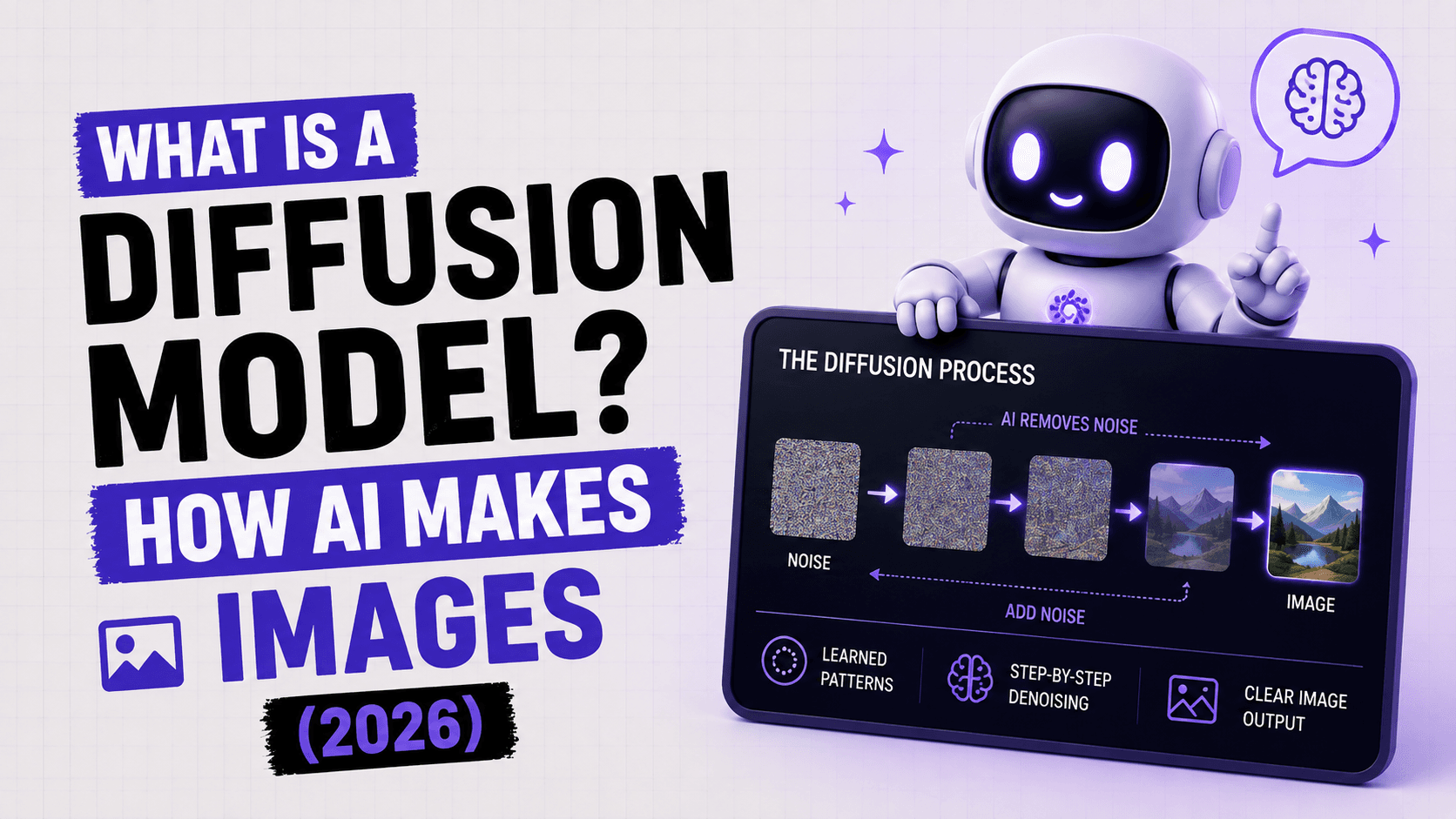
Every stunning AI image you have seen, the photorealistic portraits, the impossible landscapes, the videos of things that never happened, was created by starting with pure random noise, the same static an old TV shows when it loses signal. The AI then removed the noise, bit by bit, until a picture appeared. That sounds backwards, almost absurd. It is also the single most successful idea in AI image generation.
The technology is called a diffusion model, and by 2026 it powers essentially every major image and video tool: Midjourney, DALL-E, Stable Diffusion, Google's Imagen, and video models like Sora and Veo. If you have made an AI image, you have used one, whether you knew the name or not.
The strange part is how counterintuitive the method is. You would expect AI to build an image the way a painter does, adding detail onto a blank canvas. Diffusion models do almost the opposite, and understanding why is one of those ideas that makes AI suddenly click. This guide explains how diffusion models work, why they beat the older method, and where they still get it wrong, all without a single equation.
What Is a Diffusion Model?
A diffusion model is a type of AI that generates images by starting with random noise and gradually removing it until a clear picture emerges. It learns to do this by first studying how images turn into noise, then teaching itself to reverse that process. The result is a system that can create brand-new, realistic images from nothing but randomness and a text prompt.
Underneath, a diffusion model is a neural network, the same building block behind most modern AI. What makes it a diffusion model is not a special brain, it is a specific job it was trained to do: look at a noisy image and predict what it would look like with a little noise removed. Do that job enough times in a row and a picture appears out of the static.
The name comes from physics. Diffusion is how a drop of ink spreads out and dissolves evenly into a glass of water, a smooth slide from order into chaos. A diffusion model learns that slide in reverse: how to take the evenly-dissolved chaos and pull the ink back into a drop. Turning noise back into structure is the whole trick, and it is why these models can conjure detailed images from randomness.
A diffusion model does not paint an image onto a blank canvas. It carves an image out of a block of pure noise.
The Big Idea: Learning to Remove Noise
Diffusion models learn by first destroying images on purpose, then practicing how to rebuild them. This happens in two directions, and understanding both is the key to the whole concept.
The forward process: wrecking images to learn from them
During training, the model takes a real image, say a photo of a cat, and slowly adds random noise to it, step by step, until the cat is completely gone and only TV static remains. It does this to millions of images. At every step, it records exactly how much noise was added and what the slightly-less-noisy version looked like. This deliberate wrecking is how the model gathers its lessons.
The reverse process: learning to rebuild
Now the model trains on the opposite task. Given a noisy image, it learns to predict what the slightly cleaner version should look like, the step just before. Because it watched millions of images decay into static, it learns the patterns of how real images are built: that fur has texture, that eyes are round, that edges are sharp. It becomes an expert at removing noise in a way that produces something realistic.
This is a form of deep learning, where the model discovers what real images look like on its own, just by practicing noise removal over and over. Nobody tells it what a cat is. It figures out the patterns of realistic images from the millions it watched fall apart and, in reverse, learns to build them back up.
Once trained, the magic happens. The model no longer needs a real image to start from. You hand it a fresh patch of pure random noise, and it applies its denoising skill, imagining a realistic image hiding inside the static and pulling it out. Because the starting noise is random every time, you get a brand-new image every time, even from the same prompt.
How It Actually Makes an Image, Step by Step
To generate an image, a diffusion model starts with a canvas of pure random noise and denoises it over many steps until a coherent picture forms. Here is the process in plain order:
Start with static. The model generates a canvas of completely random noise, like TV static. This is easy for a computer to make and is different every time.
Predict a cleaner version. The model looks at the noise and predicts what a slightly less noisy version would look like, nudging the pixels toward something more image-like.
Repeat, many times. It takes that slightly cleaner image and denoises it again, and again. Each pass reveals a little more structure: vague shapes, then objects, then fine detail.
Arrive at the final image. After anywhere from around 50 to 1000 steps, the noise is gone and a sharp, coherent, entirely new image remains.
Picture a photograph developing in an old darkroom, where a blank sheet slowly resolves into a clear picture. Diffusion works like that, except the model is actively deciding what should appear at every stage, guided by everything it learned about real images. The randomness of the starting static is also why the same prompt gives you different results each time, which is a feature, not a bug.
Think of it as a photo developing in reverse-static: the picture was never there, the model decides it into existence one denoising step at a time.
How Text Prompts Steer the Picture
Text prompts work by guiding the denoising process toward an image that matches your words at every step. Without a prompt, a diffusion model would produce a random realistic image. The prompt acts like a steering wheel, nudging each denoising step toward your description.
This is where diffusion models connect to language AI. Your words are converted into a form the model understands, using the same kind of technology behind a large language model, and that meaning is fed into every denoising step. So when you type a red bicycle on a beach at sunset, the model is not just removing noise, it is removing noise in the direction of that specific scene.
At each of the dozens or hundreds of steps, the model asks itself a version of the same question: given where this image is heading, what would make it look a little more like the prompt and a little more realistic? Repeat that hundreds of times and the random static is shepherded, step by step, into a picture that matches your words. The prompt does not paint the image. It votes on every tiny decision the model makes along the way.
This also explains why prompt wording matters so much, and why small changes can produce very different results. You are not typing a search query that fetches an existing image. You are setting the direction for a journey from noise to picture, and every word tilts that journey.
Diffusion Models vs GANs: Why Diffusion Won
Before diffusion models took over, the leading way to generate images was a GAN, but diffusion models replaced them because they train more reliably and produce higher-quality, more varied results. Both can create images from scratch, but they go about it in opposite ways.
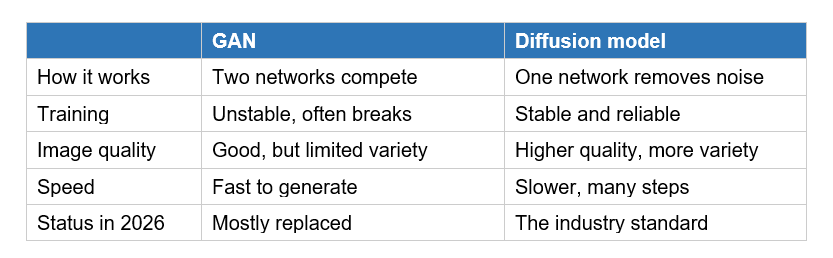
A GAN, or generative adversarial network, pits two networks against each other: one creates fake images, the other tries to spot them, and both improve by competing. It is a clever idea, and we cover it alongside other architectures in our guide on what deep learning is. The problem is that the contest is hard to balance, so GANs were notoriously unstable to train and often collapsed into producing the same few images.
Diffusion models sidestep all of that. Instead of a competition that can break, they follow one steady, cooperative task, remove a bit of noise, repeat, which trains reliably and explores the full range of possible images more evenly. The trade-off is speed: diffusion needs many steps and is slower than a GAN. The field decided that higher quality and stability were worth the wait, and by 2024 essentially every frontier image model had switched to diffusion.
Beyond Images: Video, Audio, and Even Proteins
The same denoising idea works for far more than pictures, which is why diffusion models now generate video, audio, and even 3D structures. Once researchers saw that turning noise into images worked, they applied the exact same trick to other kinds of data with startling success.
Video: models like Sora, Veo, Kling, and Runway generate clips by denoising across both space and time, so the motion stays consistent frame to frame.
Audio: tools like Stable Audio and MusicGen apply diffusion to sound, turning noise into music and speech.
3D and science: diffusion generates 3D shapes, and in a striking scientific use, models like RFdiffusion design brand-new proteins, helping drug discovery.
This is the part I find genuinely remarkable. A method invented to make prettier cat pictures turned out to be a general recipe for creating structured things out of randomness, useful enough that scientists now use it to design medicines. When a trick generalizes that far beyond its original purpose, it usually signals a deep idea, not just a neat one.
If you want to see which specific tools lead in each category and how to actually use them, our roundups on the best AI image generators put the diffusion models covered here into practical context.
The Limits: Speed, Hands, and Copyright
Diffusion models are powerful but flawed in three predictable ways: they are slow, they struggle with fine structure like hands and text, and they raise serious copyright and misinformation concerns. Knowing the limits is what separates an informed user from an impressed one.
Speed
Because generation takes many denoising steps, often 50 to 1000, diffusion is slower and more compute-heavy than older methods. This is why AI images take a few seconds and AI video takes much longer, and why running these tools at scale is expensive. Researchers keep finding ways to cut the number of steps, but the fundamental many-passes design makes speed the built-in tax.
Hands, text, and anatomy
You have probably seen an AI image with six-fingered hands or garbled text on a sign. This happens because the model learns general patterns of what images look like, not the exact rules that hands have five fingers or that letters spell words. Fine, rule-bound structure is where diffusion still slips, though it has improved a lot and keeps improving.
Copyright and misinformation
The harder problems are not technical. Diffusion models learn from enormous collections of images, often scraped from the internet without permission, which raises real and unresolved copyright questions. And because they can produce convincing fake photos and video, they fuel misinformation and deepfakes. These are the genuine open issues around the technology, and they are social and legal as much as they are engineering.
Frequently Asked Questions
Q: What is a diffusion model in simple terms?
A diffusion model is an AI that creates images by starting with random noise, like TV static, and gradually removing it until a clear picture appears. It learns this by first watching millions of images turn into noise, then training to reverse the process. It powers tools like Midjourney, DALL-E, and Stable Diffusion.
Q: How do diffusion models generate images?
They start with a canvas of pure random noise and denoise it over many steps, typically 50 to 1000, each pass revealing more structure until a coherent image forms. A text prompt steers every step toward matching your description. Because the starting noise is random, the same prompt produces a different image each time.
Q: What is the difference between a diffusion model and a GAN?
A GAN uses two networks competing against each other, which produces images fast but trains unstably and lacks variety. A diffusion model uses one network that repeatedly removes noise, which is slower but trains reliably and produces higher-quality, more diverse images. By 2026, diffusion models have largely replaced GANs as the industry standard.
Q: What AI tools use diffusion models?
Almost all major image tools, including Midjourney, DALL-E, Stable Diffusion, Google's Imagen, and FLUX. Video models like Sora, Veo, Kling, and Runway use diffusion too, as do audio tools like Stable Audio and MusicGen. The technology even extends to designing 3D shapes and new proteins for medicine.
Q: Why do diffusion models start with noise?
Because random noise is easy for a computer to generate and its randomness is what makes every image unique. The model was trained to turn noise into realistic images by practicing the reverse of adding noise, so starting from static is exactly what it knows how to work with. Different starting noise means a different final image each time.
Q: Are diffusion models slow?
Yes, relatively. Generating an image requires many denoising steps, often 50 to 1000, which makes diffusion slower and more compute-heavy than older methods like GANs. This is why AI images take a few seconds and AI videos take much longer. Researchers are actively working to reduce the number of steps needed.
Q: Do diffusion models only make images?
No. The same denoising idea works for many kinds of data. Diffusion models now generate video (Sora, Veo, Runway), audio and music (Stable Audio, MusicGen), 3D shapes, and even new protein structures for drug discovery. The method turned out to be a general way to create structured things from randomness.
Q: Why do AI images sometimes get hands wrong?
Because diffusion models learn general patterns of what images look like, not exact rules like hands have five fingers or letters spell words. Fine, rule-bound details are where the model tends to slip, producing things like extra fingers or garbled text. Quality has improved significantly, but precise structure remains a known weak spot.
Recommended Reads
• What Is a Neural Network? Plain-English Explanation
• What Is Deep Learning? The Layer Below Machine Learning
• What Is a Large Language Model? (Explained Simply)
• Best AI Image Generators 2026: Free vs Paid Compared
The magic of AI gets more fun once you know the trick behind it. Five minutes a day is enough to understand the tools everyone else just stares at.
References
• Scale AI - Diffusion Models: A Practical Guide
• SuperAnnotate - Introduction to Diffusion Models for Machine Learning
• Dataforest - Diffusion Model Image Generation Explained
• Viso.ai - Midjourney vs Stable Diffusion
AI Video Detector - Understanding Diffusion Models for Video
