What Is Deep Learning? The Layer Below Machine Learning
For roughly forty years, teaching a computer to recognize a cat meant hiring a human expert to describe a cat. Pointy ears. Whiskers. Fur texture. Engineers hand-wrote thousands of rules, and the results stayed mediocre. In the ImageNet competition, the world's best image recognition systems were stuck at around 26 percent error rates, improving by fractions of a percent each year.
Then in 2012, three researchers entered a system called AlexNet and posted a 15.3 percent error rate. They beat the field by 10.8 percentage points in a single year, and they did it without describing a cat even once. Their program figured out what a cat looked like on its own, by looking at pictures. That was deep learning arriving in public, and the entire industry pivoted within about eighteen months.
Deep learning is now the engine underneath nearly every AI you touch, from the autocorrect on your phone to ChatGPT. But most explanations either drown you in calculus or wave vaguely at brains. I want to do neither. This guide covers what the word deep actually means, how these systems teach themselves what to look for, the main types you should recognize by name, what it costs, and, the part almost nobody writes about honestly, when you should not use deep learning at all.
What Is Deep Learning? The One-Sentence Answer
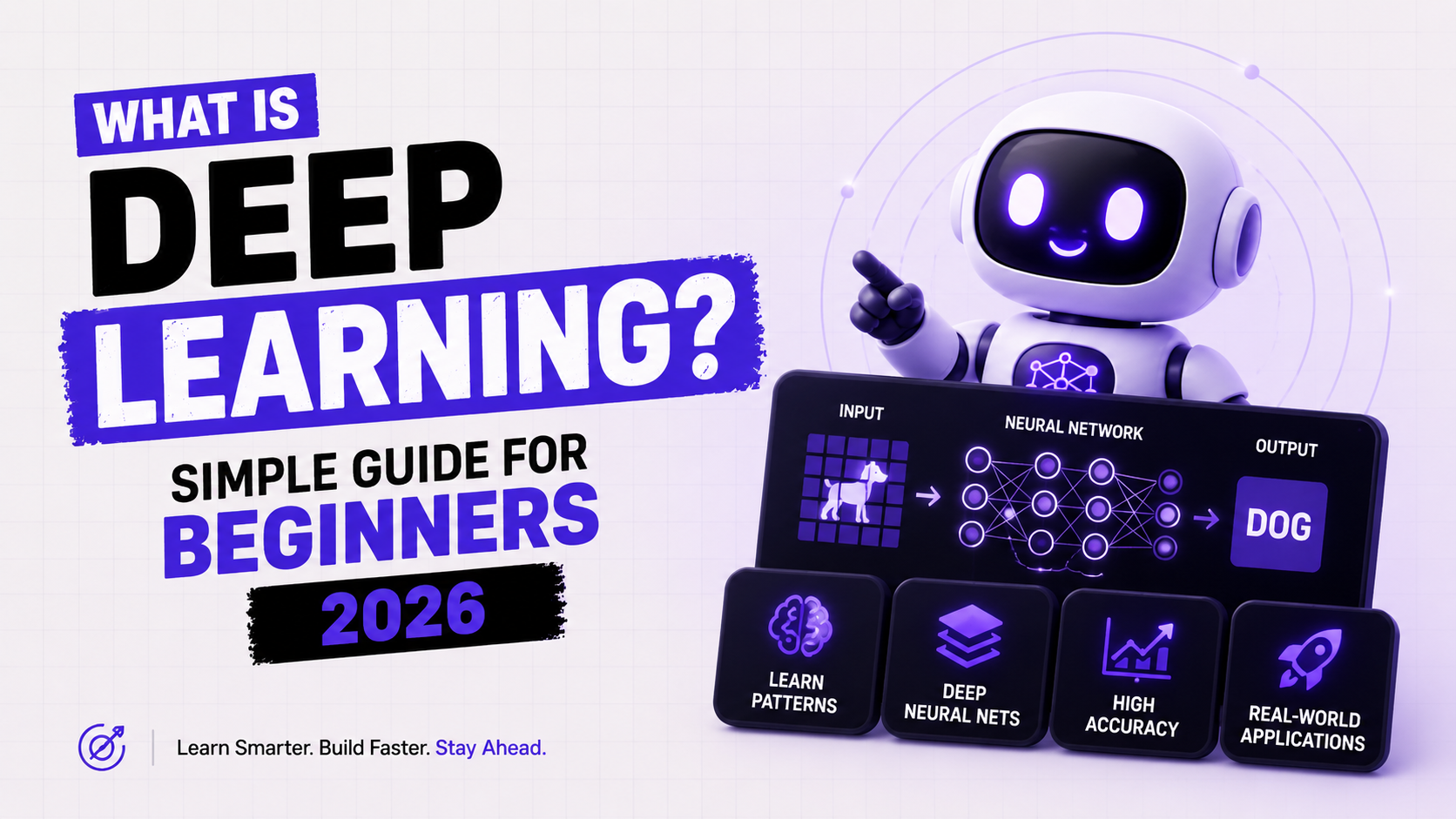
Deep learning is a type of machine learning that uses neural networks with many stacked layers to learn patterns directly from raw data, without a human telling it which features to look for. The word deep refers to the number of layers, not to any kind of profundity or understanding.
If you have read our explainer on what a neural network is, you already have the building block. A neural network is a web of simple mathematical units, called neurons, arranged in layers. Each one takes numbers in, does a small calculation, and passes numbers out. Deep learning is what you get when you stack a lot of those layers together and feed the whole thing enormous amounts of data.
Here is the distinction that actually matters. Classic machine learning needs a human to decide what the computer should pay attention to. Deep learning decides for itself. That single shift, from human-designed features to machine-discovered features, is why deep learning took over, and it is the thing to remember if you remember nothing else from this article.
Deep learning is not a smarter algorithm. It is an algorithm that writes its own instructions for what to notice.
A quick word on the brain comparison. Every article says deep learning is inspired by the human brain, and that is historically true, the early researchers borrowed the metaphor. But a modern deep learning model resembles a brain roughly the way a paper airplane resembles a falcon. Both exploit lift. Only one is alive. I would hold the analogy loosely.
AI vs Machine Learning vs Deep Learning: The Nesting Dolls
Artificial intelligence is the biggest circle, machine learning sits inside it, and deep learning sits inside machine learning. They are not three competing technologies. They are three sizes of the same nesting doll, and confusing them is the most common beginner mistake.
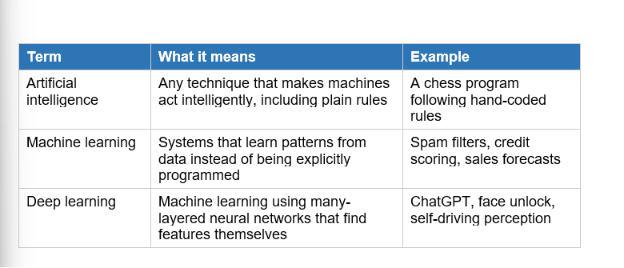
Our guide on what machine learning is covers the wider circle in detail. The practical difference between the two inner dolls comes down to four things: how much data they need, who picks the features, what hardware they demand, and how well you can explain their decisions.
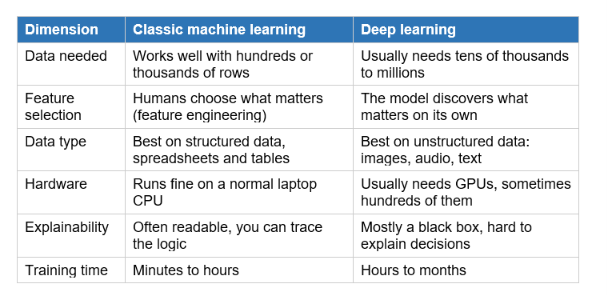
Read that table twice, because it contains the answer to a question people ask far too late: which one should I use? Deep learning wins on messy, unstructured, high-volume problems. Classic machine learning wins on tidy, small, tabular problems where you need to explain yourself. Both are still current in 2026 and teams pick between them based on problem complexity, data availability, and budget.
What Deep Actually Means: A Tour of the Layers
Deep means the network has many layers between its input and its output, typically anywhere from a handful to hundreds. Each layer transforms the data slightly and passes it forward, and the stacking is what lets the system build complicated ideas out of simple ones.
Walk through image recognition and it becomes concrete. You feed in a photo as raw pixel values.
• The first layer learns to spot edges, just abrupt changes from light to dark.
• The next layer combines edges into corners, curves, and simple textures.
• A middle layer combines those into recognizable parts: an eye, a pointed ear, a patch of striped fur.
• A deeper layer combines the parts into a whole face.
• The final layer says: cat, 94 percent confidence.
Nobody programmed the concept of an ear. The hierarchy emerged because the network was shown many labelled photos and adjusted itself until its guesses stopped being wrong. Shallow layers catch simple features, deeper layers catch complex ones, and depth equals abstraction. That is the entire architectural idea.
The adjusting happens through training, where the model makes a prediction, measures how wrong it was, and nudges its internal numbers to be less wrong next time, millions of times over. Our guide on how AI models are trained walks through that loop step by step.
One caution: more layers is not automatically better. Very deep networks are harder to train, hungrier for data, and prone to memorizing their training set instead of learning from it. Depth is a tool, not a scoreboard.
The Real Breakthrough: Feature Engineering Disappeared
The genuine revolution of deep learning was not accuracy, it was the elimination of feature engineering, the slow human process of deciding which aspects of the data a model should examine. Deep learning models analyze raw data directly and work out for themselves what matters.
Picture the old way. To build a face detector in 2005, a team of PhDs would spend months defining measurements: the distance between eye centers, the gradient around the nose, the symmetry ratio of the jaw. Every one of those had to be invented, coded, and tuned by a person. If the system failed on faces wearing glasses, you went back and hand-designed a glasses feature. The ceiling on your model was the imagination of your engineers.
Deep learning removed that ceiling. Show the network enough faces and it derives its own internal measurements, including ones no human would think to name. That is why performance jumped so violently in 2012 rather than creeping along, and it is why the field moved from expert knowledge toward data and compute almost overnight.
My hot take: this is also the source of most AI anxiety. The moment we stopped specifying what the machine should look at, we lost the ability to fully explain what it looks at. Every black-box complaint in AI today traces back to this exact trade. We bought accuracy with interpretability, and the bill still comes due in medicine, hiring, and lending.
The 2012 Moment: How AlexNet Started the Boom
Deep learning went from academic curiosity to industry consensus in 2012, when a model called AlexNet won the ImageNet competition with a top-5 error rate of 15.3 percent, beating the runner-up by 10.8 percentage points. Built by Alex Krizhevsky, Ilya Sutskever, and Geoffrey Hinton at the University of Toronto, it was the first widely acknowledged proof that deep learning worked at scale.
To feel the size of that result, understand what normal progress looked like. ImageNet winners had been posting error rates around 25 to 26 percent, using hand-engineered features fed into classical classifiers, and improving by a percentage point or so per year. AlexNet did not improve on that trend. It broke it.
Three ingredients made it work, and all three are still standard in 2026:
• GPUs for training. The team trained on consumer graphics cards, proving that gaming hardware could crunch neural networks far faster than CPUs. Every AI data centre today is a descendant of that choice.
• ReLU activations. A simple change to how neurons fire that made deep networks train dramatically faster than older methods allowed.
• Dropout. A regularization trick that randomly switches off neurons during training so the network cannot lean too hard on any one path, which keeps it from memorizing.
The people matter too. Ilya Sutskever went on to co-found OpenAI. Geoffrey Hinton, often called a godfather of deep learning, later won a share of the 2024 Nobel Prize in Physics and became one of the field's most prominent safety voices. The 2017 transformer architecture that powers today's large language models is a direct intellectual descendant of the wave AlexNet started.
Fourteen years later, the pattern that AlexNet established, more data plus more compute plus deeper networks equals better results, is still the operating assumption of the entire industry. Whether it continues to hold is arguably the biggest open question in AI.
The 4 Types of Deep Learning Models You Should Know
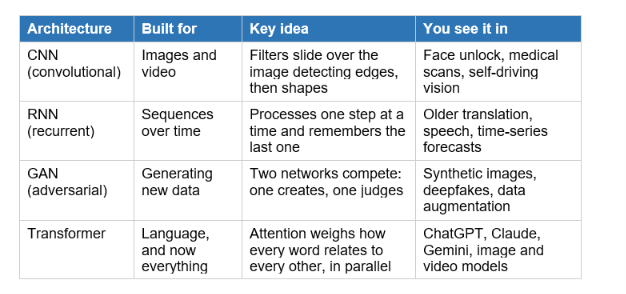
Four architectures cover most of deep learning in practice: convolutional networks for images, recurrent networks for sequences, generative adversarial networks for creating data, and transformers for language and almost everything else. Knowing which is which is enough to follow most AI news intelligently.
CNNs: the ones that see
Convolutional neural networks process data with a grid structure, which is exactly what an image is. A filter slides across the picture hunting for a pattern, shallow filters find lines and edges, deeper filters find shapes and objects. CNNs are what made AlexNet work, and they still run medical diagnostics, industrial inspection, and retail analytics.
RNNs: the ones that remember
Recurrent neural networks handle sequences by processing one element at a time and carrying forward a memory of what came before, which suits language, speech, and time series. Their weakness is that reading one word at a time is slow and they tend to forget the start of long passages. Transformers fixed both problems, which is why RNNs have largely been retired from frontier work.
GANs: the ones that create
Generative adversarial networks use two networks locked in a contest. A generator produces fake data, a discriminator judges whether it looks real, and both improve by trying to beat each other. GANs produced the first genuinely convincing synthetic faces and are the ancestor of today's image generation, though diffusion models have taken over most of that territory.
Transformers: the ones that took over
Transformers, introduced in 2017, abandoned step-by-step reading in favour of an attention mechanism that weighs how much every token matters to every other token, all at once and in parallel. That parallelism slashed training time and made today's giant models possible. Our transformer model explainer goes deeper, and it is the single most useful architecture to understand in 2026.
Where Deep Learning Already Runs Your Life
Deep learning is not a future technology, it is running dozens of times in your average day, mostly invisibly. The global deep learning market is projected at roughly 48 to 65 billion dollars in 2026 depending on the analyst, with forecasts of a 35 percent compound annual growth rate through 2031, and that money is buying systems you already use.
• Your phone: face unlock, autocorrect, voice dictation, portrait mode blur, and the search that finds photos of your dog without you tagging anything.
• Healthcare: deep learning vision systems read X-rays, CT scans, and pathology slides, flagging findings for radiologists to confirm.
• Transport: self-driving and driver-assist systems use deep learning for object detection, spotting pedestrians, lanes, and vehicles in real time.
• Media: Netflix and YouTube recommendations, Spotify playlists, and the feed ranking on every social platform you open.
• Language: instant translation of entire paragraphs, live captions, and every chatbot you have ever used.
• Money: fraud detection scoring your card transactions in milliseconds, and the risk models behind loan decisions.
Language deserves special mention because it is where progress has been most visible to ordinary users. If you want that thread specifically, our guide on what NLP is traces how computers went from keyword matching to genuine fluency.
What strikes me is how quickly all of this became boring. Face unlock was science fiction in 2013 and is a shrug in 2026. That is the actual signature of a successful technology: it stops being impressive and starts being infrastructure.
What Deep Learning Actually Costs
Deep learning is expensive in three currencies: data, compute, and money. Training GPT-4 required an estimated 78 million dollars in compute, Google reportedly spent around 191 million dollars on Gemini Ultra, and training costs for frontier models have grown roughly 2 to 3 times per year for the past eight years.
You are not training GPT-4, so here are the numbers that matter at human scale. Renting an NVIDIA H100, the workhorse AI chip, commonly runs 4 to 8 dollars per hour on demand, with cheaper decentralized options starting near 1.25 dollars, and entry-level T4 GPUs at roughly 2 to 4 dollars per hour. Fine-tuning an existing model rather than training from scratch cuts costs by 60 to 90 percent, with frontier-model fine-tunes typically landing between 5,000 and 50,000 dollars.
There is genuine good news buried in those figures. Hardware costs are falling around 30 percent per year and energy efficiency is improving roughly 40 percent annually, which is why capabilities that cost a fortune in 2023 are cheap or free in 2026. DeepSeek V3 reported a compute cost of 5.6 million dollars, a fraction of its Western peers, though that figure excludes infrastructure, experimentation, and failed runs, which is a fairly large asterisk.
Frontier AI is getting more expensive to invent and dramatically cheaper to use. Both things are true at once.
For a beginner, the practical takeaway is cheerful: you do not need any of this money. Free tiers on Google Colab and Kaggle give you GPU access, and pretrained models mean you almost never start from zero.
When You Should NOT Use Deep Learning
Deep learning is the wrong tool when your data is small, structured, or your decisions must be explainable, and in those cases classic machine learning usually beats it on accuracy, cost, and speed. This section exists because the industry has spent a decade pretending otherwise, and I think that is a genuine problem.
Skip deep learning when any of these apply:
• You have a few thousand rows in a spreadsheet. Gradient boosting methods like XGBoost routinely outperform neural networks on tabular data, and they train in seconds on a laptop.
• You must explain every decision. Banking regulators, medical boards, and courts want to know why. A black box is a legal liability, not a feature.
• The relationship is simple. If a linear model captures your pattern, adding a hundred layers buys you complexity, not accuracy.
• You lack labelled data. Deep learning is hungry, and unlabelled or tiny datasets starve it into overfitting.
• Latency and cost are tight. A small model running on a CPU may be all your product can afford.
I have watched teams burn quarters building a neural network for a problem a decision tree solved in an afternoon, because deep learning sounded better in the board deck. The most senior engineering instinct I know is reaching for the simplest thing that works. Deep learning is spectacular technology and a terrible default.
The Honest Limits of Deep Learning
Deep learning has four persistent weaknesses that no amount of scale has fixed: it is a black box, it is data hungry, it is energy intensive, and it is fragile in ways humans are not.
The black box problem
A deep model can predict accurately while giving no readable account of why. That is uncomfortable in a movie recommendation and unacceptable in a cancer diagnosis or a self-driving decision. Explainability research exists and is improving, but the honest state of play in 2026 is that we deploy systems whose reasoning we cannot fully audit.
The data appetite
Bigger architectures get hungrier, and they need large labelled datasets to produce reliable results. That favours organizations that already own enormous data, which quietly concentrates AI power among a handful of companies. It is a technical limitation with a political consequence.
The energy and compute bill
Training deep networks demands powerful GPUs or TPUs, driving both cost and real environmental impact. The efficiency gains are real, but so is the fact that the industry's total energy draw keeps climbing because we keep building bigger models.
Adversarial fragility
Deep networks can be fooled by adversarial examples, inputs deliberately tweaked in ways invisible to humans that cause confident misclassification. A few altered pixels can turn a stop sign into a speed limit sign for a vision model. Anything genuinely intelligent would not fall for that, which tells you something important about what these systems are and are not.
Add overfitting and the absence of real contextual understanding, and you get the honest summary: deep learning is a phenomenal pattern matcher that does not know what anything means.
How to Start Learning Deep Learning in 2026
You can start learning deep learning in a weekend with free tools and no PhD, provided you learn in the right order: concepts first, code second, maths last. The traditional advice to master linear algebra before touching a model has scared off more capable people than any other idea in this field.
A sequence I would actually recommend:
1. Get the concepts solid: neural networks, layers, training, and the difference between machine learning and deep learning. That is what this article and the ones linked below are for.
2. Run something before you understand it. Use a pretrained model from Hugging Face to classify images or analyze sentiment. Seeing it work builds the motivation that carries you through the harder parts.
3. Learn Python basics, then PyTorch. PyTorch dominates research and increasingly industry, so learning it is the higher-leverage choice over alternatives.
4. Train a small model end to end on a free GPU via Google Colab or Kaggle. Small and finished teaches more than ambitious and abandoned.
5. Add the maths as you hit walls. Linear algebra and calculus become far easier to absorb when you already know which problem they solve.
Do you need maths eventually? For research, yes, deeply. For building useful things with existing models, far less than people claim. If you want a structured path with daily steps rather than a pile of links, our 30-day plan to learn AI is built exactly for that.
The mistake I see most often is collecting courses instead of finishing projects. Three completed small projects will teach you more, and interview far better, than nine abandoned tutorials. Build the ugly thing that works.
Frequently Asked Questions
Q: What is deep learning in simple words?
Deep learning is a type of machine learning that uses neural networks with many stacked layers to learn patterns straight from raw data. Instead of a human deciding what features matter, the model works that out itself by processing large numbers of examples. It powers ChatGPT, face unlock, medical image analysis, and self-driving perception.
Q: What is the difference between deep learning and machine learning?
Deep learning is a subset of machine learning, so it is not a rival but a specialized branch. The core difference is feature engineering: classic machine learning needs humans to choose which data features matter, while deep learning discovers them automatically. Machine learning suits small structured data on a laptop, deep learning suits large unstructured data like images, audio, and text, and usually needs GPUs.
Q: Why is it called deep learning?
The word deep refers to the number of layers in the neural network, not to depth of understanding. A shallow network might have one or two hidden layers, while deep networks stack anywhere from several to hundreds. Each layer builds more abstract features from the previous one, so depth is what lets the model turn pixels into edges, edges into shapes, and shapes into objects.
Q: Is deep learning the same as a neural network?
Not quite. A neural network is the underlying structure, and deep learning is what you call it when that network has many layers and learns features on its own. All deep learning uses neural networks, but a simple two-layer neural network from the 1990s would not be described as deep learning.
Q: What are examples of deep learning in daily life?
Face unlock on your phone, autocorrect and voice dictation, Netflix and YouTube recommendations, Google Translate, live captions, credit card fraud detection, medical image analysis, and every AI chatbot including ChatGPT, Claude, and Gemini. Most run invisibly, which is why people underestimate how much deep learning they already depend on.
Q: How much data does deep learning need?
Usually tens of thousands to millions of examples, far more than classic machine learning, which often works with hundreds or thousands of rows. Larger architectures get hungrier still. You can sidestep this by fine-tuning a pretrained model on a small dataset, which cuts both data and cost requirements by 60 to 90 percent.
Q: What are the main types of deep learning models?
Four architectures cover most use cases: CNNs for images and video, RNNs for sequential data like speech and time series, GANs for generating synthetic data, and transformers for language and increasingly everything else. Transformers, introduced in 2017, now dominate because they process data in parallel using attention rather than reading step by step.
Q: Is deep learning still worth learning in 2026?
Yes, though the job has shifted from building models from scratch to adapting pretrained ones. The deep learning market is projected at roughly 48 to 65 billion dollars in 2026 with a 35 percent compound annual growth rate forecast through 2031. Understanding the fundamentals also makes you far better at using AI tools, even if you never train a model yourself.
Q: What are the disadvantages of deep learning?
The four big ones are the black box problem (accurate predictions with no readable explanation), heavy data requirements, high compute and energy costs, and adversarial fragility, where tiny invisible input changes cause confident wrong answers. It also overfits easily and lacks genuine contextual understanding, which is why it is the wrong tool for small, structured, or explainability-critical problems.
Recommended Reads
• What Is Machine Learning? The Clearest Beginner Guide
• What Is a Neural Network? Plain-English Explanation
• What Is a Transformer Model? Explained Simply
• How Are AI Models Trained? A Plain-English Guide
Deep learning took the world twelve years to understand. You can get the fundamentals in five minutes a day, if you keep showing up.
References
• IBM - What Is Deep Learning?
• AWS - What Is Deep Learning?
• Google Cloud - Deep Learning vs Machine Learning vs AI
• Pinecone - AlexNet and ImageNet: The Birth of Deep Learning
• Viso.ai - AlexNet: Revolutionizing Deep Learning
• TechTarget - Deep Learning and Deep Neural
• DataCamp - Deep Learning Tutorial for Beginners
• Precedence Research - Deep Learning Market Size and Trends