

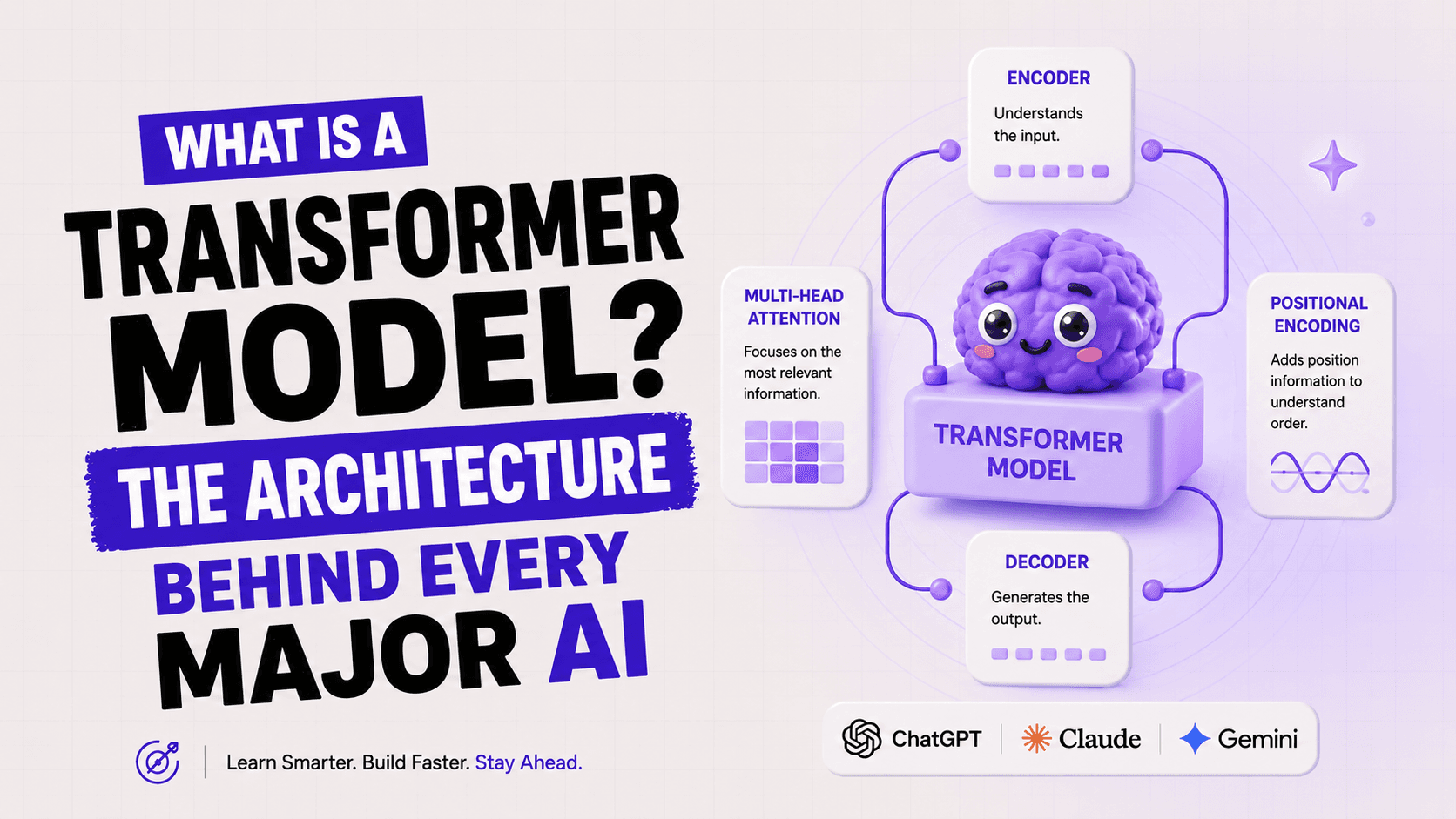
What Is a Transformer Model? The Architecture Behind Every Major AI
In June 2017, eight researchers at Google Brain published a paper with a deliberately bold title: 'Attention Is All You Need.' It was submitted to NeurIPS, the premier machine learning conference, and it described a new neural network architecture they called the Transformer.
By 2026, that paper had been cited more than 250,000 times, placing it among the ten most-cited papers of the 21st century, according to Wikipedia and multiple citation databases. Every major AI system you have used is a descendant of it. The T in GPT stands for Transformer. The T in BERT stands for Transformer. Gemini, Claude, Llama, Mistral, DeepSeek, AlphaFold, DALL-E, Stable Diffusion, Whisper. All transformers, or architectures built on top of them.
The reason you should care about this is not academic. Understanding what a transformer is, at a conceptual level, makes every AI product you use less mysterious and more useful. It explains why ChatGPT sometimes forgets the beginning of a long conversation. It explains why these models can translate between languages they were not explicitly trained on. It explains why scaling them up with more data keeps making them better in ways that surprised even their creators.
This post explains the transformer in plain English. No equations. No code. Just the idea.
What Is a Transformer Model? The One-Sentence Answer
A transformer model is a type of neural network architecture that processes entire sequences of data simultaneously by computing how every part of the input relates to every other part, using a mechanism called self-attention.
That sentence has three important parts. Entire sequences simultaneously is the key phrase. Before transformers, neural networks that handled language processed words one at a time, left to right, carrying a compressed memory of everything they had already read. Transformers threw out that sequential approach entirely and replaced it with parallel processing: all words are processed at the same time, and the model calculates the relationship between every word and every other word in a single step.
The mechanism that makes this possible is called self-attention, and it is the core innovation of the transformer architecture. Self-attention is how the model figures out which words in a sentence are most relevant to understanding every other word.
According to NVIDIA, a transformer model is a neural network that 'learns context and thus meaning by tracking relationships in sequential data.' According to IBM, the transformer 'excels at processing sequential data' and has 'achieved elite performance' across natural language processing, computer vision, speech recognition, and time series forecasting.
The Problem Transformers Solved: Why RNNs Were Not Enough
To understand why the transformer was such a leap, you need to understand what came before it and what was wrong with it.
Before 2017, the dominant approach to language AI was recurrent neural networks (RNNs) and their more capable variant, long short-term memory networks (LSTMs). The core idea of an RNN is elegant: process a sentence word by word, left to right, and at each step update a compressed summary called a hidden state that carries information from everything read so far.
Think of it like a person reading a novel by listening to it read aloud at exactly one word per second, with no ability to go back. At each word, they update their mental summary of the story so far. They can remember the beginning of the previous sentence reasonably well. They struggle to remember a character introduced in chapter one once they are in chapter fifteen. The earlier information gets compressed and diluted with every new word processed.
This is the vanishing gradient problem. In an RNN, information from early in a sequence must travel through every subsequent step to reach the end. At each step, the signal can weaken. By the time you are processing the 500th word of a document, information from the first 50 words may have nearly vanished from the model's working state.
The second problem was parallelism. Because RNNs process words sequentially, word 10 cannot be processed until word 9 is done. Word 9 cannot be processed until word 8 is done. This creates a processing chain that cannot be parallelised: you cannot throw more GPU cores at the problem and make it proportionally faster, because each step depends on the previous one. Training an RNN on a long document is inherently slow in a way that engineering cannot fix without changing the architecture.
In engineering terms: RNNs have O(n) time complexity and constant per-step state, while transformers process all tokens in parallel, which enables orders-of-magnitude differences in training throughput on modern GPU hardware, according to research published in early 2026 (HiTReader, January 2026). The trade-off is that transformers have O(n^2) memory complexity with respect to sequence length, which is why long-context processing is expensive.
The Library Analogy: How Attention Changes Everything
Here is the concrete analogy I use to explain attention. It is the one I have found sticks the best for people who have never studied ML.
Imagine you need to understand a dense academic paper. An RNN is like an assistant who reads the paper to you out loud, one sentence at a time, and summarises what they have read so far into a single index card that gets updated after each sentence. By the time you reach the conclusions, the index card only has room for information from the last few sections. The introduction and methodology are mostly lost.
A transformer is like walking into a library and having access to the entire paper spread across an enormous table, every page visible simultaneously. When you are reading any sentence, you can instantly look back at any previous sentence to check for connections. You are not relying on a degrading summary. You have the full text available for direct comparison at every point.
That 'looking at everything at once and figuring out what matters' is self-attention. For every word in the input, the transformer computes a score against every other word, asking: how relevant is this other word to understanding my current word? The scores are used to weight the information contributed by each word to the final meaning.
Consider the sentence: 'The bank by the river had thick mud on its bank.' Without context, 'bank' is ambiguous. Does it mean a financial institution or the edge of a river? A human reader resolves this instantly by attending to 'river' and 'mud.' A transformer does the same: it scores 'river' and 'mud' as highly relevant to the first 'bank,' and 'mud' as relevant to the second 'bank,' and uses those scores to produce a representation of 'bank' that carries the correct meaning in each position.
This is a qualitative leap over what RNNs could do. RNNs could approximate this through learned patterns in the hidden state. Transformers do it directly, explicitly, and in parallel for every word simultaneously.
Inside a Transformer: The Key Components Explained
A transformer has several components. You do not need to know the mathematics. You do need to understand what each component is doing conceptually.
Tokenisation: Breaking text into units
Before any attention is computed, the input text is broken into tokens. A token is roughly a word or a part of a word. 'Transformer' might be one token. 'Unbelievable' might be three tokens: 'un', 'believ', 'able'. Each token is converted into a numerical vector called an embedding, a list of numbers that represents the token's initial meaning.
Positional encoding: Telling the model where each word sits
Because transformers process all tokens simultaneously rather than sequentially, they have no inherent sense of order. The word at position 1 looks the same as the word at position 100 unless position information is added explicitly. Positional encoding solves this by adding a position-specific numerical pattern to each token's embedding. This tells the transformer whether a word is the first word, the tenth, the hundredth, so it can factor word order into its attention calculations.
Self-attention: The core mechanism
For every token, the model creates three vectors called Query, Key, and Value. The Query is what this token is looking for. The Key is what this token is offering to others. The Value is the actual information this token contributes if it gets selected.
For each token, the model calculates an attention score between its Query and every other token's Key. Higher scores mean stronger relevance. The scores are normalised and used to create a weighted sum of all the Value vectors. The result is an updated representation of the token that now incorporates context from across the entire sequence.
The library analogy maps directly: Query is what you are looking for when you read a sentence. Key is the label on each other page. Value is what you actually read when you flip to that page. The attention score determines which pages are worth flipping to.
Multi-head attention: Looking from multiple angles simultaneously
A single attention calculation captures one type of relationship. Multi-head attention runs several attention calculations in parallel, each with different learned Query-Key-Value weight matrices. One head might learn to track subject-verb agreement. Another might track coreference (which 'it' refers to). A third might track sentiment-carrying words. The outputs are concatenated, giving the model a richer, multi-perspective representation of each token's relationships.
GPT-4 has 96 attention heads per layer across 96 layers. Each head specialises in different patterns. Together they capture the full complexity of language in a way no single attention calculation could.
Feed-forward layers: Processing each token independently
After attention, each token's updated representation passes through a feed-forward neural network, applied identically and independently to each token. This step does not involve cross-token attention. It refines each token's representation based on what attention gave it, adding non-linearity and deeper pattern recognition.
Layer stacking: Depth equals abstraction
One transformer block consists of self-attention plus feed-forward processing. Real models stack many blocks. Early layers learn low-level relationships between adjacent words. Middle layers learn syntax and grammar. Later layers learn semantics, reasoning, and world knowledge. The depth is what enables GPT-4 and Claude to perform complex reasoning rather than just pattern matching.
Encoder vs Decoder: Two Roles, One Architecture
The original transformer had two halves: an encoder that reads and understands input, and a decoder that generates output. In 2026, most frontier models specialise in one half or the other.
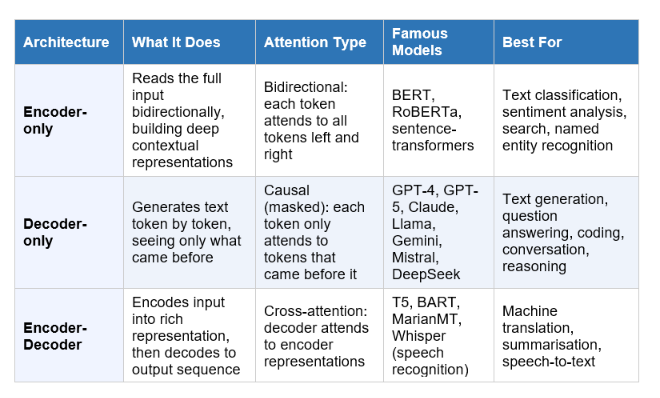
The decoder-only architecture dominates the frontier in 2026. GPT-4o, Claude Opus 4, Gemini 3, Llama 3, and DeepSeek V4 are all decoder-only transformers. The reason is that the next-token prediction objective (predicting the most likely next word from all previous words) generalises remarkably well to almost every language task when scaled up with enough data and parameters.
BERT-style encoder models still power the infrastructure of search. Google has used transformer encoders in its search ranking since 2019 (with BERT) and has continued developing them since. When you search on Google and get a relevant result despite using unconventional phrasing, a transformer encoder is doing the understanding.
How Transformers Are Trained
A transformer's parameters (its weights) start as random numbers. Training adjusts those numbers across billions of examples until the model's outputs become useful.
For decoder-only language models, training uses a simple but powerful objective called next-token prediction (also called causal language modelling). The model is given a text sequence and must predict the next token. If it predicts incorrectly, the error propagates backwards through the network (via backpropagation) and the weights are adjusted slightly. Repeated billions of times across trillions of tokens of text, the model learns grammar, facts, reasoning, and world knowledge from the statistical patterns in language.
For encoder models like BERT, training uses masked language modelling. Some tokens in the input are randomly replaced with a special mask token, and the model must predict what the masked tokens originally were. Because the encoder sees tokens from both left and right, it learns bidirectional contextual representations.
The compute requirements for training frontier models are staggering. GPT-4's training reportedly cost over $100 million in compute according to estimates from Epoch AI (2024). Gemini Ultra's training required Google's custom TPU v4 clusters across multiple data centres. Training a frontier model from scratch is one of the most expensive engineering undertakings in technology.
For a deeper look at how AI training works in general, our post on how AI models are trained covers the full process including pretraining, fine-tuning, and RLHF.
The Paper That Started It All: Eight Researchers Who Changed AI
'Attention Is All You Need' was published in June 2017 by Ashish Vaswani, Noam Shazeer, Niki Parmar, Jakob Uszkoreit, Llion Jones, Aidan N. Gomez, Lukasz Kaiser, and Illia Polosukhin, all working at Google Brain at the time.
The paper was not expected to have the impact it did. It was submitted to NeurIPS 2017 primarily as an improvement to machine translation systems. The authors had a hunch it would generalise. They noted in the conclusion that they planned to extend the model to other problems including images, audio, and video. They were right, but even they did not anticipate the scale of what followed.
By 2026, the paper has been cited more than 250,000 times, according to Wikipedia and Atlan's enterprise AI research (2026). It is among the ten most-cited papers of the 21st century across all fields. The 'T' in GPT literally stands for Transformer.
The human story of what happened next is remarkable. All eight authors left Google after the paper's success. Ashish Vaswani co-founded Adept AI. Noam Shazeer co-founded Character.AI (valued at over $1 billion). Aidan Gomez co-founded Cohere. Illia Polosukhin co-founded NEAR Protocol. Lukasz Kaiser joined OpenAI. The group that published one of the most consequential computer science papers of the century dispersed to seed the very industry that paper created.
My take: there is something worth sitting with in that story. Eight researchers, one eight-page paper, and a decade later every major AI system in the world runs on the architecture they described. Few ideas in the history of technology have propagated so fast and so completely.
Every Major AI Running on Transformers in 2026
The transformer is not just a language technology. It has become the dominant architecture across almost every domain of AI.
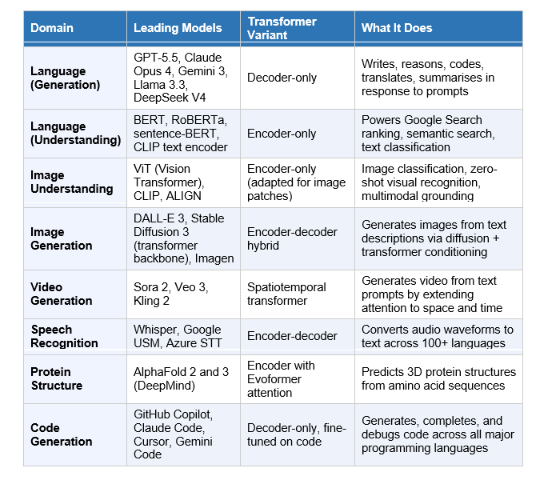
AlphaFold deserves special mention. DeepMind's protein structure prediction system, which won the 2024 Nobel Prize in Chemistry (jointly awarded to Demis Hassabis and John Jumper), uses a transformer variant called the Evoformer that applies attention across amino acid sequences. Its predictions have accelerated drug discovery, giving researchers structural data for proteins that took years to characterise experimentally. A transformer architecture winning a Nobel Prize in chemistry is a meaningful signal about how far beyond language this technology has reached.
What Transformers Cannot Do: The Honest Limits
Transformers are the most powerful AI architecture ever deployed. They also have structural limitations that matter for real-world use.
The quadratic memory problem
Self-attention computes relationships between every pair of tokens. For a sequence of n tokens, this means n x n comparisons. Double the sequence length and the memory cost quadruples. This quadratic scaling is why context windows matter and why extending them is expensive. GPT-4o's 128K token context window requires significantly more compute than a 32K context window, not linearly but quadratically. Gemini 3's 2 million token context window is a remarkable engineering achievement partly because it had to overcome this scaling problem.
Research into linear attention variants (RWKV, RetNet, Mamba) aims to achieve the quality of transformer attention at linear rather than quadratic cost. As of 2026, these alternatives are competitive on many tasks but have not yet displaced the standard transformer at the frontier.
Hallucination is structural, not accidental
A decoder-only transformer generates text by predicting the most statistically likely next token given everything that came before. It has no mechanism to verify whether what it is generating is factually correct. It does not look anything up unless given tools to do so. The confident, fluent, completely wrong answer is a structural property of next-token prediction, not a bug that can be patched with a simple fix.
Compute concentration is a global equity problem
Training a frontier transformer model requires hundreds of millions of dollars, access to thousands of specialised GPUs or TPUs, and large research teams. This concentrates AI capability in a handful of organisations in the United States and China. The largest open-source models (Llama 3.3, Mistral, DeepSeek V4) reduce this concentration but still require substantial compute to run at scale. For researchers, startups, and governments in developing countries, including India, the cost of frontier transformer training remains a genuine barrier.
The compute asymmetry is not inevitable. Efforts to distill smaller, more efficient transformer models (DistilBERT, Phi-3, Gemma) and to run models on-device (Apple Intelligence, Alibaba's Qwen2.5-Omni-7B on smartphones) are real progress. But as of 2026, the frontier is still defined by organisations with access to massive GPU clusters.
Transformers do not reason the way humans do
Transformers are extraordinarily good at pattern matching across language. Impressive reasoning-like behaviour emerges from scale. But the mechanism is fundamentally statistical: the model produces the most likely continuation given its training distribution. When a problem requires genuine multi-step logical reasoning with no analogues in training data, transformer performance degrades. Chain-of-thought prompting, which asks the model to reason step by step before answering, improves performance on such tasks, but the improvement is also pattern-learned, not a true reasoning engine.
Transformers Beyond Language: Science, Vision, and Music
The reason the transformer has spread so far beyond language is that the attention mechanism is domain-agnostic. Anywhere you have a sequence of elements and want to model relationships between them, a transformer can potentially help.
Computer vision: The Vision Transformer (ViT), introduced by Google Brain researchers Dosovitskiy et al. in 2021, divides an image into small patches and treats each patch as a token, feeding them into a standard transformer encoder. ViT models now compete with convolutional neural networks on image classification benchmarks and form the vision encoder inside multimodal models like CLIP and GPT-4o.
Protein structure prediction: AlphaFold 2 and 3 (DeepMind) use transformer-based attention to model relationships between amino acids in a protein sequence, predicting how the protein folds in 3D space. AlphaFold has predicted structures for over 200 million proteins, covering nearly every known protein in existence, according to DeepMind (2023). The 2024 Nobel Prize in Chemistry was awarded for this work.
Music generation: Suno and Udio use transformer-based architectures to generate full audio tracks from text descriptions, including lyrics, instruments, tempo, and genre. The same attention mechanism that resolves pronoun ambiguity in English text learns which musical motif should resolve which harmonic tension.
Drug discovery: Transformer models applied to molecular sequences are accelerating the identification of drug candidates. Insilico Medicine used a transformer-based pipeline to identify a novel drug candidate for idiopathic pulmonary fibrosis (ISM001-055) in 18 months, compared to the typical decade-long timeline. The candidate progressed to Phase II clinical trials in 2023.
Climate modelling: Google DeepMind's Graphcast (2023) and Pangu-Weather (Huawei) use transformer architectures trained on 40 years of weather data to produce 10-day forecasts more accurately than traditional physics-based models, at a fraction of the compute cost.
The pattern across all of these applications is the same: wherever sequential or structured data contains long-range dependencies that previous architectures struggled to capture, transformers find those dependencies and model them effectively.
Frequently Asked Questions
What is a transformer model in simple terms?
A transformer model is a type of neural network that processes entire sequences of data simultaneously, computing how every part of the input relates to every other part using a mechanism called self-attention. Unlike earlier models that read sequences word by word, transformers look at the whole input at once, which lets them capture long-range relationships in language, images, or audio far more effectively. Every major AI you use today, including ChatGPT, Claude, Gemini, and Google Translate, is built on this architecture. The paper that introduced it, 'Attention Is All You Need' (Vaswani et al., 2017), has been cited more than 250,000 times, making it one of the most influential scientific papers of the 21st century.
How does the transformer model work?
A transformer works through five key steps. First, text is split into tokens and each token is converted into a numerical vector (embedding). Second, positional encodings are added to tell the model where each token sits in the sequence. Third, self-attention computes scores between every token pair: for each token, a Query vector searches for relevant other tokens using their Key vectors, then weighted Value vectors are combined to produce a context-aware representation. Fourth, multi-head attention runs several attention operations in parallel, each capturing different types of relationships. Fifth, the enriched representations pass through feed-forward layers and the whole block is repeated across many layers. For generation models, the final layer predicts the probability of each possible next token and the most likely is selected.
What is the difference between a transformer and an RNN?
RNNs (recurrent neural networks) process sequences word by word, left to right, carrying a compressed hidden state that represents everything read so far. This creates two problems: the hidden state struggles to maintain information from the beginning of long sequences (vanishing gradient problem), and sequential processing cannot be parallelised across GPU cores. Transformers process all tokens in parallel and compute direct relationships between every pair of tokens via self-attention, solving both problems. The trade-off is that transformers require memory proportional to the square of the sequence length (O(n^2)), making very long sequences expensive, while RNNs have constant memory per step. In practice, the parallelism and quality advantages of transformers have made them the dominant architecture for almost all sequence tasks since 2018.
Why is it called a transformer model?
The name comes from the original use case: transforming one sequence into another, specifically translating sentences from one language to another. The encoder reads and transforms the input sequence into a rich contextual representation. The decoder transforms that representation into the output sequence (the translation). The 'transformation' the architecture performs is a sequence-to-sequence mapping using attention mechanisms. The name predates the broader use of transformers for generation, understanding, images, and protein prediction, so today it is arguably too narrow, but the name stuck.
Is ChatGPT a transformer model?
Yes. ChatGPT is built on GPT-4 (and GPT-5.5 in 2026), which is a decoder-only transformer model developed by OpenAI. The name GPT stands for Generative Pre-trained Transformer. The T literally refers to the transformer architecture. ChatGPT generates each word of its response by running the transformer forward pass, predicting the probability distribution over all possible next tokens, sampling from that distribution, and repeating token by token until the response is complete. The same is true for Claude (Anthropic), Gemini (Google), Llama (Meta), and every other major large language model in 2026.
What is self-attention in a transformer?
Self-attention is the core mechanism of the transformer. For every token in the input, the model creates three vectors: a Query (what this token is looking for), a Key (what this token offers to others), and a Value (what information this token contributes). The model scores each token's Query against every other token's Key to produce attention weights: higher weight means more relevant. These weights are used to create a weighted sum of all Value vectors, producing an updated representation of each token that now incorporates context from across the entire sequence. The word 'self' in self-attention means the attention is computed within a single sequence (the input attending to itself), as opposed to cross-attention where one sequence attends to another.
What is the difference between encoder and decoder in a transformer?
The encoder reads the full input sequence and produces rich contextual representations for each token using bidirectional attention (each token can attend to all others in both directions). The decoder generates output tokens one at a time using causal attention (each token can only attend to tokens generated before it, to prevent cheating during training). In the original encoder-decoder transformer for translation, the encoder reads English and the decoder generates French. In decoder-only models like GPT-5 and Claude, there is no separate encoder: the decoder reads the prompt using causal attention and then generates the response. In encoder-only models like BERT, there is no decoder: the model produces bidirectional representations used for classification or search.
Who invented the transformer model?
The transformer was introduced in the paper 'Attention Is All You Need' (June 2017) by eight researchers at Google Brain: Ashish Vaswani, Noam Shazeer, Niki Parmar, Jakob Uszkoreit, Llion Jones, Aidan N. Gomez, Lukasz Kaiser, and Illia Polosukhin. All eight subsequently left Google. Vaswani co-founded Adept AI. Shazeer co-founded Character.AI. Gomez co-founded Cohere. Polosukhin co-founded NEAR Protocol. Kaiser joined OpenAI. The attention mechanism the paper built on was developed by Dzmitry Bahdanau, Kyunghyun Cho, and Yoshua Bengio in their 2014 paper on neural machine translation.
What are the limitations of transformer models?
Transformers have four significant structural limitations. First, quadratic memory scaling: self-attention requires computing relationships between every pair of tokens, so memory cost grows quadratically with sequence length. Doubling the context doubles the computation four times, not twice. Second, hallucination: decoder-only transformers generate statistically likely text without any mechanism to verify factual accuracy, producing confident incorrect statements. Third, compute concentration: training frontier transformers costs hundreds of millions of dollars and requires hardware only accessible to a handful of organisations. Fourth, limited generalisation to novel reasoning: transformers excel at tasks represented in their training distribution but degrade on problems requiring multi-step reasoning without training analogues, even when that reasoning appears simple to humans.
Recommended Reads
• What Is a Large Language Model?
• What Is Multimodal AI? How AI Reads Text
• What Are AI Embeddings? How Machines
Eight researchers published eight pages in 2017. Every AI conversation you have had since runs on what they wrote.
References
• Vaswani et al. - Attention Is All You Need
• Wikipedia - Attention Is All You Need
• Wikipedia - Transformer (deep learning)
• IBM Think - What Is a Transformer Model?
• NVIDIA Blog - What Is a Transformer Model?
• Atlan - What Is a Transformer Model?
• DataCamp - How Transformers Work
• Grammarly Blog - What Is a Transformer
• JerryCards - The Paper That Built Modern AI