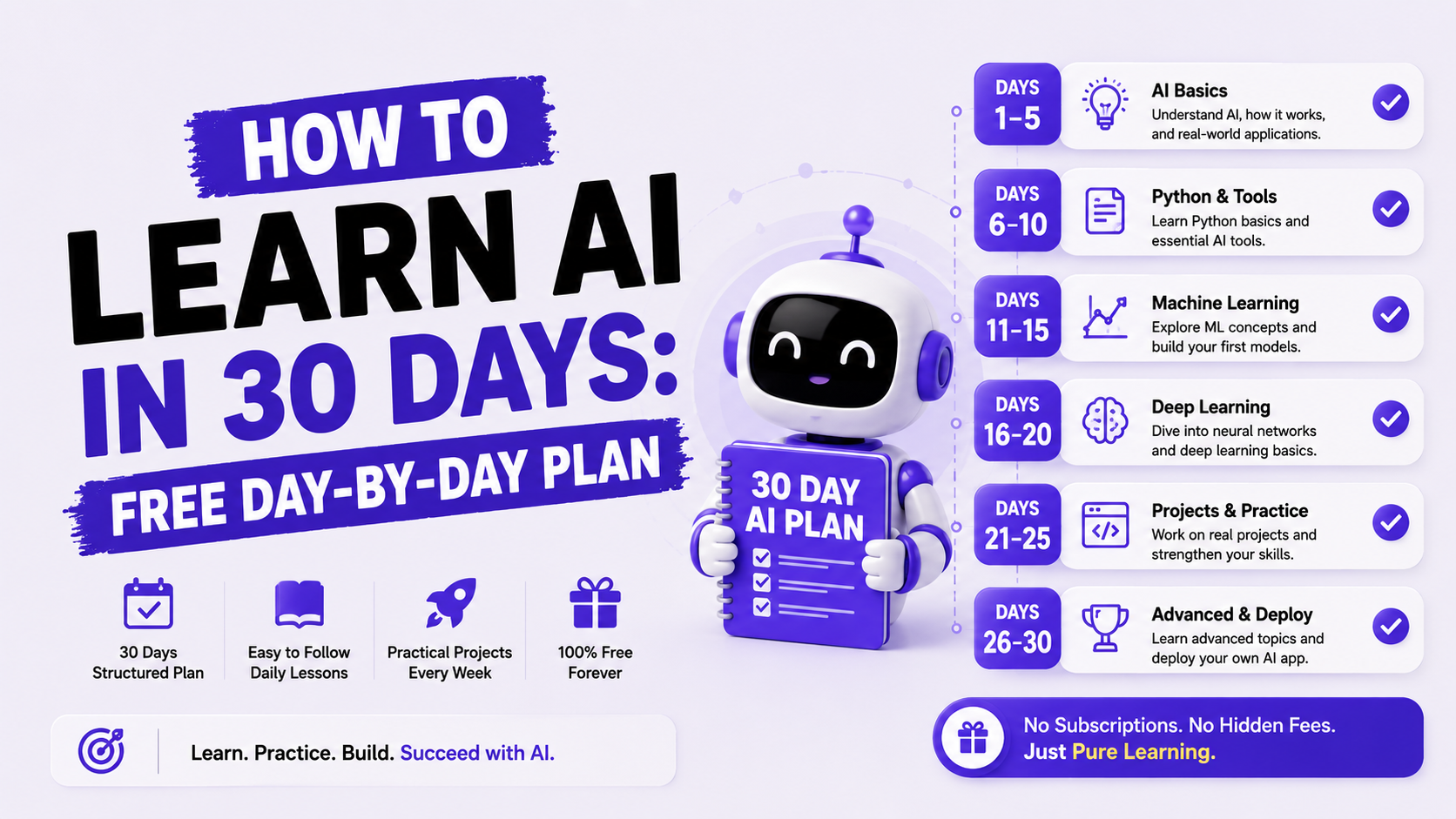
How to Learn AI in 30 Days: Free Day-by-Day Plan
Most 30-day AI plans fail by day four. Not because AI is hard. Because the plans are built by people who already know AI.
They open with neural network architecture. They assume you know what a token is. They tell you to install Python on day one. By the time you close the tab, you feel less capable than when you opened it.
This plan is built differently. The goal for the first 30 days is not to make you an AI engineer. It is to make you genuinely AI-literate: someone who understands what is actually happening inside the tools reshaping every industry, can use them confidently, and can ask better questions than 90% of the people around them. That is achievable in 30 days at 30 minutes per day. Nothing in this plan costs money.
Before You Start: Setting Honest Expectations
69% of business leaders say AI literacy is important for their teams' daily tasks, according to DataCamp's State of Data and AI Literacy Report 2026. The same report documents that most employees do not yet have it. That gap is where 30 focused days can genuinely move you.
But here is what 30 days will and will not get you.
What it will get you: a solid understanding of how machine learning, large language models, prompt engineering, RAG, and AI agents work. Confidence using ChatGPT, Claude, Perplexity, and NotebookLM for real tasks. A mental framework for evaluating any new AI tool or claim. An Anthropic Academy certificate if you do the optional structured coursework alongside this plan.
What it will not get you: a job as an ML engineer, the ability to train your own model, or deep Python proficiency. Those take 6-12 months of consistent effort. This plan is about AI literacy, not AI engineering. Most people reading this need the first thing, not the second.
The time commitment is real but manageable. Thirty minutes per day, every day for 30 days. No marathon weekend sessions. The research on spaced learning is clear: daily short sessions produce better retention than infrequent long ones. That is the entire premise of Unrot, and it is the premise of this plan.
How This Plan Is Structured
The 30 days are split into four weekly themes that build on each other deliberately. You cannot use AI tools well without understanding what they are. You cannot apply them to your work without first using them on low-stakes tasks. You cannot go deeper without the foundation the earlier weeks provide.
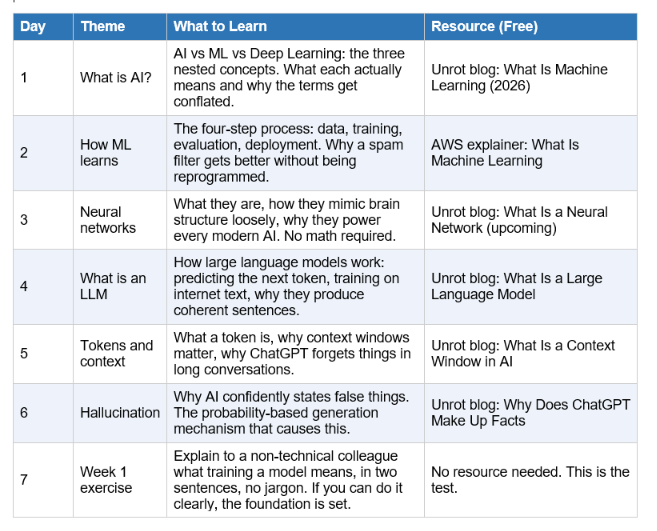
Week 1 (Days 1-7): How AI Actually Works. Concepts only, no tools yet. Machine learning, neural networks, large language models, tokens, training, hallucination, and the difference between AI types. This week exists because people who skip it spend months using AI tools badly and blaming the tools.
Week 2 (Days 8-14): The Tools Worth Your Time. Hands-on with ChatGPT, Claude, Perplexity, and NotebookLM. You will use each one for a specific real task, understand its strengths, and learn why the free tiers are more capable than most people realise.
Week 3 (Days 15-21): Using AI in Your Actual Work. Prompt engineering, writing workflows, research workflows, summarisation, and AI for your specific job function. This is where the plan gets personal.
Week 4 (Days 22-30): Going Deeper Without Getting Lost. RAG, AI agents, embeddings, fine-tuning, and AI safety. Not to build these systems. To understand them well enough to talk about them, evaluate claims about them, and know when they are being used on you.
Each day has one concept, one resource (free), and one practical action. The action takes under 10 minutes. The reading or watching takes under 20. You are done in 30 minutes.
Week 1 (Days 1-7): How AI Actually Works
The most important week. Every misunderstanding people have about AI, every hype claim they believe, every fear that is outsized, traces back to not understanding what AI actually is. Seven days is enough to fix that.
Week 2 (Days 8-14): The Tools Worth Your Time
Week 2 is hands-on. You will use four tools, one major task per tool, and develop real opinions about what each is actually good for. By the end of this week, you will have genuine experience rather than general impressions.
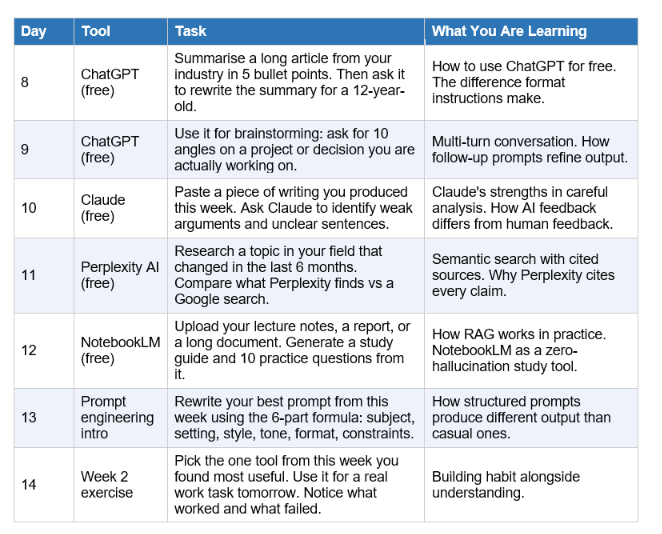
My honest take: most people who leave week 2 with one tool they use daily are ahead of 80% of their colleagues. The goal is not to master everything. It is to find one thing that saves you real time this month.
Week 3 (Days 15-21): Using AI in Your Actual Work
Week 3 is where the plan gets personal. The best AI learning happens when you use these tools on problems that actually matter to you, not on synthetic examples someone else designed. This week adapts to your job function.
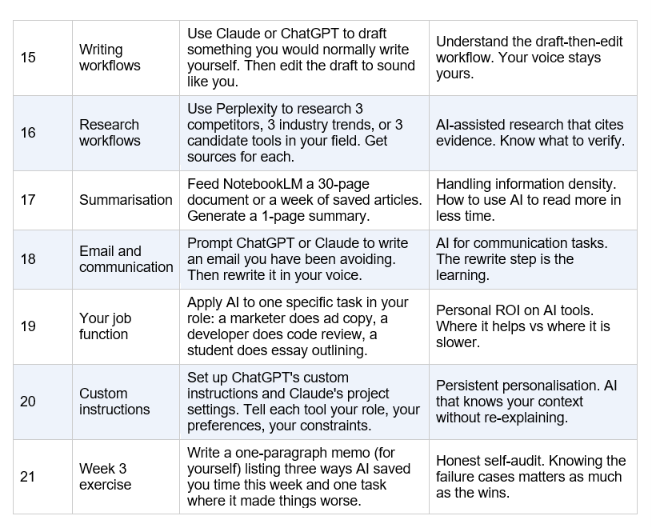
The week 3 exercise matters. The most valuable learning in this whole plan happens when you notice what the tools get wrong, not just what they get right. That is the judgment that separates someone who uses AI well from someone who uses it blindly.
Week 4 (Days 22-30): Going Deeper Without Getting Lost
Week 4 is conceptual again, but at a higher level. These are the topics you will encounter in every serious conversation about AI in 2026: RAG, agents, embeddings, fine-tuning, and AI safety. You are not building these systems. You are learning enough to understand them, evaluate claims about them, and know when they matter.
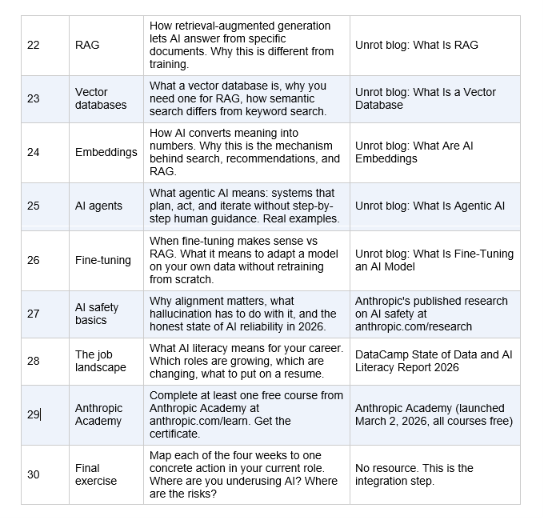
Day 29 is real: Anthropic Academy launched on March 2, 2026, offers 13 self-paced courses covering AI fluency, API development, and agent engineering, every one of them free, every one awarding a completion certificate. Its Higher Education Advisory Board is chaired by Rick Levin, former president of Yale and former CEO of Coursera. The certificates are recognised by employers and cost nothing.
The Free Resources Behind This Plan
Every resource in this plan is free. Here is the complete list:
Conceptual learning
Unrot: Five AI concepts per week, app and blog, no cost. The blog covers every topic in weeks 1 and 4 in beginner-accessible depth. unrot.co
Anthropic Academy: 13 free self-paced courses, certificates included. Covers AI fluency, Claude, API development, agents. Sign up at anthropic.com/learn
Andrew Ng's AI for Everyone (Coursera): The gold standard introduction to AI for non-technical professionals. Free to audit. Covers AI strategy, what ML can and cannot do, and how to think about AI at an organisational level.
Google AI Essentials (Google): Free short course covering generative AI fundamentals and practical tool use. No coding, no prerequisites. Available at grow.google
Hands-on tools (all free tiers used in this plan)
ChatGPT free tier: chatgpt.com, no account required for basic use
Claude free tier: claude.ai, account required, generous daily limits
Perplexity AI free tier: perplexity.ai, real-time search with citations
Google NotebookLM: notebooklm.google.com, completely free, no paid tier
Going further after day 30
Andrew Ng's Machine Learning Specialization (Coursera): If you decide to go technical. The most respected free ML course available, co-created with DeepLearning.AI. Free to audit.
Hugging Face NLP Course: Free, practical, hands-on with transformer models. The best free resource for understanding how LLMs actually work at the implementation level.
fast.ai: Top-down practical ML teaching. Builds working models first, then explains theory. Free.
What Comes After Day 30
Day 30 is not the finish line. It is the point where you know enough to choose your own direction. Here is how to think about what comes next, based on where you want to go.
If your goal is to use AI better at your current job: spend 30 more days building one specific AI workflow that saves you real time every week. Pick one repetitive task and automate it using ChatGPT or Claude with a well-crafted system prompt. Repeat until it is faster with AI than without.
If your goal is to move into an AI-adjacent role: the next step is building a visible portfolio. One project with a real use case, documented on GitHub or in a public post, is worth more than three more certificates. Employers in AI hire based on what you have built.
If your goal is to build AI products: you need Python, APIs, and RAG fundamentals. Andrew Ng's Machine Learning Specialization and the Hugging Face NLP course are both free and well-structured. Expect 3-6 months of consistent effort before you are building things you can ship.
If your goal is to stay informed: five minutes per day is enough. Unrot's app is literally built for this. One concept per session, no jargon, no commitment to a full course arc.
According to Global Tech Council, AI-related job postings grew over 60% year-over-year through 2025 and into 2026. The people who benefit from that growth are not necessarily those who took the most courses. They are the ones who started early, stayed consistent, and built real familiarity rather than credential collections.
Thirty days from now, you will not be an AI researcher. But you will understand more about what is reshaping every industry than most of the people in your field. That is a meaningful advantage, and it costs nothing but your time.
Frequently Asked Questions
Q: Can I actually learn AI in 30 days?
You can become genuinely AI-literate in 30 days at 30 minutes per day, which means understanding how machine learning, large language models, prompt engineering, RAG, and AI agents work, and using the major free AI tools confidently for real tasks. What 30 days will not get you is the ability to train models or build AI systems from scratch. That level of AI engineering takes 6-12 months of consistent effort. Most people asking this question need AI literacy, not AI engineering. The 30-day plan is designed for that goal specifically.
Q: Do I need coding skills to learn AI?
Not for AI literacy. The four weeks in this plan cover concepts and tool use, neither of which requires coding. You will use ChatGPT, Claude, Perplexity, and NotebookLM through their standard interfaces. If you decide after day 30 that you want to build AI systems or understand how models work at an implementation level, Python becomes necessary. For learning what AI is, how to use it in your work, and how to evaluate AI claims, no coding is needed.
Q: What is the best free AI course for beginners in 2026?
Andrew Ng's AI for Everyone on Coursera is the most respected free introductory AI course for non-technical learners and is free to audit. Anthropic Academy, launched March 2, 2026, offers 13 self-paced courses covering AI fluency through to developer-level topics, all free with completion certificates. Google AI Essentials is a short free course covering generative AI basics. For practical hands-on learning at 5 minutes per day, Unrot's app and blog are built for exactly this format.
Q: Is Anthropic Academy free?
Yes. Anthropic Academy, hosted at anthropic.com/learn, launched on March 2, 2026 and is entirely free. Every course awards a completion certificate at no cost. No Claude subscription is required. As of April 2026, the platform includes 13 self-paced courses covering AI fluency for beginners, Claude product training, developer API courses, and agent engineering. The Higher Education Advisory Board is chaired by Rick Levin, former president of Yale University and former CEO of Coursera.
Q: Is 30 minutes per day enough to learn AI?
For AI literacy, yes, if the 30 minutes are structured. Passive video watching is less effective than reading a focused concept, practising with a tool for 10 minutes, and reflecting on what you observed. This plan is built around that active pattern. Research on spaced learning consistently shows that daily short sessions produce better retention than infrequent long sessions. Thirty minutes every day for 30 days (15 hours total) is a meaningful investment that produces real, lasting understanding when applied to a well-structured curriculum.
Q: What should I learn first in AI?
Start with the distinction between AI, machine learning, and deep learning, then understand how machine learning actually learns (training on data rather than following hand-coded rules). From there, large language models and why they produce plausible-sounding text, then tokens and context windows, then hallucination and why it happens. This sequence, covered in days 1-6 of this plan, gives you the conceptual foundation that makes every subsequent topic faster to learn. Skipping to tools first is the most common mistake beginners make.
Q: How long does it take to become job-ready in AI?
Becoming job-ready depends on the specific role. For roles that use AI tools, such as AI-assisted marketing, operations, writing, or analysis, genuine proficiency takes 1-3 months of consistent practice. For technical roles building AI systems, 6-18 months is a realistic range depending on your existing programming and mathematics background. According to Global Tech Council, a software developer with existing skills may become productive with applied AI workflows in 3-6 months, while a complete beginner building from scratch needs 9-18 months for job-ready technical AI skills.
Q: What free resources should I use to learn AI after this plan?
After day 30, the best next steps depend on your direction. For deeper conceptual understanding: Anthropic Academy (free, certificates) and Andrew Ng's Machine Learning Specialization on Coursera (free to audit). For practical implementation: the Hugging Face NLP Course (free, covers transformer models hands-on) and fast.ai's courses (free, practical deep learning). For staying current with daily updates: Unrot's app (5 minutes per day, one concept per session, iOS and Android). For competition and project experience: Kaggle (free, real datasets, community notebooks).
Recommended Reads
Unrot teaches AI in 5 minutes a day. The app is the daily habit layer that keeps the 30-day plan going after day 30. Download it on iOS or Android at unrot.co.
References
• DataCamp -- State of Data and AI Literacy Report 2026
• Anthropic Academy -- Official Free AI Course Platform
• Labla.org -- Anthropic Just Launched a Free AI Academy: 13 Courses, Real Certificates
• AI Weekly -- How to Learn AI in 2026: The Complete Roadmap for Beginners
• Synapse -- Learn AI in 30 Days: A Free Curriculum (2026)
• Global Tech Council -- How Long Does It Take to Learn AI? (2026)
• GenAI Unplugged -- AI Learning Roadmap: Non-Technical Guide 2026
Coursera -- 30 Days of GenAI: A Beginner's Guide to Generative AI Tools (Free Video Series)