What Is Machine Learning? The Guide That Actually Makes Sense (2026)
Your spam filter hasn't been manually updated by an engineer in years. It just gets better on its own. That's machine learning — and it's the most important technology you've never been properly introduced to.
Right now, machine learning decides what you see on Instagram, whether your credit card transaction goes through, how Spotify knows you'll like that song you've never heard, and how ChatGPT turns your question into a coherent answer. It's not magic. It's math applied to patterns — and once you understand how it actually works, you'll start seeing it everywhere.
Most explanations of machine learning go one of two ways: too technical (gradient descent, loss functions, backpropagation) or too vague ("it's when computers learn like humans!"). This is neither of those. This is the explanation I'd give a smart friend who asked me at dinner.
The One-Paragraph Explanation
Machine learning is a way of building software that learns from data instead of being told every rule explicitly. Instead of a programmer writing: "if the email contains the word 'lottery' and was sent from an unknown address, mark it as spam" — they feed thousands of real spam emails and real non-spam emails to an algorithm, and the algorithm figures out the patterns itself. The result is a model that can classify new emails it has never seen before, based on what it learned from the examples.
That's the core idea: give the system data, let it find the patterns, and use those patterns to make predictions about new data. No manual rule-writing. No explicit programming for every scenario. The machine learns from experience, the same way you learned to recognise a dog without anyone ever handing you a formal definition of dog-ness.
The global machine learning market was valued at $120 billion in 2026 and is projected to grow to over $1.7 trillion by 2035, according to market research firm ResearchNester. That trajectory tells you something important: this is not a niche research discipline anymore. It's the engine running most of modern software.
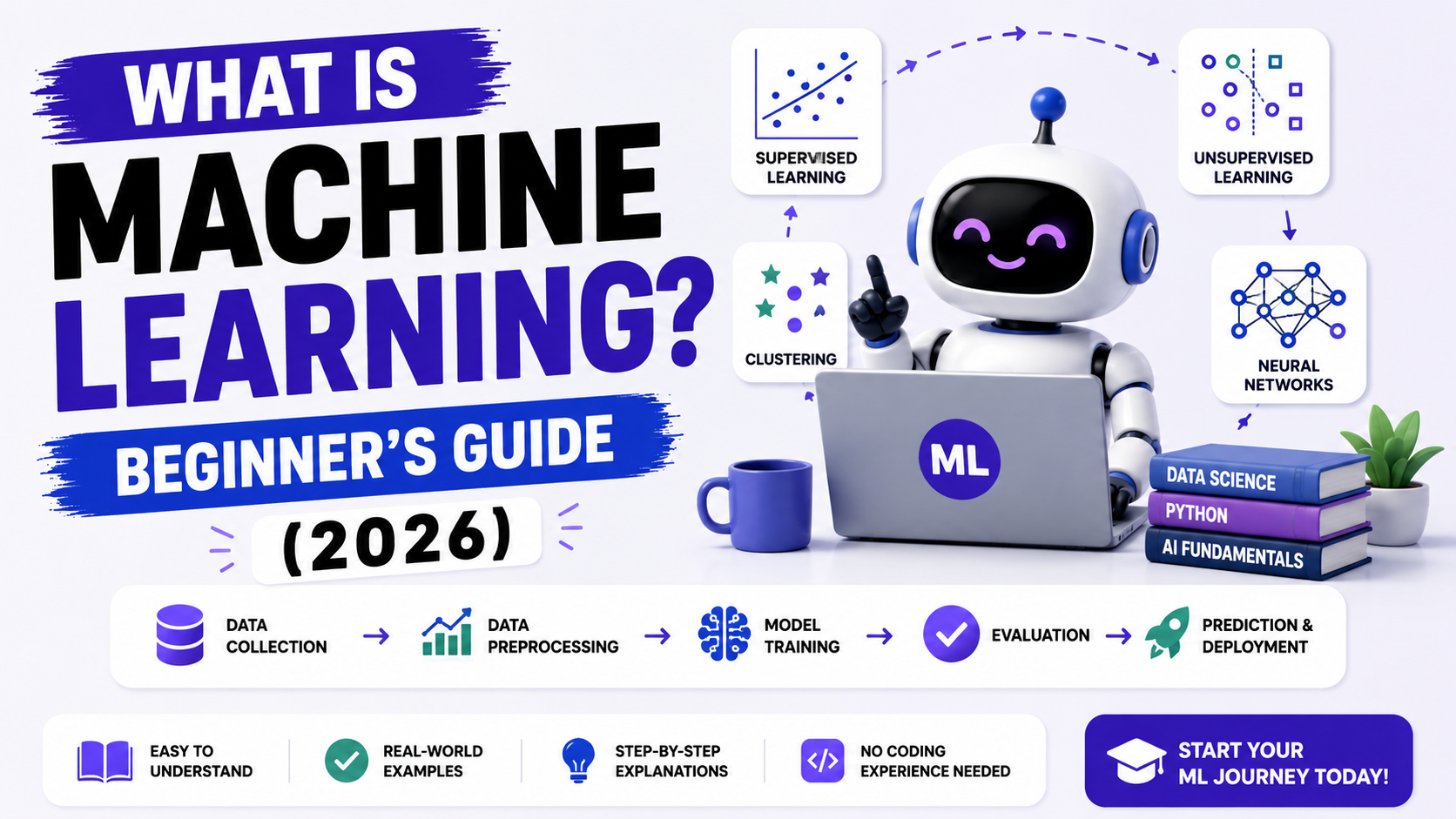
How Machine Learning Actually Works: The 4-Step Process
The concept is straightforward. The implementation can be complex. Here's the process broken down into four steps that make it concrete:
Step 1: Collect and prepare data
Every machine learning system starts with data. Lots of it. A fraud detection model needs millions of real transaction records. A speech recognition model needs thousands of hours of recorded audio. An image classifier needs hundreds of thousands of labelled photographs.
The data has to be clean and representative. Garbage in, garbage out is not a cliche in ML — it's the single most common reason models fail in practice. Data scientists spend 60-80% of their time cleaning, formatting, and labelling data before a single line of model code gets written.
Step 2: Choose a model and train it
A model is a mathematical structure that can learn relationships between inputs and outputs. You feed it the prepared data and run the training process, which involves the model making predictions, comparing them to the correct answers, measuring how wrong it was, and adjusting its internal parameters to be less wrong next time. This cycle repeats thousands or millions of times.
Think of it like a student doing practice exam questions. Each question is a data point. Each wrong answer is a signal to adjust understanding. By the end of enough practice questions, the student has internalised the pattern and can answer questions they've never seen before.
Step 3: Evaluate the model
Before deploying a model into the real world, you test it on data it has never seen before — called the test set, which is held back from the training process specifically for this purpose. This tells you whether the model has genuinely learned the pattern or whether it has just memorised the training data (a problem called overfitting).
This step is where most beginners' mental models break down. A model that scores 99% on training data but 60% on new data is useless. A model that scores 85% on both is actually useful. Evaluation on unseen data is the only honest measure of whether learning actually happened.
Step 4: Deploy and improve
Once the model passes evaluation, it goes into production. A spam filter starts classifying real emails. A fraud detection system starts screening real transactions. But the job doesn't end there — models degrade over time as the world changes (new spam techniques emerge, new fraud patterns appear). Keeping a model accurate means retraining it on fresh data regularly.
Your Gmail spam filter has been quietly doing all four of these steps, continuously, for over 20 years. Every time you manually mark something as spam or not spam, you're contributing training data to the next version of the model.
The Three Types of Machine Learning
Not all machine learning works the same way. The approach depends on what kind of data you have and what problem you're trying to solve. Here are the three main categories, each explained with a real example:
1. Supervised Learning — Learning with the Answer Key
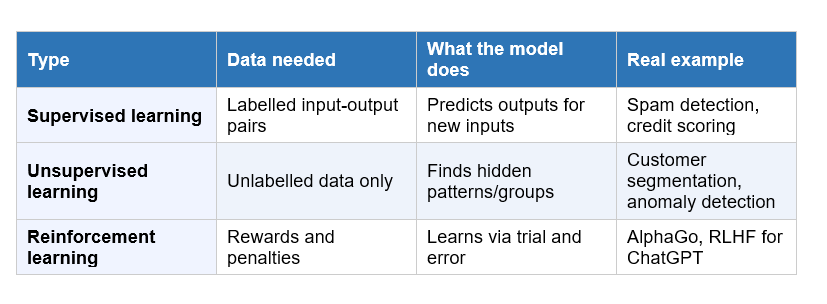
In supervised learning, you train the model on labelled data — data where every input already has a known correct output. The model learns the relationship between inputs and outputs, then uses that learned relationship to predict outputs for new inputs.
Examples of supervised learning you use every day:
Spam detection: labelled data = emails marked spam or not spam; prediction = is this new email spam?
Credit scoring: labelled data = past borrowers and whether they repaid; prediction = will this new applicant repay?
Disease diagnosis from scans: labelled data = medical images with confirmed diagnoses; prediction = what does this new scan show?
House price prediction: labelled data = past sale prices with property details; prediction = what should this house sell for?
Supervised learning is the most common type and the backbone of most commercial AI applications. When someone says their company uses ML, supervised learning is usually what they mean.
2. Unsupervised Learning — Finding Hidden Structure
In unsupervised learning, you give the model data with no labels and no correct answers. The model's job is to find structure — to discover groupings, patterns, or relationships that weren't explicitly defined.
Real examples:
Customer segmentation: a retailer feeds in purchase history with no predefined groups; the model discovers that customers naturally cluster into distinct personas (bargain hunters, loyal brand buyers, occasional splurgers)
Anomaly detection: a cybersecurity system learns what normal network traffic looks like, then flags anything that deviates significantly — no one defined "attack" explicitly
Recommendation systems: Spotify groups songs by similarity in listening patterns without anyone manually tagging musical genres
Unsupervised learning is harder to evaluate than supervised learning because there's no answer key to compare against. The model found clusters — but are they meaningful clusters? That requires human judgment to verify. It's powerful but messier.
3. Reinforcement Learning — Learning Through Trial and Error
In reinforcement learning, an agent learns by taking actions in an environment, receiving rewards for good outcomes and penalties for bad ones. It doesn't need labelled data. It needs a clear objective and a way to score progress toward it.
The classic analogy: training a dog. You don't give the dog a manual explaining what "sit" means. You reward the right behaviour and ignore or correct the wrong behaviour. Over thousands of repetitions, the right behaviour becomes automatic.
Real examples:
Game-playing AI: DeepMind's AlphaGo learned to play Go by playing millions of games against itself, receiving rewards for winning and penalties for losing — with no human games as training data
Robotics: robot arms learning to pick up objects by trying repeatedly and receiving feedback on success or failure
ChatGPT fine-tuning: a key part of the training process for GPT models involves reinforcement learning from human feedback (RLHF), where human raters score model outputs and the model is optimised to produce higher-rated responses
Reinforcement learning is why ChatGPT sounds human rather than robotic. The base language model learned from text data, but RLHF is what shaped its conversational style, tone, and tendency to be helpful rather than technically correct but socially jarring.
The Three Types at a Glance
Machine Learning vs AI vs Deep Learning: Clearing Up the Confusion
These three terms get used interchangeably in news coverage, job descriptions, and LinkedIn posts. They're not the same thing. Here's the actual relationship:
Artificial Intelligence (AI) is the broad field — any technique that allows machines to perform tasks that normally require human intelligence. This includes rule-based systems, expert systems, and machine learning.
Machine Learning (ML) is a subset of AI — specifically the approach where systems learn from data rather than following hand-coded rules. Almost all modern AI is built on ML, which is why the terms get conflated.
Deep Learning (DL) is a subset of machine learning — specifically ML using neural networks with many layers. Deep learning requires large amounts of data and significant compute, but it enables breakthroughs that shallower ML methods couldn't achieve: image recognition, language generation, voice synthesis.
The clean version: AI is the vision, ML is the method, deep learning is the most powerful version of that method. ChatGPT is an AI product, built using machine learning, specifically using deep learning (a large transformer neural network trained with supervised and reinforcement learning).
My honest take: the terminology confusion is mostly a media and marketing problem. Engineers working in the field rarely confuse these terms. But for someone learning the space, understanding the hierarchy saves a lot of confusion about what tools actually do and how they relate to each other.
Where Machine Learning Shows Up in Your Daily Life
Most people interact with machine learning dozens of times a day without recognising it. Here's what's actually happening behind the interfaces you use:
Your Gmail inbox: spam filtering, email categorisation (Primary/Social/Promotions), and the smart reply suggestions are all ML models trained on billions of emails.
Spotify Discover Weekly: a collaborative filtering model identifies users with similar listening patterns, then recommends what those similar users liked that you haven't heard yet. Your playlist is generated by ML every Monday with no human curation involved.
Your bank's fraud detection: when you tap your card in an unusual location and your bank doesn't call to verify, that's a supervised learning model that decided the transaction matched your normal pattern. When it does flag a transaction, that's the same model finding an anomaly. As of 2025, 75% of real-time financial transactions globally are monitored by ML fraud detection systems, according to iTransition.
Google Maps travel time: the "18 minutes" estimate comes from a model trained on billions of actual journeys, time of day, day of week, weather, and current traffic density. It's not a formula — it's a prediction from a trained model.
Face unlock on your phone: a computer vision model trained on thousands of facial images learned to recognise your face as distinct from all other faces. The model runs on-device in milliseconds every time you raise your phone.
ChatGPT responses: a large language model trained on internet-scale text data, fine-tuned with supervised learning on human-written demonstrations, and then refined with reinforcement learning from human feedback. Every coherent sentence it generates is a probability prediction from a deep learning model.
The machine learning market is already embedded in every major industry. Healthcare ML applications in the US grew 34% year-over-year in 2025, driven primarily by imaging diagnostics. Finance uses ML for fraud detection, credit scoring, and algorithmic trading. Manufacturing uses it for predictive maintenance to fix machines before they break rather than after. Retail uses it to forecast demand down to individual SKUs at individual store locations.
Nearly 88% of organisations now use AI in at least one business function, up from 55% just two years earlier, according to McKinsey data cited by Uvik Software. The people who understand what's happening under the hood are the ones who can build on it, audit it, and make decisions about whether to trust it.
What Machine Learning Still Gets Wrong
I'd be doing you a disservice if I only covered the strengths. Machine learning has real, well-documented failure modes that matter:
It inherits bias from its training data. A hiring algorithm trained on historical hiring data will learn to prefer candidates who resemble past hires. A medical diagnosis model trained primarily on data from one demographic group performs worse on others. The model doesn't invent bias — it amplifies whatever bias already existed in the data it learned from.
It can fail silently. Unlike a traditional software bug that crashes the program, a machine learning model that's performing poorly often just returns confident-sounding wrong answers. You need ongoing monitoring and evaluation to catch drift — the gradual degradation that happens as the world changes and the model's training data becomes less representative.
It doesn't understand causation. An ML model that discovers ice cream sales and drowning incidents are correlated might genuinely learn to predict one from the other — without understanding that both are caused by summer heat. This matters when you're using ML to make decisions, not just predictions.
It hallucinates. Language models in particular produce fluent-sounding text even when the underlying prediction is wrong. The model doesn't "know" things the way humans know things — it predicts likely token sequences based on patterns. That's why ChatGPT confidently cites papers that don't exist.
My take: none of these failures make machine learning less valuable. They make thoughtful use of machine learning more valuable. Understanding the failure modes is exactly what separates someone who builds something useful with ML from someone who builds something that causes harm.
How to Start Learning Machine Learning
The good news is that understanding machine learning conceptually — well enough to work with it, evaluate it, and make smart decisions about it — doesn't require a maths degree. The path depends on what you want to do with it.
If you want to understand it (no coding)
Start with the conceptual foundation: what it is, how the three types work, where it shows up. You're mostly there from reading this. The next step is building intuition about specific applications — how a recommendation system works, how a language model generates text, how fraud detection makes decisions. Unrot's app covers one concept per day in exactly this format.
If you want to use it (some coding)
Python is the universal language for ML work. Start with the Scikit-learn library, which implements all the standard ML algorithms in a clean, consistent API. A beginner can train their first classification model in 30 lines of code. Andrew Ng's Machine Learning Specialization on Coursera (co-created with DeepLearning.AI) is still the most recommended structured starting point as of 2026.
If you want to build with it (serious commitment)
A data science foundation (statistics, probability, linear algebra) plus Python fluency, then progressing through Scikit-learn, PyTorch or TensorFlow, and eventually to specific sub-fields like computer vision or NLP. This is a 6-12 month path for someone working consistently. The free courses from fast.ai are notable for teaching top-down — building working models first, then explaining the theory — which many people find more motivating than bottom-up textbook approaches.
One honest warning: the field moves fast enough that specific tools and libraries change regularly. The concepts in this article — supervised/unsupervised/reinforcement learning, training/evaluation/deployment, bias and failure modes — don't change. Build conceptual fluency first. Tool fluency follows.
Frequently Asked Questions
Q: What is machine learning in simple words?
Machine learning is a way to build software that learns from data instead of following pre-written rules. You show the system thousands of examples, it identifies the patterns, and it uses those patterns to make predictions about new data it hasn't seen before. Your spam filter, Netflix recommendations, and ChatGPT are all built this way.
Q: What is the difference between AI and machine learning?
Artificial intelligence is the broad field of making machines perform tasks that normally require human intelligence. Machine learning is one specific approach within AI, where systems learn from data rather than following hand-coded rules. Almost all modern AI is built using machine learning, which is why the two terms are often used interchangeably — but technically, ML is a subset of AI. Deep learning is a further subset of ML, using neural networks with many layers.
Q: What are the three types of machine learning?
Supervised learning uses labelled data where the correct answer is known, and trains the model to predict outputs for new inputs (spam detection, credit scoring). Unsupervised learning uses unlabelled data and finds hidden patterns or groupings without predefined categories (customer segmentation, anomaly detection). Reinforcement learning trains an agent through trial and error, using rewards and penalties as feedback (AlphaGo, RLHF for ChatGPT).
Q: Is ChatGPT an example of machine learning?
Yes. ChatGPT is a large language model built using multiple machine learning techniques. The base model was trained with self-supervised learning on internet-scale text data, then fine-tuned using supervised learning on human-written demonstrations, and finally shaped using reinforcement learning from human feedback (RLHF). Every response it generates is a prediction produced by a deep learning model — specifically a transformer neural network.
Q: What is the difference between machine learning and deep learning?
Machine learning is the broad category of systems that learn from data. Deep learning is a specific type of machine learning that uses neural networks with many layers (hence "deep"). Deep learning requires more data and more compute than traditional ML, but it can model much more complex patterns — which is why breakthroughs in image recognition, speech synthesis, and language generation all came from deep learning specifically. All deep learning is machine learning, but not all machine learning is deep learning.
Q: What is supervised learning vs unsupervised learning?
Supervised learning trains on labelled data — every example has a known correct answer. The model learns the mapping from input to output and can then predict outputs for new inputs. Unsupervised learning trains on unlabelled data, with no correct answers provided. The model discovers structure — groups, anomalies, or patterns — without being told what to look for. Supervised learning is more common in commercial applications because it's easier to evaluate. Unsupervised learning is more powerful for exploration when you don't know what patterns to expect.
Q: Do I need to know maths to understand machine learning?
To understand machine learning conceptually — how it works, what the different types are, where it's used, how to evaluate it — no. To build machine learning models from scratch, a working knowledge of statistics and linear algebra helps. To do cutting-edge ML research, advanced maths is necessary. Most practitioners work at the middle level: using libraries like PyTorch and Scikit-learn that handle the mathematics for you, while understanding enough to make good decisions about model choice, data preparation, and evaluation.
Q: How long does it take to learn machine learning?
Conceptual understanding — enough to have intelligent conversations and make good decisions about ML — takes 2 to 4 weeks of focused reading. Enough practical skill to build and deploy basic ML models takes 3 to 6 months for someone learning consistently with Python. Deep proficiency in a specific sub-field (computer vision, NLP, time series) takes 1 to 2 years of consistent practice. The most important variable isn't time — it's whether you build real projects or just follow tutorials.
Recommended Reads
• What Is a Large Language Model? Explained Simply
• How Are AI Models Trained? A Beginner's Guide With No Math
• What Is Fine-Tuning an AI Model? Plain-English Guide for Beginners
• What Is RAG? Retrieval-Augmented Generation Explained Simply
• What Is Agentic AI? Simple Guide for Beginners (2026)
• Learn AI From Scratch in 2026: Free Roadmap for Beginners
Unrot teaches AI in 5 minutes a day. One concept per session, zero jargon, built for people with actual jobs. Download the app if you'd rather learn this during your commute than sit through a course.
References
• IBM Think — What Is Machine Learning?
• IBM Think — AI vs Machine Learning vs Deep Learning vs Neural Networks
• MIT Sloan Management Review — Machine Learning, Explained
• Coursera — Deep Learning vs Machine Learning: A Beginner's Guide
• iTransition — Machine Learning Statistics 2026
• ResearchNester — Machine Learning Market Size, Share and Forecast to 2035
• Uvik Software — Machine Learning Statistics 2026
• DigitalOcean — Types of Machine Learning: Supervised, Unsupervised and More
• Google Cloud — Deep Learning vs Machine Learning vs AI
• GeeksforGeeks — Difference Between AI vs Machine Learning vs Deep Learning