What Is Agentic AI? A Beginner's Guide
Imagine telling your AI: "Book me flights to Goa for next weekend, find the best budget hotels, and email my manager that I'll be out." Then watching it actually do it. No follow-up prompts. No copy-pasting. Just done.
That's agentic AI. And it's not a future concept -- it's happening right now in 2026.
I've spent months tracking this space, and I can tell you: the shift from generative AI to agentic AI is the biggest leap in practical AI since ChatGPT launched. Most people still don't understand what it means. That's about to change.
What Is Agentic AI? (The Simple Version)
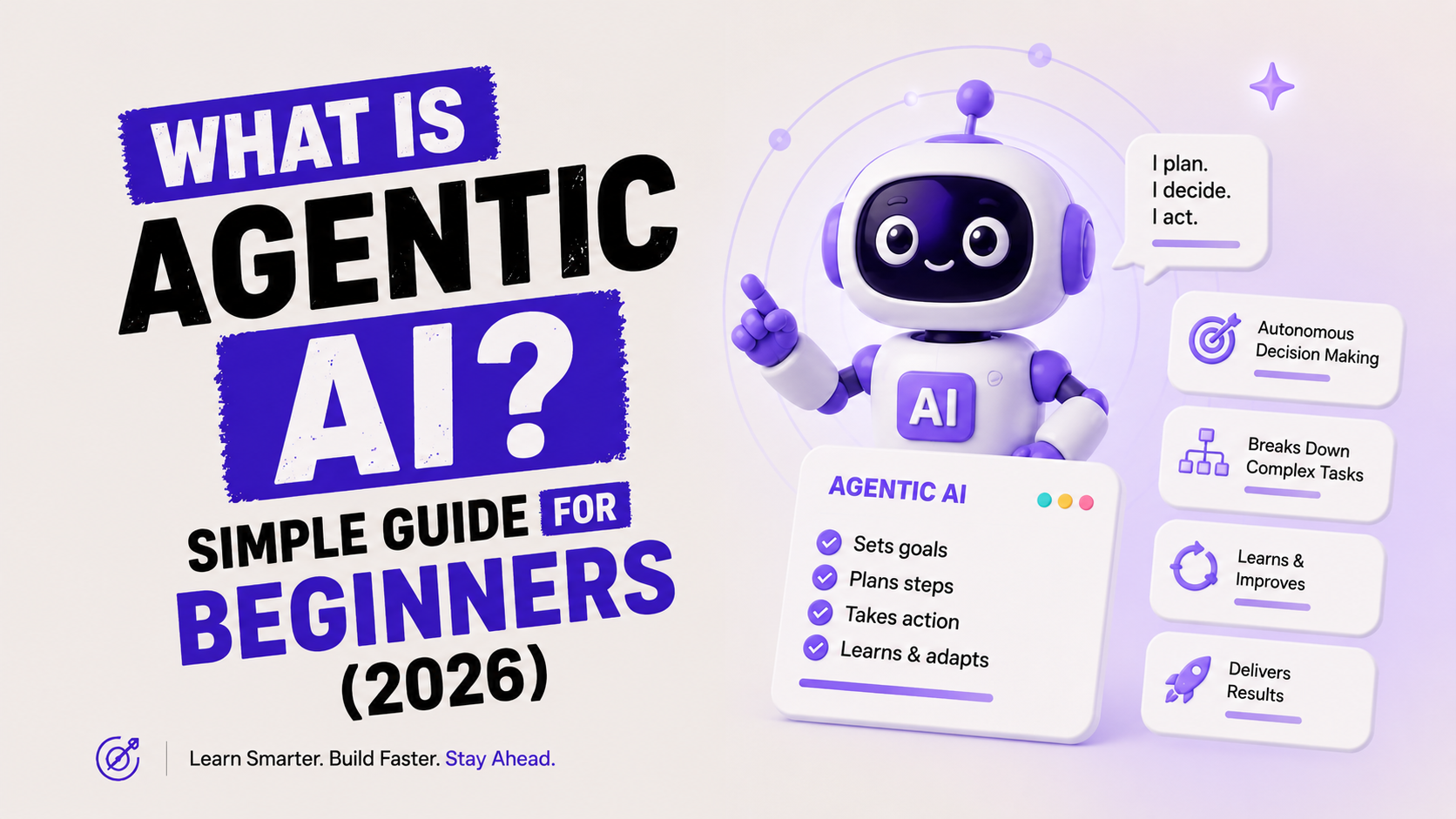
Agentic AI is artificial intelligence that can pursue goals on its own -- without needing a human prompt at every step. Give it a task, define the goal, and it plans, decides, acts, and adjusts until the job is done.
Regular AI tools like ChatGPT respond when you ask them something. Agentic AI flips that model. Instead of waiting for your input, it takes initiative. It uses tools, searches the web, runs code, calls APIs, sends messages, and makes decisions -- all in a loop, until the task is complete.
QUOTABLE DEFINITION
Agentic AI = AI that acts. It pursues goals, calls real tools, and adapts -- instead of just generating text.
A simple way to think about it: a calculator waits for you to press buttons. A robot accountant files your taxes, flags anomalies, and sends you a report. Agentic AI is the robot accountant.
The word "agentic" comes from agency -- the ability to act independently. And that's the key idea. These systems don't just know things. They do things.
How Agentic AI Works
Agentic AI operates in a loop. Understanding that loop is the key to understanding why it's so different from anything that came before.
Here's what happens inside a typical agentic AI system:
Perceive: The agent reads the goal and gathers context -- from files, databases, the web, your calendar, whatever it needs.
Plan: It breaks the goal into smaller steps and decides what to do first.
Act: It executes a step using real tools -- web search, APIs, code execution, browser control.
Observe: It reads the result. Did it work? Did something change?
Adjust and loop: Based on what it observed, it updates its plan and runs the next step.
This perceive-plan-act-observe loop is what makes agentic AI so powerful. It can handle tasks that break in unexpected ways, recover from errors, and adapt as circumstances change.
HOW IT WORKS
The key technical enablers are: large language models (LLMs) for reasoning, tool-use APIs to take real-world actions, and memory systems to retain context across steps.
IBM describes agentic AI as using "a digital ecosystem of LLMs, machine learning, and NLP to perform autonomous tasks on behalf of the user." What that means practically: these systems coordinate multiple AI models and tools the way a project manager coordinates a team.
Agentic AI vs. Generative AI: The Real Difference
This is the question I get asked most often, and the answer is cleaner than people expect.
Generative AI creates content. Agentic AI creates outcomes.
Generative AI - tools like ChatGPT, Claude, and Gemini - responds to prompts. You ask, it answers. Each interaction is largely independent. It's brilliant at drafting, summarizing, explaining, and generating. But it stops when you stop.
Agentic AI takes that reasoning power and adds the ability to act. It can send emails, book appointments, write and run code, browse the web, call external services, and chain those actions together toward a defined goal -- without you driving every step.
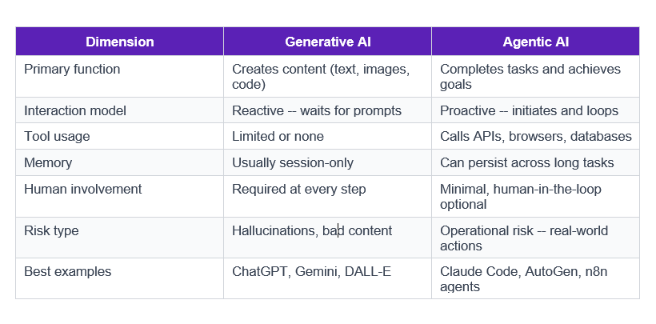
My take: these aren't competing technologies. Agentic AI uses generative AI as its brain. The LLM reasons about what to do next. The agentic layer actually does it. They're complementary -- and increasingly, the best tools combine both.
Is ChatGPT Agentic AI?
Short answer: not exactly. But the line is blurring.
ChatGPT is primarily a generative AI. IBM puts it clearly: while ChatGPT has "similar creative abilities to agentic AI, it isn't the same. Agentic AI is focused on decisions as opposed to creating actual new content, and doesn't solely rely on human prompts nor require human oversight."
That said, OpenAI has been building agentic capabilities into ChatGPT. With memory, browsing, code execution, and the new Operator and Tasks features, ChatGPT is moving toward the agentic end of the spectrum.
KEY CONCEPT
Agenticness is a spectrum, not a yes/no. A pure chatbot scores near zero. A fully autonomous system managing complex enterprise workflows scores at the top. Most real tools sit somewhere in the middle.
OpenAI's GPT-5.5 model (released in 2026) is explicitly designed for agentic tasks -- planning, tool use, memory management, and sequential decision-making without constant human input. So "is ChatGPT agentic?" is becoming more true every month.
The better question is: how agentic is the specific tool or configuration you're using?
5 Types of Agentic AI
Not all agents are built the same. Researchers and practitioners generally group agentic AI into these five categories:
1. Reactive Agents
The simplest type. These agents respond to real-time inputs without memory or planning. They observe the environment and pick an action from a predefined set. A spam filter is a classic reactive agent -- it sees email, classifies it, acts.
2. Deliberative Agents
These build an internal model of the world, plan sequences of actions, and reason about consequences before acting. They're slower but more capable. Most LLM-based agents today are partially deliberative -- they reason through steps using chain-of-thought.
3. Learning Agents
These agents improve over time. They observe outcomes, update their internal models, and get better at achieving goals. Reinforcement learning from human feedback (RLHF) -- what made ChatGPT so good -- is one form of this.
4. Multi-Agent Systems
Multiple specialized agents work together, each handling one part of a larger task. A supervisor agent might coordinate a researcher agent, a writer agent, and a formatter agent. CrewAI and AutoGen are built specifically for this model.
5. Hybrid Agents
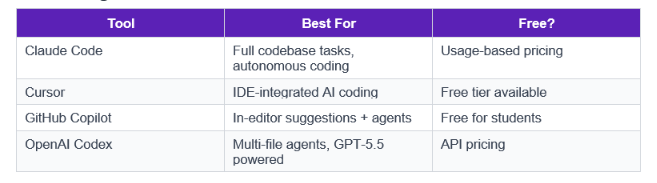
Most production agentic systems are hybrids -- combining reactive speed with deliberative reasoning, learning from feedback, and often coordinating multiple specialized sub-agents. Claude Code and OpenAI's Codex are good examples.
Real-World Examples of Agentic AI in 2026
Here's where agentic AI stops being abstract and becomes genuinely interesting.
Software engineering: Claude Code reads a codebase, understands the goal, writes multi-file changes, runs tests, fixes failures, and submits a pull request. A developer reviews the output, not every keystroke.
Customer support: An agentic system triages support tickets, writes responses, escalates critical cases, and closes resolved tickets -- without a human in the loop for routine queries.
Sales outreach: An agent researches prospects, personalizes emails based on their LinkedIn data, schedules follow-ups, and updates the CRM -- all autonomously.
Research: In 2026, agentic AI runs literature reviews across millions of scientific papers, synthesizes findings, and drafts research summaries.
Finance: Agents monitor investment portfolios, rebalance based on predefined rules, and flag anomalies for human review.
Personal productivity: Claude Cowork (Anthropic's desktop tool) can organize files, extract data from PDFs into spreadsheets, and draft summaries -- watching your local file system and taking action.
GARTNER DATA POINT
According to Gartner's 2026 Hype Cycle, agentic AI is currently at the Peak of Inflated Expectations. Only 17% of organizations have deployed agents to date, yet more than 60% expect to within two years -- the most aggressive adoption curve among all emerging technologies surveyed.
Best Agentic AI Tools in 2026 (Free + Paid)
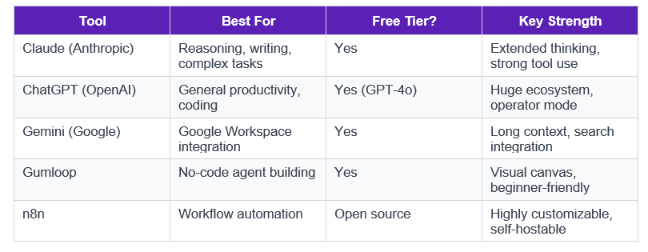
The tools market has exploded. Here are the ones actually worth your time, organized by use case.
For General Use (Personal + Professional)
For Coding
For Enterprises
UiPath: End-to-end enterprise automation with agentic AI. Strong governance and audit trails.
Salesforce Agentforce: CRM-native agentic AI for sales, service, and marketing workflows.
IBM Watsonx: Enterprise-grade AI platform with strong compliance features.
Microsoft AutoGen + Azure: Multi-agent orchestration with deep enterprise integration.
My honest take: if you're just starting out, Claude's free tier or Gumloop's no-code builder is the fastest way to experience agentic AI without writing a single line of code. For developers, Claude Code or n8n give you serious power with real flexibility.
Top Agentic AI Frameworks for Developers
If you're building agentic systems rather than just using them, these are the frameworks driving the ecosystem in 2026.
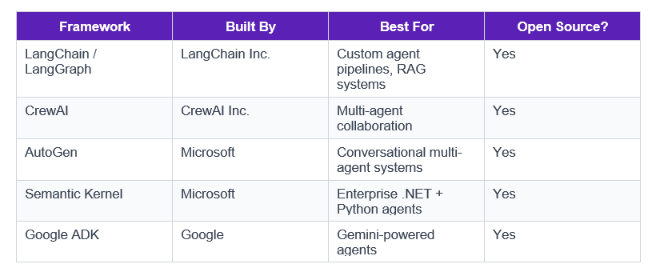
LangChain remains the most popular starting point for custom agents. CrewAI has become the go-to for multi-agent setups where you want specialized sub-agents working together. Microsoft's AutoGen is strong in enterprise settings where security and compliance matter.
Who Is Leading in Agentic AI?
The race is genuinely competitive, which is exciting.
Anthropic: Claude models consistently rank among the best for tool use and instruction-following. Claude Code, Claude Cowork, and the MCP (Model Context Protocol) ecosystem position Anthropic strongly for agentic applications. The Claude 4.x family is built with agentic workflows as a primary use case.
OpenAI: GPT-5.5 is explicitly designed for agentic work. Their Operator mode (computer-using agents) and Codex agent push the frontier of what autonomous systems can do.
Google: Gemini's long context window and deep Google Workspace integration make it strong for enterprise agentic workflows.
Startups: The 2026 Agentic List identifies 120 promising private companies building enterprise-grade agentic AI. The space is fragmented in the best way -- lots of specialized tools solving real problems.
My contrarian take: the "which model is best" debate misses the point. The real winner in agentic AI isn't the model -- it's the orchestration layer. The teams building the best agent infrastructure (memory, tool integration, governance) will matter more than raw model capability.
Risks and Things to Watch Out For
I'd be doing you a disservice if I only talked about the upside. Agentic AI introduces risks that generative AI simply doesn't have.
Operational risk: Unlike a chatbot that says something wrong, an agent can do something wrong -- send an email, delete a file, trigger a transaction. Governance matters.
Prompt injection: Malicious content embedded in web pages or documents can hijack an agent's behavior. This is a top security concern in 2026.
Agent washing: Vendors are slapping "agentic" on basic chatbots and workflow tools. Ask: does it actually run a planning loop? Does it call external tools? Does it adapt to failures?
Over-trust: The biggest mistake I see beginners make is giving agents too much autonomy too fast. Start narrow. Give the agent a specific, bounded task. Expand as you build trust in its behavior.
PRACTICAL ADVICE
Start with one well-designed agent doing a specific task. That's more valuable than five half-built ones running loose.
FAQ: Agentic AI Questions, Answered
Q: What is agentic AI in simple terms?
Agentic AI is AI that can complete tasks autonomously without needing a human to guide every step. You give it a goal -- like "research and book flights for my trip" -- and it plans, acts, adjusts, and finishes the task on its own using real tools and data.
Q: What is the difference between agentic AI and generative AI?
Generative AI creates content when prompted -- text, images, code. Agentic AI takes those capabilities and adds autonomy: it can execute multi-step tasks, use external tools, make decisions, and adapt to changing circumstances without constant human input.
Q: Is ChatGPT an agentic AI?
Not traditionally, but OpenAI is adding agentic capabilities. Standard ChatGPT is generative -- it responds to prompts. But with operator mode, memory, and code execution, newer versions inch toward agentic behavior. GPT-5.5, released in 2026, is explicitly designed for agentic tasks.
Q: What are examples of agentic AI?
Real examples include Claude Code (which autonomously writes, tests, and debugs software), Salesforce Agentforce (which runs customer service workflows), n8n agents (which automate business processes), and computer-using agents from OpenAI and Anthropic that control browsers and applications directly.
Q: What are the best free agentic AI tools?
For beginners: Claude's free tier, ChatGPT free, and Gumloop's no-code builder. For developers: n8n (open source, self-hostable), LangChain (open source framework), and CrewAI (open source multi-agent framework). Most major tools offer a free tier to start.
Q: What are the 5 types of agentic AI?
The five main types are: (1) Reactive agents that respond to inputs without memory, (2) Deliberative agents that plan and reason, (3) Learning agents that improve over time, (4) Multi-agent systems where multiple AI agents collaborate, and (5) Hybrid agents combining multiple approaches.
Q: Which model is best for agentic AI?
In 2026, Claude Opus 4.6 (Anthropic) and GPT-5.5 (OpenAI) are the top performers for agentic tasks. Claude consistently ranks high for tool use and instruction-following. The right choice depends on your use case, budget, and existing infrastructure.
Q: What are the top agentic AI frameworks?
The leading frameworks are LangChain/LangGraph, CrewAI, Microsoft AutoGen, Semantic Kernel, Google ADK, and the OpenAI Agents SDK. LangChain is most popular for custom builds. CrewAI excels at multi-agent collaboration. AutoGen is strong in enterprise contexts.
Keep Learning: Related Reads on Unrot
The best time to start learning AI was yesterday. The second best time is right now.
Unrot teaches AI in 5 minutes a day. Most people fail at AI because they learn randomly. A consistent daily habit changes that.
Start learning at unrot.co -- iOS and Android available.
References
IBM Think -- What is Agentic AI:
Gartner 2026 Hype Cycle for Agentic AI:
Agentic.ai -- What Is Agentic AI (2026):
Databricks -- Agentic AI vs Generative AI:
UiPath -- Adopting Agentic AI in 2026:
AWS -- Agentic AI vs Generative AI (SMB Guide):
Berkeley RDI Agentic AI Summit 2026:
CIO.com -- How Agentic AI Will Reshape Engineering in 2026:
arXiv -- Agentic AI Frameworks: Architectures, Protocols, and Design Challenges:
Salesforce -- Agentic AI vs Generative AI:
unrot.co -- AI microlearning, 5 minutes a day ( iOS | Android )