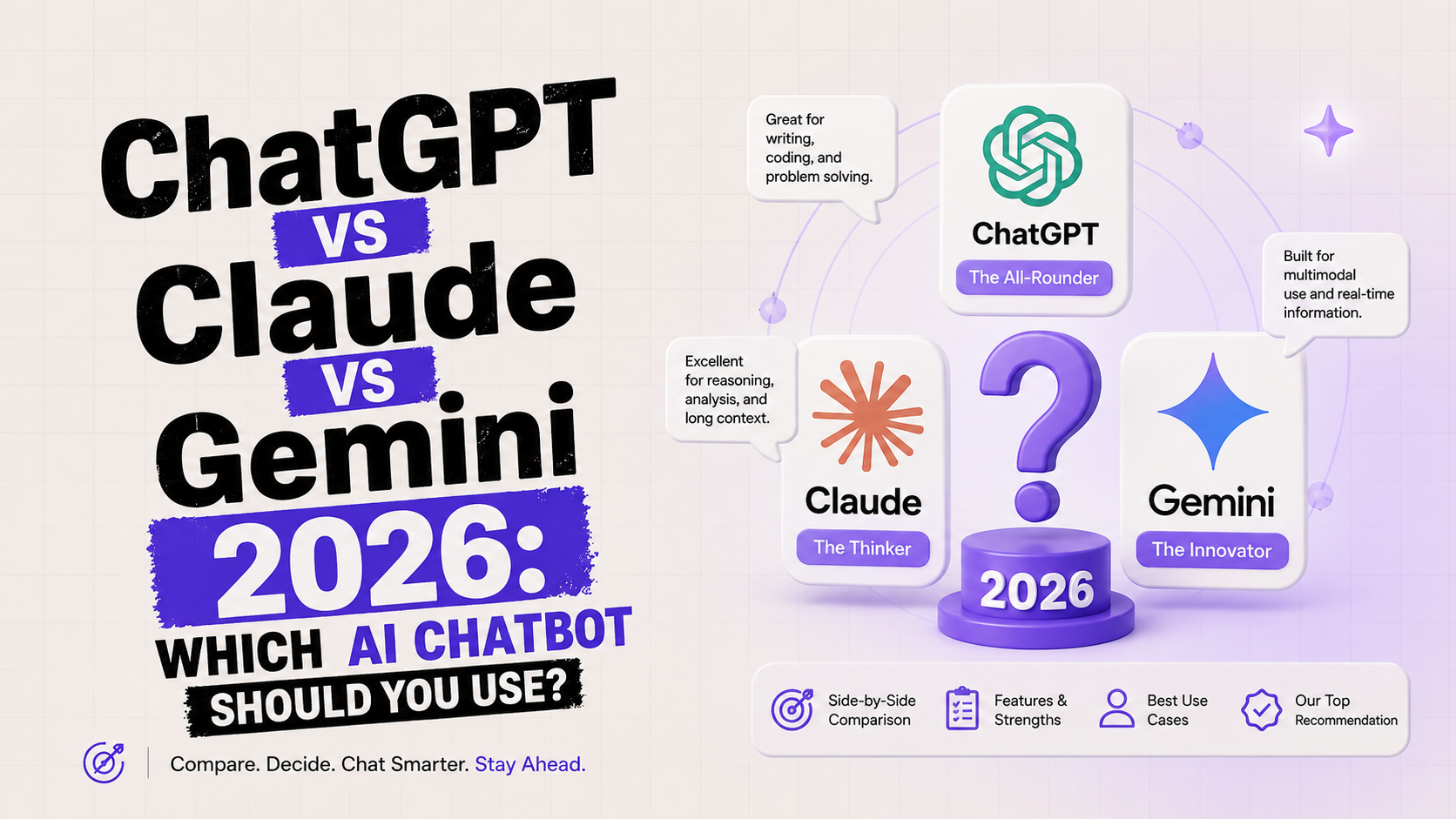
ChatGPT vs Claude vs Gemini (2026): Which AI Should You Actually Use?
I have a confession. I use all three of them. ChatGPT for certain things. Claude for others. Gemini when I need something specific. And that is exactly the honest answer most comparison articles refuse to give you.
Every guide you will find right now either picks a winner to get clicks, or tells you they are all the same so nobody gets upset. Neither is true in 2026. These three models have genuinely different strengths. And if you pick the wrong one for your main use case, you are leaving real capability on the table.
I am going to give you the real breakdown: what each AI is actually good at, what each one gets wrong, which one wins for beginners, which one wins for work, which one wins on free tier, and my honest final recommendation.
Let me be upfront: I have a bias. I am writing this for Unrot, which is built on Anthropic's Claude. So I will be especially careful to be honest about where ChatGPT and Gemini genuinely win. You deserve the real picture, not a Claude ad.
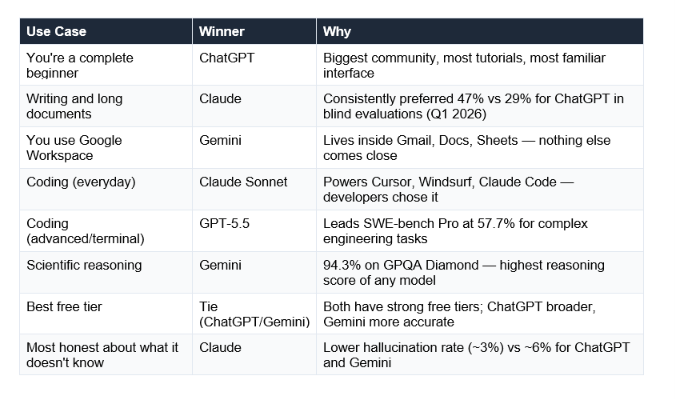
The Quick Answer (If You Just Want a Verdict)
If you only have 30 seconds:
Now let me explain why, so you actually understand the decision and can update it as these tools evolve.
What They Actually Are (The Real Differences Under the Hood)
Most AI comparison articles treat these three as interchangeable chatbots with slightly different personalities. That misses something important. They are built by different companies, for different primary purposes, and those origins shape everything about how they behave.
ChatGPT (OpenAI)
ChatGPT launched in November 2022 and is still the most-used AI tool in the world by a significant margin. SimilarWeb data from January 2026 shows ChatGPT at 64.5% of global AI chatbot web traffic, versus Gemini at 21.5%. As of May 2026, it runs on GPT-5.5, with GPT-5.5 Pro available on the $200/month tier.
OpenAI built ChatGPT to be a generalist. It is designed to handle the widest range of tasks — writing, coding, image generation, data analysis, voice conversations, web search — reasonably well. It is not always the best at any single category, but it rarely fails completely at anything.
Claude (Anthropic)
Claude was built by Anthropic, a company founded explicitly around AI safety. That origin matters: Claude is designed to be careful, honest about uncertainty, and less likely to confidently produce wrong answers. The current flagship is Claude Opus 4.7 (May 2026), with Claude Sonnet 4.6 being the workhorse model most people use.
Where Claude distinguishes itself is in writing quality, long document handling, and coding. In blind human evaluations in Q1 2026, Claude-generated content was preferred 47% of the time versus 29% for GPT-5.4 and 24% for Gemini. Professional writers, editors, and documentation teams consistently rank Claude's output as more natural and better structured.
Gemini (Google DeepMind)
Gemini is Google's AI, and Google's strategic advantage is obvious: they have the world's best search engine, the world's most used productivity suite (Google Workspace), and one of the most capable research labs. Gemini 3.1 Pro (February 2026) leads every published reasoning benchmark in May 2026, including 94.3% on GPQA Diamond (graduate-level science questions) — the highest reasoning score of any model.
Where Gemini wins definitively: if your life runs on Gmail, Docs, Sheets, and Drive, Gemini is the only AI that lives inside those tools. Nothing else matches that level of integration.
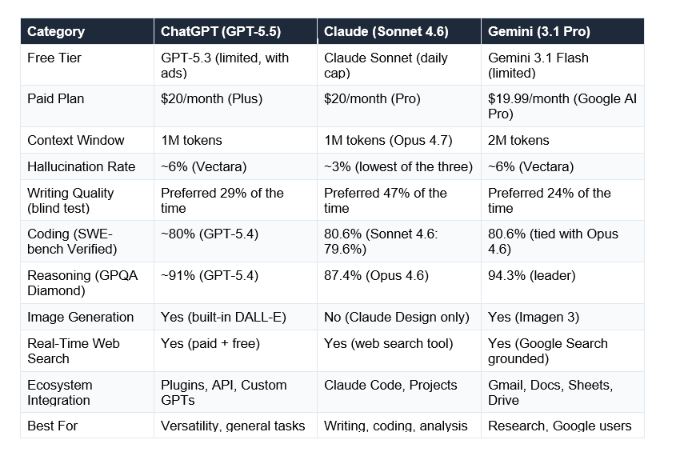
The Master Comparison Table (May 2026)
All data sourced from independent benchmarks, pricing pages, and real user testing as of May 2026.
ChatGPT: What It Is Genuinely Best At
ChatGPT's main strength is breadth. It handles more tasks in one interface than any competitor. Image generation (DALL-E built in), voice mode, web search, code execution, file analysis, Custom GPTs — it is the Swiss Army knife of AI tools in 2026.
Reddit's AI communities, which aggregate millions of daily users, consistently describe ChatGPT as 'the best all-rounder. If you only use one AI tool, this is it.' That verdict is earned. The ecosystem is unmatched: thousands of Custom GPTs, a massive prompt library, and more tutorials than any other tool. If something goes wrong with ChatGPT, there are 10 forum threads already explaining the fix.
ChatGPT wins on:
Versatility: handles creative writing, data analysis, image generation, voice, research, and code in one place
Ecosystem: Custom GPTs, plugin integrations, and the most extensive third-party tooling of any AI platform
Community: 4.2 million members on r/ChatGPT — if you are stuck, someone has already solved it
Accessibility: the most familiar interface for people who are new to AI tools in 2026
Advanced reasoning modes: GPT-5.5 with extended thinking for hard multi-step problems
Where ChatGPT is weaker:
Writing quality: in blind evaluations, human judges preferred ChatGPT 29% of the time vs Claude's 47%
Hallucination rate: ~6% on factual queries (twice Claude's rate)
Free tier now shows ads (introduced February 2026)
Context window is 1M tokens — same as Claude, but smaller than Gemini's 2M
My honest take on ChatGPT: It is the safest default for beginners because of the ecosystem and community. But once you know what you want to do with AI, the specialized tools often win. ChatGPT is the best starting point. It is not always the best destination.
Claude: What It Is Genuinely Best At
Claude is the AI I personally reach for when the output actually matters. Not because it is the most powerful on every benchmark, but because of something harder to measure: it produces output that sounds like a thoughtful human wrote it, and it is more honest about what it does not know.
In Q1 2026, independent blind evaluations across writing tasks found Claude-generated content preferred 47% of the time, versus 29% for GPT-5.4 and 24% for Gemini. That gap is not close. For long-form writing — reports, articles, documentation, emails — Claude consistently produces cleaner structure, better tone, and more natural flow than the alternatives.
On coding, Claude powers the three tools that professional developers use most: Cursor, Windsurf, and Claude Code. 53% of developers surveyed in early 2026 use Claude as their primary AI for coding. That is a market preference that benchmarks alone do not explain — it is developers saying, through their daily choices, that Claude's outputs require less correction.
Claude wins on:
Writing quality: consistently preferred in blind human evaluations by a wide margin
Honesty: ~3% hallucination rate on factual queries, lowest of the three major models
Long documents: Projects feature lets you build context across multiple files and conversations
Coding: powers Cursor, Windsurf, Claude Code — the developer community voted with their tools
Instruction following: better at adhering to complex style guides and formatting requirements
Where Claude is weaker:
No native image generation (Claude Design does layout and prototypes, but not generated images)
The flagship Opus 4.7 model requires the $100/month Max plan — the $20 Pro plan gets Sonnet 4.6
Smaller plugin/integration ecosystem vs ChatGPT
My honest take on Claude: If you write anything for work — emails, reports, proposals, content — Claude is genuinely better than the alternatives. The writing quality difference is noticeable and consistent. For most professionals, this alone justifies trying it.
Gemini: What It Is Genuinely Best At
Gemini's strongest card is one that sounds boring until you actually use it: it lives inside the tools you already use. If your day runs on Gmail, Google Docs, Google Sheets, and Google Drive, Gemini is already there. Not as a tab you switch to. Inside the document you are editing.
No other AI platform matches this integration. ChatGPT and Claude require you to copy, paste, switch tabs, reformulate the question. Gemini can see your draft directly and suggest changes in place. For people who live in Google Workspace — which is a majority of office workers globally — that workflow difference is enormous.
On benchmarks, Gemini 3.1 Pro (released February 19, 2026) leads on scientific reasoning with a 94.3% score on GPQA Diamond — graduate-level physics, chemistry, and biology questions. That is 3 points above Claude Opus 4.6 and the highest reasoning score of any model as of May 2026. For research workflows, data analysis, and anything that requires understanding complex source material, Gemini's reasoning is genuinely exceptional.
Gemini wins on:
Google Workspace integration: native in Gmail, Docs, Sheets, Slides, Meet — no switching needed
Context window: 2M tokens — the largest of the three, useful for processing entire books or codebases
Scientific reasoning: 94.3% GPQA Diamond, leading all models as of May 2026
Real-time information: Google Search grounding means less outdated information than competitors
Multimodal capability: processes text, images, audio, and video natively — the most complete multimodal package
Cost efficiency: $2/$12 per million API tokens — cheapest frontier model for developers
Where Gemini is weaker:
Writing quality: preferred only 24% of the time in blind human evaluations — noticeably behind Claude
Consistency: sometimes gives different answers to the same question across sessions
Outside Google Workspace: significantly less useful if you do not use Google tool
My honest take on Gemini: If you live in Google Workspace, this is not a close decision — Gemini wins. If you do not, the Google integration advantage disappears and you should evaluate writing quality and coding performance instead, where Claude and ChatGPT are stronger.
What About Grok, DeepSeek, Meta AI, and Perplexity?
The question you sent included Grok, DeepSeek, and Perplexity — and that is the right instinct. In 2026, the AI landscape is genuinely broader than the Big Three. Here is the short version:
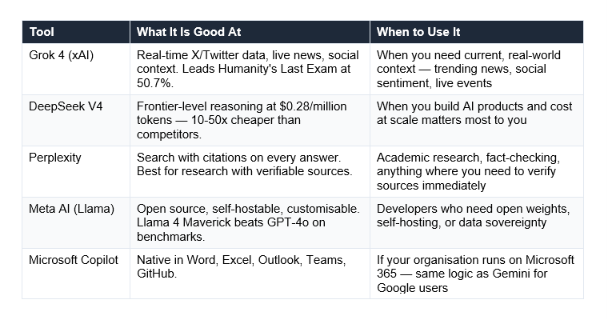
For a complete beginner who just wants to understand AI, I would focus on the Big Three first. They are the most documented, the most supported, and the safest starting points. Once you have a handle on what AI can do for you, branching into Perplexity or DeepSeek becomes a natural progression.
Which AI Should Beginners Use?
If you are brand new to AI, you have probably heard of ChatGPT and nothing else. That is actually a fine starting point. ChatGPT holds about 65% of the global AI chatbot market for a reason: it is the most widely documented, has the largest community, and the interface is the most familiar.
My actual recommendation for beginners: start with ChatGPT free, then try Claude free within your first week. The free tiers of both are genuinely good in 2026. You will quickly notice what you use AI for — and once you know that, picking a tool is much easier.
The beginner trap: Most people start with one AI and never try the others, assuming they are all the same. They are not the same. Spending 20 minutes with all three on the same task is more valuable than reading 10 articles about them.
Here is a 3-step beginner test I recommend:
Step 1: Paste the same 300-word email or document into all three. Ask each to improve it. Compare the outputs.
Step 2: Ask all three the same factual question on something you know well. Check which one gets it right, and which one sounds most confident while being wrong.
Step 3: Ask all three something you genuinely want to learn. Which explanation felt clearest? That is your model.
Which AI Is Best for Work?
This depends entirely on what kind of work you do. The honest answer is a simple lookup table:
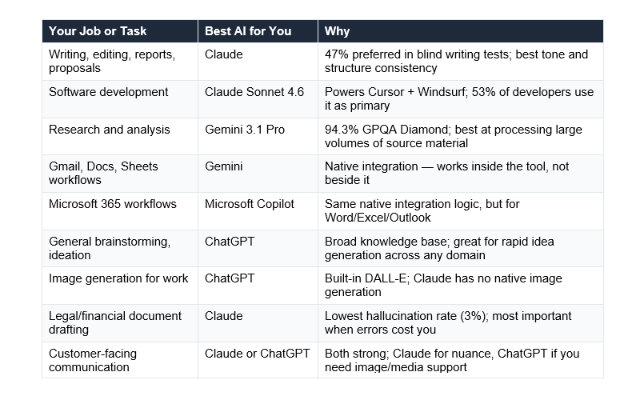
The most productive professionals in 2026 are not loyal to one tool. They have a primary AI (usually the one that fits their main workflow) and use the others for specific tasks. The paid tiers are all $20/month — using one does not prevent you from trying the others on free tiers.
Which AI Is the Best Free Option in 2026?
The free tier war is real, and the 2026 verdict is good news for everyone wh
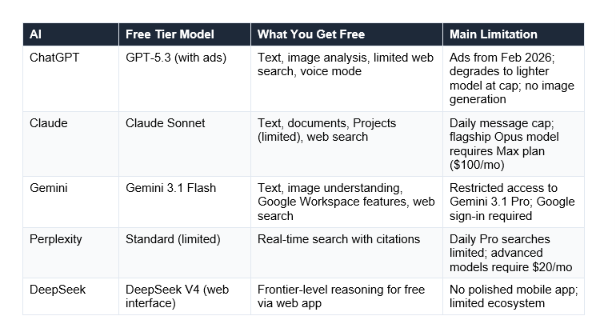
My free tier recommendation for most people: use ChatGPT for general tasks and try Claude for anything involving longer writing or documents. Both free tiers are genuinely capable. The single biggest benefit of the paid tiers in 2026 is higher usage limits, not dramatically better models.
The Verdict: Which AI Wins?
I promised an honest answer, so here it is. There is no single winner. That is not a cop-out — it is the actual situation in 2026, and anyone who tells you otherwise is either simplifying for clicks or has a paid relationship with one of these companies.
What I can give you are honest use-case verdicts:
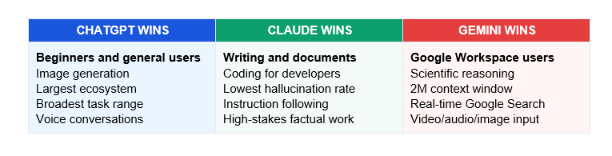
If I had to pick one for a person who had never used AI before: ChatGPT free for a week, then Claude free for a week. After those two weeks, you will know which one feels right for the things you actually use AI for. That is more useful than any article, including this one.
Frequently Asked Questions
Q: Which is the No. 1 AI app in 2026?
By market share and global usage, ChatGPT is the No. 1 AI app in 2026, holding approximately 64.5% of AI chatbot web traffic according to SimilarWeb (January 2026). However, 'best' depends on use case: Claude leads for writing and document work, Gemini leads for scientific reasoning and Google Workspace integration.
Q: Is Claude better than ChatGPT?
Claude is better for writing quality and accuracy. Independent blind evaluations in Q1 2026 found Claude-generated content preferred 47% of the time versus 29% for ChatGPT. Claude also has a lower hallucination rate (~3% vs ~6%). ChatGPT is better for general versatility, image generation, and ecosystem breadth. Neither is universally 'better.'
Q: Which AI chatbot is better — Gemini or ChatGPT?
Gemini is better for Google Workspace integration, scientific reasoning (94.3% GPQA Diamond, vs ~91% for ChatGPT), and has a larger 2M token context window. ChatGPT is better for general-purpose use, image generation, creative tasks, and has a larger ecosystem. If you use Google tools daily, Gemini wins. For everything else, ChatGPT has broader capability.
Q: What is the best free AI tool in 2026?
All three major AI chatbots have useful free tiers in 2026. ChatGPT Free gives access to GPT-5.3 with text, limited web search, and voice (with ads from February 2026). Claude Free gives access to Claude Sonnet with high-quality writing outputs. Gemini Free gives access to Gemini 3.1 Flash with Google Workspace integration. For no technical background: start with ChatGPT or Claude free.
Q: Which AI is best for beginners with no tech background?
ChatGPT is the most beginner-friendly starting point due to its massive community, tutorial ecosystem, and familiar interface. However, Claude's writing quality makes it worth trying within the first week. Both are free to start. The best approach is to try both on a real task you care about — writing an email, summarising something, asking a question — and see which output feels more useful.
Q: What are the Big 4 or Big 5 AI models in 2026?
The de facto Big 4 in 2026 are OpenAI (GPT/ChatGPT), Anthropic (Claude), Google DeepMind (Gemini), and xAI (Grok). A fifth tier is emerging with DeepSeek and Meta's Llama models offering frontier-competitive performance at dramatically lower cost or open-source availability. The landscape is more competitive than at any point previously.
Q: Which AI model hallucinates the least?
Claude has the lowest hallucination rate among the three major consumer AI models in 2026, estimated at approximately 3% on factual queries. GPT-5.5 and Gemini 3.1 Pro both show approximately 6% hallucination rates on similar evaluations. For tasks where being wrong has real consequences — legal documents, medical information, financial data — Claude's lower error rate is meaningfully relevant.
Recommended Articles
These are the natural next reads from here:
What Are AI Tokens? Token Limits, Tiktoken, and How GPT Reads Your Text
Knowing which AI to use is step one. Knowing how to use it well is step two.
Unrot teaches one AI concept per day in 5 minutes. How LLMs Work. Prompt Engineering. RAG. AI Agents. Free on iOS and Android.
References
MindStudio (March 2026). GPT-5.4 vs Claude Opus 4.6 vs Gemini 3.1 Pro benchmark results.
Explore AI Together (April 2026). LLM usage limits 2026 — free tier comparison.
Beginners in AI (May 2026). Reddit consensus on best AI tools 2026.
Sentisight (January 2026). 2026 AI subscription pricing comparison.
GuruSup (May 2026). AI models comparison 2026 — decision framework.
Published on Unrot.co | May 2026