Supervised vs Unsupervised Learning: A Simple Guide
Here is the entire distinction in one sentence, and everything else in this article is just detail on top of it: supervised learning is given the answers, unsupervised learning is not.
That single difference, whether the data comes with labels or without, decides which algorithms you use, what problems you can solve, how much the project costs, and how long it takes. It is the first fork in the road for almost every machine learning system ever built, and most explanations bury it under jargon about regression coefficients and cluster centroids before you ever understand the basic idea.
I have watched smart people nod along to a definition of supervised learning and then completely fail to say which type their own problem needs. So this guide does it backwards from most: concept first, examples second, algorithms third, and a dead-simple decision rule at the end that tells you which one any problem calls for. No maths required to follow it.
The One-Sentence Difference
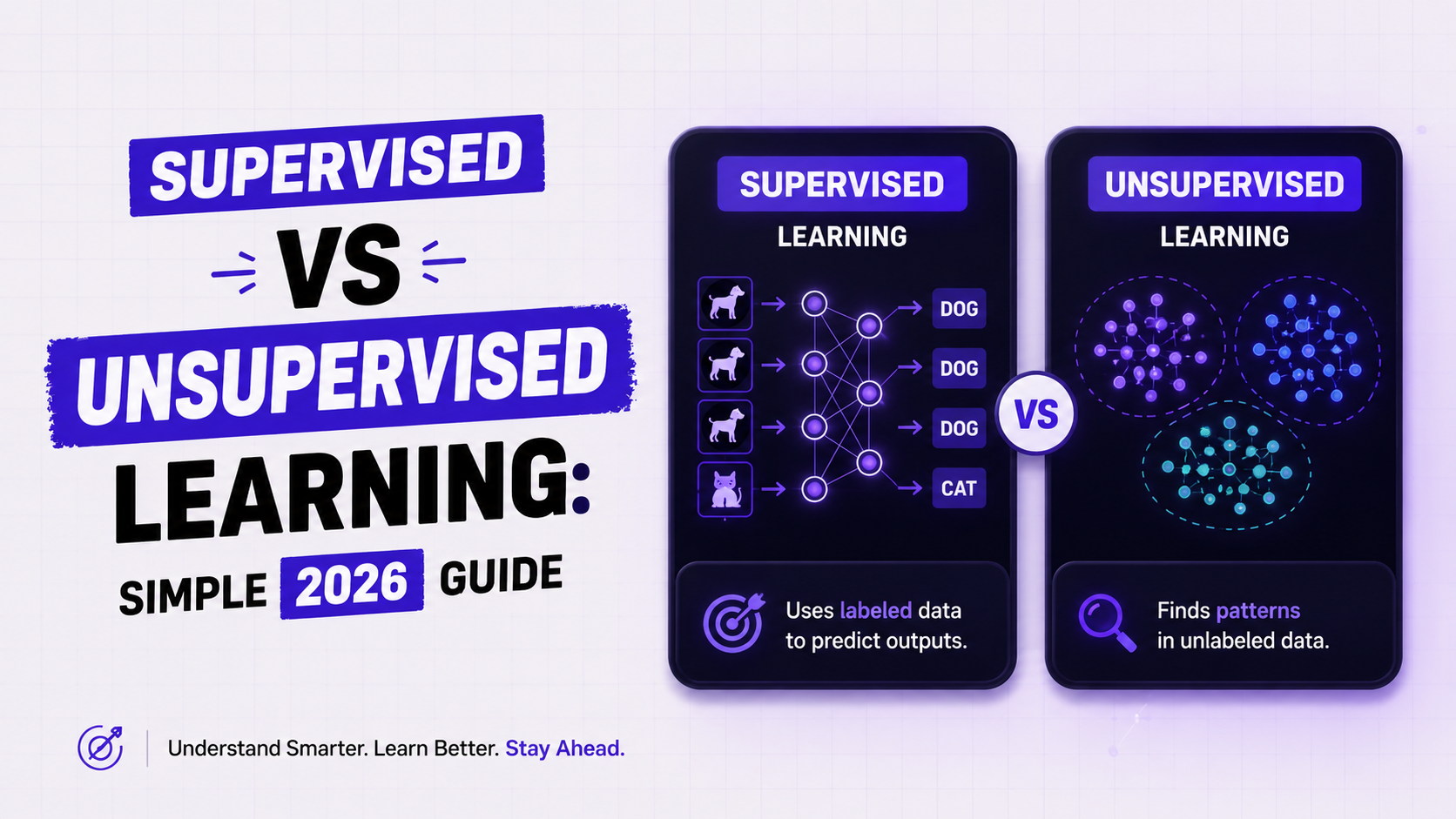
The main difference between supervised and unsupervised learning is labels: supervised learning trains on data that already has the correct answers attached, and unsupervised learning trains on data that has none. Everything else follows from that.
A label is just the correct answer paired with an example. A photo tagged cat is a labeled example. An email marked spam is a labeled example. A house with its final sale price attached is a labeled example. Supervised learning feeds on thousands of these pairs and learns to predict the label for new, unseen inputs.
Unsupervised learning gets the photos with no tags, the emails with no markings, the houses with no prices. Its job is not to predict a known answer, because there is no known answer. Its job is to find structure that was already sitting in the data, groupings, patterns, oddities, that nobody told it to look for.
Both are branches of machine learning, the wider field where computers learn patterns from data instead of being explicitly programmed. If that parent concept is fuzzy, start there and come back, because supervised and unsupervised only make sense as two answers to the same question: how does a machine learn from examples?
Labels are the whole story. If the data has answers attached, it is supervised. If it does not, it is unsupervised. That one test settles ninety percent of the confusion.
Supervised Learning: Learning With an Answer Key
Supervised learning trains a model on labeled examples so it can predict the label for new inputs it has never seen. It works exactly like a student studying with an answer key: shown enough worked examples, the student learns the pattern well enough to answer fresh questions correctly.
Picture teaching a model to detect spam. You hand it 50,000 emails, each already marked spam or not spam by a human. The model studies the patterns, certain words, sender behavior, link density, and builds an internal rule connecting inputs to labels. Show it a brand new email afterwards and it predicts the label on its own. That prediction is the entire point.
Supervised learning splits into two flavors depending on what kind of answer you want:
Classification predicts a category. Spam or not spam. Cat, dog, or bird. Approved or declined. The answer is one of a fixed set of labels.
Regression predicts a number. A house price, tomorrow's temperature, next quarter's sales. The answer is a value on a scale rather than a category.
This is the workhorse of practical AI, and it runs an enormous amount of what you touch daily: fraud detection scoring your card transactions, medical models flagging findings on a scan, face recognition unlocking your phone, and the sentiment analysis reading whether a review is positive. Every one of those learned from labeled examples first.
The catch, and it is a big one, is that labels are expensive. Somebody has to create them. Thousands of medical images do not diagnose themselves; a radiologist has to label each one. The quality and cost of your labels sets the ceiling on your model, which is why in practice the hardest part of supervised learning is often not the algorithm, it is getting good labeled data at all.
Unsupervised Learning: Finding Patterns With No Answer Key
Unsupervised learning finds hidden structure in data that has no labels, discovering groupings and patterns nobody told it to look for. There is no answer key, so it cannot be graded on correctness the way supervised learning can. Its job is discovery, not prediction.
The classic example is customer segmentation. A shop hands a model its purchase records with no labels attached, no groups defined in advance, and asks it to find natural clusters. The model might surface patterns a human never named: people who only buy during sales, regulars who show up weekly, and one-time buyers who purchase once and vanish. Nobody defined those three groups. The algorithm found them sitting in the data.
Unsupervised learning shows up in a few recognizable jobs:
Clustering groups similar things together, like segmenting customers, organizing news articles by topic, or grouping genes with similar behavior.
Anomaly detection flags the things that do not fit any pattern, which is how banks spot unusual transactions and security systems catch strange network activity.
Dimensionality reduction simplifies messy, high-detail data into something visualizable or faster to process, without throwing away the important structure.
The honest limitation is that you often cannot fully verify the result. Since there is no correct answer, judging whether the discovered groups are meaningful takes human interpretation, and two reasonable people can disagree. Unsupervised learning hands you patterns, not truths, and deciding whether a pattern matters is still a human job.
Both approaches ultimately learn by adjusting a model against data, a process our guide on how AI models are trained walks through in plain English. The training loop is similar; what differs is whether there is a correct answer to check against
Supervised vs Unsupervised: The Side-by-Side
Supervised learning predicts known answers from labeled data, while unsupervised learning discovers unknown patterns from unlabeled data. Laid out directly, the trade-offs become obvious.
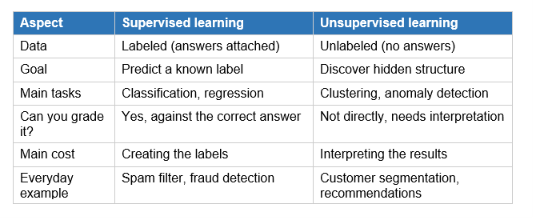
Read the cost row twice, because it is where projects actually succeed or fail. Supervised learning moves the hard work to the front: you pay in labeling before you get a model. Unsupervised learning moves it to the back: the model runs cheaply on raw data, then you pay in figuring out whether what it found means anything.
Neither is better. That framing is the single most common beginner mistake, and search results are full of it. They answer different questions. Supervised asks can you predict this specific thing, unsupervised asks what is hiding in this data. A tool that predicts is not superior to a tool that explores; they are for different jobs.
Classification vs Clustering: The Confusion That Trips Everyone
Classification and clustering both sort data into groups, which is exactly why beginners mix them up, but one is supervised and the other is unsupervised. Classification sorts into groups you defined in advance; clustering discovers groups it decides for itself.
The tell is where the groups come from. In classification, you hand the model a fixed set of labels, spam and not spam, and it learns to file new items into those existing buckets. The buckets existed before the model did. In clustering, you hand the model nothing, and it invents the buckets by noticing what naturally groups together. The buckets did not exist until the model found them.
Run the same data through both and the difference is stark. Give a classification model emails already labeled spam or not, and it sorts new mail into those two known categories. Give a clustering model the same emails with no labels, and it might split them into five groups you never anticipated, newsletters, personal notes, receipts, promotions, and actual spam, based purely on similarity.
Classification files things into boxes you built. Clustering discovers the boxes. Same sorting instinct, opposite starting point.
Hold onto this one, because it is the exact pair of terms that trips people in interviews and exams. If the categories were decided by a human before training, it is classification and therefore supervised. If the algorithm defined the groups itself, it is clustering and therefore unsupervised.
The Algorithms Behind Each (In Plain English)
You do not need the maths to recognize the main algorithms, and knowing their names by category is enough to follow most AI conversations. Each type has a small handful of workhorses that show up again and again.
Common supervised algorithms
Linear and logistic regression: the simplest starting points, drawing a line or boundary that best separates or predicts the labeled data. Fast, readable, and often good enough.
Decision trees and random forests: a series of yes-or-no questions that split the data toward an answer, with random forests combining many trees for accuracy. These quietly outperform fancier methods on ordinary spreadsheet data.
Support vector machines: an algorithm that finds the cleanest possible boundary between two categories, strong for classification when the line between classes is sharp.
Common unsupervised algorithms
K-means clustering: the most famous unsupervised method, which groups data into a chosen number of clusters by similarity. It is the go-to for customer segmentation.
DBSCAN: a clustering method that finds groups of any shape and flags outliers as noise, useful when you do not know how many clusters exist.
PCA (principal component analysis): the standard dimensionality reduction tool, compressing detailed data into fewer dimensions while keeping the important structure.
One important note: none of these are neural networks. Neural networks can do supervised or unsupervised work depending on how they are trained, but the classic algorithms above are simpler, cheaper, and frequently the right choice. Reaching for a neural network by default is a common and expensive mistake on small, structured problems.
My practical take: for most real business problems on tabular data, a random forest or K-means will get you 90 percent of the way in an afternoon, and the exotic methods buy the last 10 percent at ten times the effort. Start simple. You can always escalate.
The Two Types Nobody Mentions: Semi-Supervised and Reinforcement
Supervised and unsupervised are not the only two options, they are just the cleanest two. In practice, most modern AI blends approaches, and two others complete the picture: semi-supervised learning and reinforcement learning.
Semi-supervised learning is the pragmatic middle. You label a small slice of your data, the expensive part, and let the model use a much larger pile of unlabeled data alongside it. This is how teams get supervised-quality results without the cost of labeling everything, and it is extremely common in the real world precisely because labels are the bottleneck. Think of it as a student who gets a few worked examples and then practices on a mountain of unmarked problems.
Reinforcement learning is the fourth type, and it learns by trial and error against rewards rather than from a fixed dataset. It is how systems learn to play games, control robots, and it is a key ingredient in tuning chatbots. Our full explainer on what reinforcement learning is covers it properly, because it deserves its own guide.
The thing to internalize is that these are not rival philosophies competing for a winner. The smartest AI systems in 2026 use all of them, often inside a single product. A large language model, for instance, is pre-trained in a self-supervised way on raw text, then fine-tuned with labeled examples, then polished with reinforcement learning from human feedback. Three types, one model, working together.
So Is ChatGPT Supervised or Unsupervised?
ChatGPT is trained with all of them, which is why the question has no clean one-word answer. Its foundation is built with self-supervised learning, a clever variant of unsupervised learning, and it is then refined with supervised and reinforcement learning on top.
Here is the sequence in plain terms. First, the model reads a staggering amount of text and learns by predicting the next word, over and over. Nobody labeled that text, so it is unsupervised in spirit, but the model generates its own answer key from the text itself, which is why it is called self-supervised. That stage teaches raw language ability.
Then comes supervised fine-tuning, where humans provide labeled examples of good responses, teaching the model how to be helpful rather than merely fluent. Finally, reinforcement learning from human feedback tunes its behavior based on which answers people prefer. The chatbot you talk to is the product of all three stages stacked in order.
If you want the full architecture behind that, our guide on what a large language model is traces how these training stages combine. The short version for this article: modern AI rarely picks one type, it layers them, and understanding supervised versus unsupervised is what lets you see the layers.
How to Know Which One a Problem Needs
The fastest way to tell which type a problem needs is to ask one question: do I have the answers already? If your data comes with correct labels and you want to predict them for new cases, it is supervised. If you have raw data and want to discover what is in it, it is unsupervised.
Walk through a few and it becomes automatic:
• Predict which customers will cancel next month, using past customers you know cancelled or stayed? You have labels. Supervised.
• Group your customers into segments you have not defined yet, to see what natural types exist? No labels, pure discovery. Unsupervised.
• Flag fraudulent transactions when you have thousands of past ones marked fraud or legit? Labels exist. Supervised.
• Spot unusual transactions when you have no examples of fraud, just normal activity and a hunch something is off? No labels. Unsupervised anomaly detection.
A second, sharper test for the tricky middle: can you write down the correct answer for a training example? If yes, and you can afford to do it at scale, lean supervised. If the whole point is that you do not know the answer and want the machine to reveal it, you are in unsupervised territory. And if you have a few answers but not enough, that is exactly what semi-supervised learning is for.
Knowing this distinction is a genuine milestone in AI literacy, and it makes almost every later concept easier to place. If you are building that foundation piece by piece, our 30-day plan to learn AI sequences these ideas so each one builds on the last.
For a beginner deciding what to study first, I would start with supervised learning. It has clearer feedback, you can measure whether your model is right, and that measurability makes the learning loop far more satisfying while the ideas are still new.
Frequently Asked Questions
Q: What is the main difference between supervised and unsupervised learning?
The main difference is labels. Supervised learning trains on labeled data where the correct answers are attached, and it learns to predict those answers for new inputs. Unsupervised learning trains on unlabeled data and discovers hidden patterns or groupings on its own, with no correct answer to predict.
Q: What is a simple example of supervised vs unsupervised learning?
A spam filter is supervised: it learns from emails already labeled spam or not spam, then predicts the label for new mail. Customer segmentation is unsupervised: it takes purchase records with no labels and discovers natural groups of shoppers, like sale-only buyers or weekly regulars, that nobody defined in advance.
Q: Is ChatGPT supervised or unsupervised?
Both, in stages. ChatGPT is first built with self-supervised learning by predicting the next word across huge amounts of unlabeled text, then refined with supervised fine-tuning on labeled example responses, and finally tuned with reinforcement learning from human feedback. Modern AI usually layers all three rather than picking one.
Q: Which is better, supervised or unsupervised learning?
Neither is better, they answer different questions. Supervised learning is better when you have labeled data and want to predict a specific outcome, like fraud or price. Unsupervised learning is better when you have raw data and want to discover unknown structure, like hidden customer segments. Choosing between them depends entirely on your data and goal.
Q: What is semi-supervised learning?
Semi-supervised learning uses a small amount of labeled data alongside a large amount of unlabeled data. It is a practical middle ground that gets close to supervised-quality results without the cost of labeling everything, which matters because labeling is usually the most expensive part of a machine learning project.
Q: Is clustering supervised or unsupervised?
Clustering is unsupervised. It groups similar data points together without any predefined labels, discovering the groups itself based on similarity. This distinguishes it from classification, which is supervised and sorts data into categories that a human defined in advance.
Q: Do I need labeled data for unsupervised learning?
No. Unsupervised learning works specifically on unlabeled data, which is its main advantage since labeled data is expensive and time-consuming to create. It finds patterns, clusters, and anomalies in raw data without anyone having to mark the correct answers first.
Q: Which type should a beginner learn first?
Start with supervised learning. It gives clearer feedback because you can measure whether the model's predictions are correct against the labels, which makes the learning process more concrete and satisfying. Once classification and regression feel natural, unsupervised methods like clustering are easier to grasp.
Recommended Reads
• What Is Machine Learning? The Clearest Beginner Guide
• What Is a Neural Network? Plain-English Explanation
• How Are AI Models Trained? A Plain-English Guide
• What Is Reinforcement Learning? Explained Simply
Machine learning gets simple once you know which questions have answers and which do not. Five minutes a day is all it takes to keep building that instinct.
References
• IBM - Supervised vs Unsupervised Learning
• Google Cloud - Supervised vs Unsupervised Learning
• AWS - The Difference Between Supervised and Unsupervised Learning
• Databricks - Supervised vs Unsupervised Learning
• V7 Labs - Supervised vs Unsupervised Learning: Differences and Examples
GeeksforGeeks - Difference Between Supervised and Unsupervised Learning