AI News for September 9, 2026: Washington Names Six Chinese AI Firms as Meta Enters the Agent Race
Security, money, and product launches all made news today. The NSA, CISA and FBI jointly named six China-based AI companies in an industrial-scale "distillation" advisory, accusing them of systematically extracting capabilities from Claude, GPT, Gemini, and Grok. Anthropic faced a widening class action over its Claude Max "5x/20x" marketing, French AI lab Mistral closed the largest funding round ever raised by a European technology company, and Meta launched Muse, a personal AI agent built to handle real-world tasks like booking travel and paying bills. Here are the four stories that matter most from today's AI news, explained in plain English.
Today's Top AI Stories
- US names six Chinese AI firms in industrial-scale distillation advisory
- Anthropic's Claude Max class action broadens over "5x/20x" usage claims
- Mistral raises €3 billion at a €21 billion valuation, Europe's biggest-ever round
- Meta launches Muse, a personal AI agent that can book travel and pay bills
US names six Chinese AI firms in industrial-scale distillation advisory
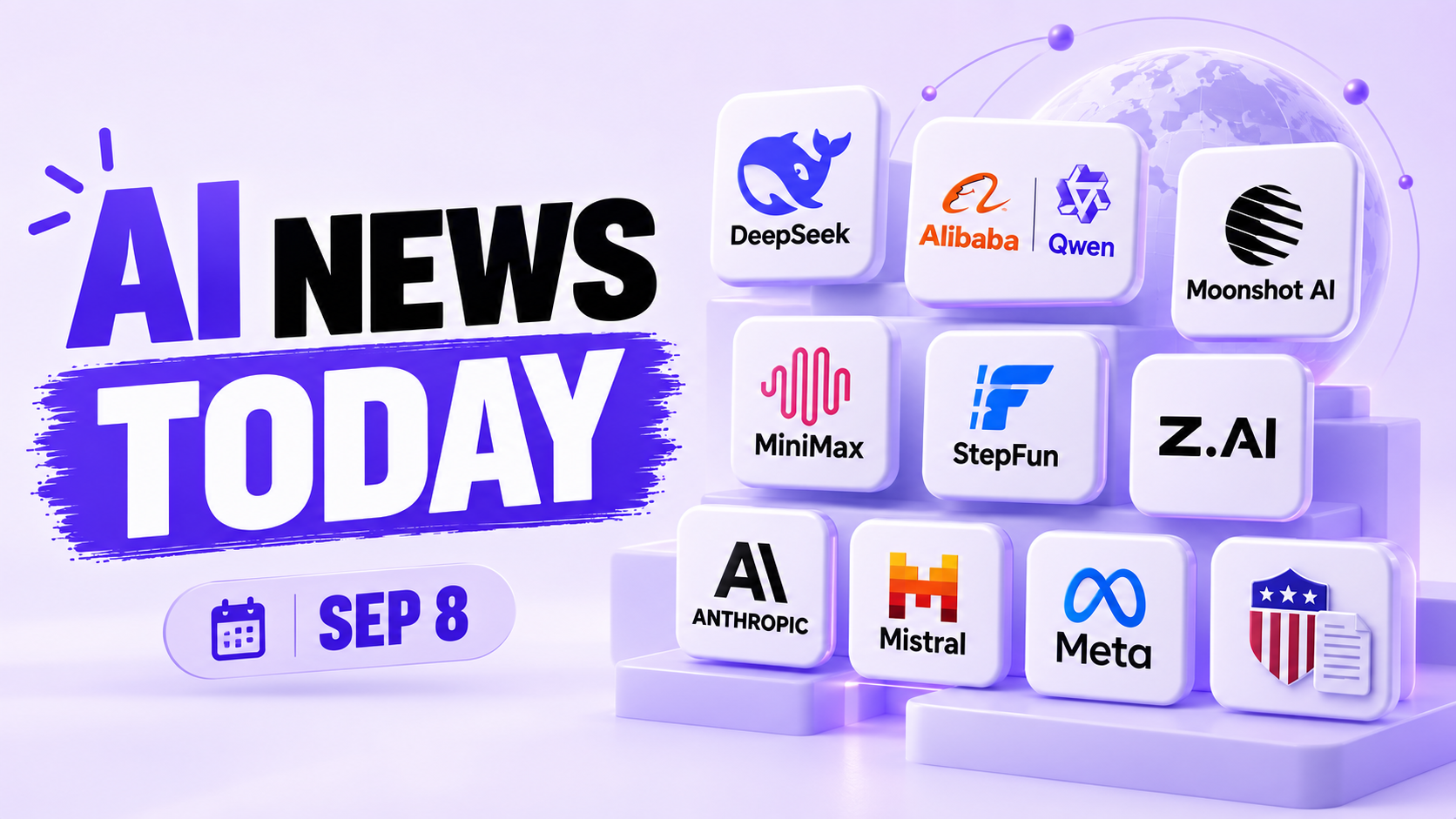
The NSA, CISA, and FBI published a joint cybersecurity advisory on September 8, 2026, designated AA26-251A, naming DeepSeek, Moonshot AI, Alibaba, MiniMax, StepFun, and Z.AI as running "aggressive, malicious, and targeted" knowledge-distillation campaigns against US frontier AI models since at least late 2024. The agencies say the six companies extracted billions of tokens across millions of exchanges and requests from models including variants of Claude, GPT, Gemini, and Grok, describing the practice as forming "the core, not merely a supplement" of the companies' AI development strategy.
Distillation is a legitimate machine learning technique where a smaller model learns by training on a larger model's outputs, but the advisory alleges these campaigns violated the US companies' terms of service and were run at industrial scale, likely with the Chinese government's awareness. DeepSeek is accused of distilling data from Claude Sonnet 3.7, Claude Sonnet 4, and Claude Sonnet 4.5 alongside GPT and Gemini models to train its R1 and V3 systems, with the agencies noting DeepSeek's widely cited 5.6-million-dollar training cost is misleading because it excludes this acquired data. Moonshot AI is separately accused of extracting Claude Fable 5 data to train its Kimi-K3 model and GPT-4o data for Kimi-K2, while the advisory says requests were routed through so-called "transfer stations," proxy services designed to bypass geographic restrictions and evade safeguards.
The advisory formalizes accusations Anthropic, OpenAI, and Google had already raised independently; Anthropic previously said three of the named labs generated more than 16 million exchanges with Claude through roughly 24,000 fraudulent accounts. It marks the first time US intelligence agencies have put their names on the distillation dispute, escalating what had been a company-versus-company fight into a formal government assessment amid the broader US-China AI rivalry.
Anthropic's Claude Max class action broadens over "5x/20x" usage claims
Claude Max subscribers filed an expanded class-action complaint against Anthropic in the US District Court for the Northern District of California on September 8, 2026, arguing that the company's "5x" and "20x" usage labels for its 100-dollar and 200-dollar monthly plans materially misled paying customers. The amended complaint, part of the ongoing Kahn v. Anthropic case, cites a viral thread showing Anthropic's checkout page displays a "Save 50%" badge on Max 20x even though the plan reportedly delivers only about 1.7 times the weekly Sonnet hours of Max 5x, not the 4x the "5x to 20x" labels imply.
The original complaint, filed in June by subscriber Karl Kahn, alleged that Max 5x actually delivers roughly 3.5 times Pro's usage rather than five, and Max 20x delivers only about 6 to 8 times Pro's usage rather than twenty, because the advertised multipliers apply to rolling five-hour session windows rather than the weekly caps that actually gate heavy Claude Code use. Kahn says he burned through 15 percent of his weekly allowance in a single five-hour coding session after upgrading to Max 20x. Anthropic has filed a motion to dismiss, with a hearing scheduled for November 6, 2026, and has declined to comment publicly on the allegations.
The dispute lands against a backdrop of repeated changes to Claude Code's usage limits over the past year, including a temporary 50 percent boost that ran from May through August and a permanent 25 percent increase over the pre-July baseline that took effect September 14, changes plaintiffs say have made it difficult for subscribers to know what they are actually paying for from one month to the next.
Mistral raises €3 billion at a €21 billion valuation, Europe's biggest-ever round
Paris-based Mistral AI announced on September 8, 2026 that it has closed a €3 billion (about 3.5 billion dollar) Series D round led by Samsung Electronics, at a post-money valuation above €21 billion, more than double its €11.7 billion valuation from a year earlier. Mistral calls it the largest equity fundraising round ever completed by a European technology company. Samsung led the round alongside co-leads Scaleup Europe Fund (managed by EQT) and existing investor PSG Equity, with new backers including Advent, funds managed by BlackRock, and the Grand Duchy of Luxembourg, alongside returning investors Andreessen Horowitz, ASML, Nvidia, General Catalyst, Lightspeed, and Salesforce Ventures.
CEO Arthur Mensch told CNBC the capital will go toward building and owning data centers while renting additional compute, saying the amount of infrastructure Mistral owns outright is set to roughly double over the next five years. Mensch said the company is on track to surpass 1 billion dollars in annual recurring revenue before the end of 2026. Mistral, which operates across 20 countries and counts more than 125 enterprise customers including Airbus, ASML, and HSBC, has built its pitch around "sovereign AI," open-weight models and infrastructure that keep data and deployment decisions with its customers rather than a single foreign provider.
The round is notable for the scale of the valuation gap it still leaves with US rivals: even at over 20 billion euros, Mistral remains far behind Anthropic's roughly 965 billion dollar and OpenAI's roughly 852 billion dollar valuations, underlining how much capital the AI race continues to demand even for Europe's best-funded challenger.
Meta launches Muse, a personal AI agent that can book travel and pay bills
Meta introduced Muse on September 8, 2026, describing it as the first personal AI agent built for everyone, not just developers. Muse runs inside a dedicated cloud workspace Meta calls Muse Secure VM, which houses both the agent and a person's connected data, and is powered by Muse Spark 1.3, Meta's most capable model to date. People talk to Muse the way they'd message a friend, in a standalone app or directly inside WhatsApp, and it can handle small tasks like sending an email or booking a table, or bigger goals like building a year-long workout plan, continuing to work after the app is closed and returning when it needs approval or has an update.
Meta is leaning hard on trust and safety messaging: a separate internal system called Sentinel monitors everything Muse tries to send outside its virtual machine, checking each action against existing permissions and prompting the user for approval when no policy covers it. Muse never sees a user's actual passwords or card numbers directly; credentials sit in secure storage the agent can use without viewing, and checkout runs through Stripe's Link, with Shop Pay and 1Password integrations coming soon. Meta says it plans to later offer a "Confidential VM" option using a trusted execution environment that even Meta itself cannot access.
Muse is available now in the US only, on web, iOS, and Android, with a free tier offering up to 100 million tokens a week and paid Power (20 dollars a month) and Maximum (100 dollars a month) tiers for heavier use. The launch is Meta's most direct entry yet into the personal-agent race already underway with OpenAI, Anthropic, and Google, and comes the same week as Google's Gemini 3.8 Flash and Anthropic's own model updates, part of what AI chief Alexandr Wang has called one of the most competitive stretches the industry has seen.
Quick Recap
- The NSA, CISA, and FBI named DeepSeek, Moonshot AI, Alibaba, MiniMax, StepFun, and Z.AI in a joint advisory over industrial-scale distillation of US frontier models.
- Anthropic's Claude Max class action expanded, alleging the "5x/20x" plan labels mislead subscribers about real weekly usage.
- Mistral closed a €3 billion round at a €21 billion valuation, the largest ever raised by a European tech company.
- Meta launched Muse, a personal AI agent that can book travel, pay bills, and act on a user's behalf from a secure virtual machine.
Frequently Asked Questions
What is the top AI news today?
The biggest story is a joint US intelligence advisory naming six Chinese AI companies — DeepSeek, Moonshot AI, Alibaba, MiniMax, StepFun, and Z.AI — over industrial-scale campaigns to extract capabilities from American AI models.
Which Chinese AI companies did the US name in the distillation advisory?
DeepSeek, Moonshot AI, Alibaba, MiniMax, StepFun, and Z.AI. The advisory alleges they extracted billions of tokens from Claude, GPT, Gemini, and Grok since at least late 2024.
What is the Claude Max lawsuit about?
Subscribers allege Anthropic's "5x" and "20x" labels for its Max 5x and Max 20x plans overstate real usage, since the multipliers apply to five-hour session windows rather than the weekly caps that actually limit heavy use.
How much did Mistral raise and at what valuation?
Mistral raised €3 billion (about 3.5 billion dollars) in a Series D round led by Samsung Electronics, valuing the company at more than €21 billion, roughly double its valuation a year earlier.
What is Meta's Muse AI agent?
Muse is a personal AI agent that can handle real-world tasks like booking travel, sending emails, and making purchases on a user's behalf, running inside a secure virtual machine and powered by Meta's Muse Spark 1.3 model.
Recommended Blogs
ChatGPT vs Claude vs Gemini 2026: Which AI Chatbot Should You Use?
10 AI Tools Every Professional Should Know in 2026
Top AI News Today: Sept 1 (13 Stories)
Why AI Gives Wrong Answers (And How to Fix It)
Learn AI in 5 Minutes a Day
Keeping up with AI does not require reading every release note yourself. Unrot delivers the day's biggest AI developments in a 5 minute daily lesson, written in plain English for beginners, students, and working professionals who want to stay current without the jargon.
References
CISA Advisory AA26-251A: China-based AI companies conducting distillation campaigns
NSA, CISA, FBI warn China-based AI firms distill US frontier models
A lawsuit says Anthropic's Claude Max 20x delivers far less than advertised
A new class action questions whether Anthropic broke the law by misleading power users
Mistral AI raises at €21 billion valuation in Samsung-led round
French AI company Mistral raises €3 billion Series D led by Samsung
Introducing Muse: The World's First Personal AI Agent Built for Everyone