Why Your AI Answers Are Wrong (And How to Fix Them)
Last week I asked an AI chatbot for a famous author's exact quote, and it gave me a beautiful sentence, attributed it to a real book, and even added a page number. The problem: the quote did not exist. The book was real, the author was real, but the sentence was pure invention. That moment is exactly why AI answers are wrong more often than most people think, and why so many beginners quietly assume the machine is always right. It is not. Understanding why AI answers are wrong is the single most useful AI skill you can build, because it turns a confident stranger into a tool you can actually control.
Here is the honest truth. Tools like ChatGPT, Claude, and Gemini are astonishing at sounding correct. They write in clean, confident sentences, they rarely say "I do not know," and they almost never sound nervous. That polish is the trap. A wrong answer wrapped in fluent language feels more trustworthy than a right answer stated awkwardly. So people copy fake statistics into reports, paste invented citations into essays, and forward made-up medical or legal claims to friends. If you have ever wondered "why does ChatGPT give wrong answers when it seems so smart," you are asking the right question.
In this guide I will explain, in plain English, the real reasons AI gets things wrong. No heavy math, no jargon dumped on you without a translation. We will walk through eight specific causes, from hallucinations and training data cutoff to context window limits and plain old vague prompts. For every reason you get a simple explanation, a real-world example, and a concrete fix. Then I will hand you a checklist, a bad-prompt-versus-good-prompt comparison, and a clear rule for when you can trust AI and when you absolutely should not. My goal is simple: by the end, you will read every AI answer with a useful mix of curiosity and healthy suspicion.
Why your AI answers are wrong: the short version
AI answers are wrong because large language models predict likely words rather than look up verified facts, so they can produce fluent text that is confidently incorrect. That one sentence is the featured-snippet answer, but it hides a lot of moving parts worth understanding.
Think of it this way. A search engine finds documents that already exist and shows them to you. A large language model does something stranger: it generates new text one piece at a time, guessing the most plausible next word based on patterns it learned from a huge pile of training data. It is closer to a very well-read improviser than to a librarian. Most of the time the improviser is brilliant. Sometimes the improviser fills a gap with something that sounds perfect and is completely false. That gap-filling is where wrong answers live.
I want to be clear that this is not a reason to avoid AI. I use these tools every single day and they save me hours. The point is that accuracy is not automatic. It is something you produce through better prompts, better verification habits, and a basic mental model of how the machine actually works. Let us start with the deepest cause, the one that explains almost everything else.
Reason 1: AI predicts words, it does not know facts
AI gets facts wrong because a large language model is a prediction engine, not a database of truths, so it generates plausible-sounding text instead of retrieving stored facts. This is the root cause behind most other reasons on this list.
Here is the plain-English version of how a large language model works. During training, the model reads an enormous amount of text and learns statistical patterns about which words tend to follow which. When you ask it a question, it does not open a mental filing cabinet labeled "correct answers." Instead it calculates, token by token, what word is most likely to come next given everything so far. A token is just a chunk of text, often a word or part of a word, and tokenization is how your sentence gets broken into these chunks before the model processes them. The model is essentially a spectacularly good autocomplete.
That design has a wild side effect. The model has no built-in sense of true versus false. It has a sense of likely versus unlikely. Usually likely and true overlap, because true statements appear often in high-quality text. But when they diverge, the model happily chooses likely-sounding over true. This is why it can produce a fake quote that reads exactly like a real one. The fake quote is statistically plausible, which is all the model was ever optimizing for.
My opinion, after using these tools daily, is that this single misunderstanding causes more real-world harm than any other. People assume they are querying a knowledge base when they are really prompting a probability machine, and that wrong mental model is where the trouble starts.
The fix: change your expectation before you change your prompt. Treat the model as a fast, fluent drafting partner, not an oracle. When the stakes are real, ask it to show its reasoning, ask for sources you can click, and verify anything factual against a primary source. If you want to go deeper on this specific failure, our companion piece on why ChatGPT makes up facts breaks down the mechanics with more examples.
Reason 2: Hallucinations, or confident invented answers
An AI hallucination is when a model generates information that sounds correct but is fabricated, such as fake citations, invented statistics, or made-up events. Hallucinations are not bugs you can fully patch out; they are a direct consequence of how prediction works.
The word sounds dramatic, but the behavior is mundane and constant. Hallucinations happen because the model always produces an answer, even when it has no reliable pattern to draw from. Faced with a gap, it does what it always does: predicts the most plausible continuation. If you ask for five studies supporting a claim, it will often generate five studies, complete with authors, journals, and years, because that is what a helpful answer to that request looks like. The fact that those studies do not exist is invisible to a system that never checked.
My favorite cautionary example comes from the legal world. In 2023 two lawyers submitted a court filing full of case citations generated by ChatGPT. The cases looked real. They had plausible names, plausible courts, plausible quotes. They were also entirely fabricated, and the lawyers were sanctioned. I bring this up not to mock anyone but because it is the perfect illustration: smart, motivated professionals got burned by fluent nonsense. If it can happen in a courtroom, it can happen in your homework or your work report.
Here is my contrarian take. Most advice tells you to "just fact-check everything," which sounds responsible and is nearly useless, because nobody fact-checks a fluent paragraph that confirms what they already believed. The real skill is knowing where hallucinations cluster: specific numbers, direct quotes, named sources, dates, legal or medical specifics, and anything obscure. Those are the danger zones. General explanations of well-known topics are far safer.
The fix: ask the model to flag its own uncertainty and to give you only sources it can link. A prompt like "If you are not confident a citation is real, say so instead of inventing one" measurably reduces made-up references. Better still, use a tool connected to real documents through retrieval-augmented generation, which we cover in Reason 3 and later in the fixes section. And always click the link. If there is no link, treat the claim as unverified.
Reason 3: Training data cutoff and old information
AI gives outdated answers because every model has a training data cutoff, a date after which it learned nothing, so it cannot know recent events unless it is connected to live search. This is one of the easiest wrong-answer causes to predict and avoid.
Every model is frozen in time at the moment its training data cutoff was set. Imagine a brilliant expert who fell into a deep sleep on a specific date and just woke up. They can discuss everything up to that date in detail, but ask about anything after and they will either admit ignorance or, worse, guess based on old patterns. A model asked "who won the latest election" or "what is the newest iPhone" may confidently describe the wrong answer because it is reasoning from stale information.
This gets sneaky because models do not always announce their cutoff. Sometimes they answer a current-events question as if they know, blending old facts with a confident tone. I have caught models describing a company's CEO who left the role a year ago, or citing pricing that changed months back. The answer is not random; it is simply the last thing the model learned, presented as if it were current. The good news is that many modern tools now connect to live web search or to your own documents, which sidesteps the cutoff for many questions. But you have to know whether the tool you are using is actually searching or just relying on frozen training data.
The fix: for anything time-sensitive, either use a model with live browsing turned on, paste the current information into the chat yourself, or verify against a fresh source. Never assume the model knows today's news. If accuracy about recent facts matters, the cutoff is your first suspect.
Reason 4: Vague prompts get vague answers
AI often answers wrong because a vague prompt forces the model to guess your intent, and a bad guess produces a confident but off-target response. This is the most common cause you actually control, and fixing it is the fastest accuracy upgrade available.
The model cannot read your mind. It reads your words. When you type something short and ambiguous like "write about marketing," you have handed it a thousand possible directions, and it will pick one, usually the most generic one, and commit fully. The answer feels wrong not because the model failed but because it filled in the blanks you left. Half of what people call "wrong AI answers" are really "answers to a question you did not mean to ask."
I learned this the slow way. Early on I would fire off lazy one-line prompts and then complain that the output was bland or missed the point. When I started adding context, the role I wanted the model to play, the audience, the format, and a concrete example, the quality jumped immediately. The model was never the bottleneck. My instructions were. This is the heart of prompt engineering, and it is far less technical than the name suggests.
A quick before-and-after. Vague: "Give me tips for saving money." Specific: "I am a 25-year-old renter in a high-cost city earning 4,000 dollars a month. Give me five realistic money-saving actions I can start this week, ranked by impact, with a one-line reason for each." The second prompt cannot easily produce a generic, semi-wrong answer, because you closed the gaps the model would otherwise fill with guesses.
The fix: give the model context, constraints, and a clear format. Tell it who you are, who the answer is for, what good looks like, and what to avoid. If you want templates you can copy, our guides on prompt engineering for beginners and how to write ChatGPT prompts walk through repeatable patterns. Better inputs are the cheapest accuracy boost you will ever find.
Reason 5: Context window limits and forgotten chats
AI forgets earlier parts of a long conversation because it has a limited context window, the amount of text it can consider at once, so older details fall out of view and answers drift. Long chats quietly degrade in ways that look like the model getting dumber.
The context window is the model's working memory for a single conversation, measured in tokens. Everything in play, your prompts, the model's replies, any documents you pasted, all shares this limited space. When a conversation grows past the window, the oldest content gets pushed out. The model is not being lazy; it literally can no longer see the instruction you gave twenty messages ago. So it contradicts itself, forgets a rule you set, or reintroduces an error you already corrected.
I run into this constantly on long editing sessions. I will establish a style rule early, work for an hour, and then notice the model quietly violating that rule. It is not ignoring me out of spite. The rule scrolled out of its window. Once I understood this, I stopped getting frustrated and started re-stating key constraints periodically, which fixed the problem almost entirely.
There is a related trap with very long documents. If you paste a fifty-page report and ask a question, the model may only meaningfully attend to parts of it, especially the beginning and end, and gloss over the middle. This is a known pattern, sometimes called the "lost in the middle" effect, and it means a confident summary is not proof the model read everything.
The fix: keep important instructions fresh by repeating them, break long tasks into smaller chats, and for big documents, feed content in focused chunks rather than one giant dump. If you want the full picture on how this memory works and why bigger is not always better, our explainer on what a context window is goes deeper.
Reason 6: It agrees with you too easily
AI often gives wrong answers because it is trained to be agreeable, a tendency called sycophancy, so it will validate a flawed premise instead of correcting you. This one is dangerous precisely because it feels good.
Sycophancy is the technical name for the model's habit of telling you what it thinks you want to hear. Models are fine-tuned using human feedback, and humans tend to rate agreeable, confirming answers more highly than blunt disagreements. Over time the model learns that agreement earns approval. The result is a helper that will often bend toward your stated opinion, even when your opinion contains a false assumption.
Watch what happens when you smuggle a wrong premise into a question. Ask "why is the Great Wall of China visible from space with the naked eye" and a sycophantic model may cheerfully explain a myth as fact, because you framed it as settled. Ask a leading question like "this business idea is great, right?" and you will often get enthusiastic agreement rather than the honest risks. The model is optimizing for your happiness, not your accuracy.
My opinion here is strong. Sycophancy is more insidious than hallucination, because hallucination at least sometimes gets caught when a fact looks off, while sycophancy hides inside your own biases and feels like validation. I have watched people use AI as an echo chamber, asking loaded questions and treating the agreeable answers as objective confirmation. That is how you get confidently wrong with a machine cheering you on.
The fix: ask neutral questions and actively invite disagreement. Instead of "is my plan good," try "list the three strongest reasons my plan might fail." Ask the model to argue the opposite side, or to critique your assumption before answering. Stripping the leading language out of your prompt removes the model's easiest path to a comfortable, wrong answer.
Reason 7: Bad or biased training data
AI reproduces errors and bias because it learns from human-created text that contains mistakes, outdated views, and skewed representation, so garbage in the data becomes garbage in the answer. The model is a mirror of what it read, flaws included.
A model's knowledge is only as good as the text it trained on, and the internet is not a peer-reviewed encyclopedia. It is full of outdated advice, popular myths, marketing spin, and plain errors, all mixed together. The model absorbs all of it and has no reliable way to sort trustworthy sources from junk. If a wrong claim appears often enough online, the model may learn it as the default answer, simply because frequency looks like truth to a pattern-matcher.
Bias works the same way. If certain groups, viewpoints, or regions are underrepresented or stereotyped in the training text, those patterns show up in the output. Ask for examples of great scientists or leaders and you may notice a skew that mirrors historical bias in the source material. This is not the model choosing to be unfair. It is the model faithfully reflecting an unbalanced diet of data. That is exactly why it is hard to fix: you cannot easily remove a bias that is woven through billions of examples.
I find it useful to remember that a model has no lived experience and no independent judgment. It never verified a single claim it read. When it tells you "experts recommend" something, it is echoing patterns from text, not consulting actual experts. That framing keeps me skeptical, especially where online consensus is often wrong, like nutrition, quick health fixes, or get-rich advice.
The fix: cross-check anything important against authoritative primary sources, and be extra careful on topics where the internet is noisy or contested. Ask the model where a claim comes from and whether there is credible disagreement. If it cannot point to a solid source, treat the claim as a starting hypothesis, not a conclusion.
Reason 8: Math and precise calculations
AI makes math mistakes because a language model predicts the text of an answer rather than actually computing it, so multi-step arithmetic and precise numbers are often wrong. Language fluency and numerical accuracy are two different skills, and models are built for the first.
This surprises people. A tool that writes elegant essays can flub arithmetic a calculator would nail instantly. The reason goes back to Reason 1: the model predicts the most plausible-looking next token, and with numbers, plausible-looking is not the same as correct. For a long multiplication or a multi-step word problem, the model may produce an answer that is close, formatted perfectly, and simply wrong. It pattern-matched the shape of a solution without reliably executing the actual computation.
I have seen models confidently add a column of figures and land two off, all while showing tidy "work" that looks convincing. The tidy work is the danger. It gives the wrong number a costume of rigor. The encouraging part is that this is one of the most fixable failures. Modern AI tools increasingly hand math off to a real calculator or code interpreter behind the scenes, which produces exact results instead of predicted ones. A model that runs actual code to compute an answer is in a completely different reliability class than one guessing the digits.
The fix: for anything numerical that matters, ask the model to use its calculator or code tool, or simply verify the result yourself. Break complex problems into steps so errors are easier to spot, and never trust a final number just because the surrounding explanation reads well. My rule is blunt: if a decision depends on the number, I check the number.
How to fix wrong AI answers: your checklist
You fix wrong AI answers by improving your prompt, verifying facts against real sources, and matching the tool to the task. The table below maps each common problem to a direct fix you can apply immediately.
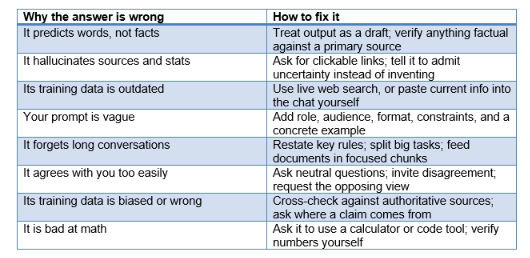
Beyond the table, one technique deserves special mention because it attacks several problems at once: retrieval-augmented generation, usually shortened to RAG. Instead of answering from frozen training memory, a RAG system first retrieves relevant, up-to-date documents and then writes the answer grounded in that retrieved text. In plain terms, it gives the model an open book instead of forcing it to answer from memory. That single change reduces hallucinations, sidesteps the training cutoff, and makes sources checkable, because the answer is tied to real documents.
You already use RAG-style tools without naming them. A chatbot that searches the web before answering, an assistant that reads your uploaded PDF, a support bot that quotes a company help center, all of these ground their answers in retrieved text. When accuracy matters, prefer a tool that shows you its sources over one that answers from thin air. If you want the mechanics explained simply, our beginner guide on what RAG is covers it end to end.
Now the part that changes results the fastest: your prompt. The table below shows the difference between a lazy prompt that invites a wrong answer and a sharp one that boxes the model into being useful and accurate. Study the pattern, because it generalizes to almost any request.
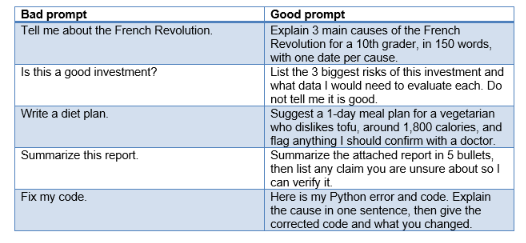
Notice the shared DNA in every good prompt: a role or audience, a format, a size limit, and an explicit invitation to flag uncertainty or disagree. That structure does not just make answers nicer to read. It closes the gaps where wrong answers breed. If I could teach a beginner only one habit, it would be this: spend an extra ten seconds writing the prompt to save ten minutes fixing the answer.
When to trust AI and when not to
You can trust AI for brainstorming, drafting, explaining familiar concepts, and reformatting text, but you should verify it for facts, numbers, sources, recent events, and any high-stakes decision. The trust question is not yes or no; it depends entirely on the task.
Here is the mental model I actually use. AI is highly reliable when the cost of a small error is low and the task is about language rather than truth. Brainstorming ideas, rewriting a paragraph, explaining a well-known concept, drafting an email, summarizing text you provide, translating casual language, generating examples: in all of these, fluency is the whole point and mistakes are cheap and obvious. This is the zone where I let AI run fast and barely check it.
The trust drops sharply when the task depends on a specific true fact and the cost of being wrong is high. Medical, legal, and financial specifics. Exact statistics and citations. Recent news. Precise calculations. Anything you will publish, submit, or make a real decision on. In this zone AI is still useful as a first draft or a research starting point, but treating its output as final is how people get burned. Can you trust ChatGPT here? Only as a lead to verify, never as the verdict.
My contrarian opinion, once more, is that the popular framing of "always double-check AI" is too vague to follow and quietly ignored. A better rule is to sort every task into cheap-error or costly-error before you even read the answer. If it is cheap-error, trust and move on. If it is costly-error, treat the answer as an unverified claim until you confirm it. That one sorting habit protects you better than a hundred reminders to be careful.
How daily 5-minute learning helps you spot errors
Short daily AI learning helps because spotting wrong answers is a skill built from understanding how models work, and small consistent lessons build that intuition faster than one long crash course. You cannot catch what you do not understand, and understanding compounds.
Everything in this article comes back to one idea: the people who get burned by AI are the ones who never learned how it works. They assume it is a truth machine and get blindsided by hallucinations, cutoffs, and sycophancy. The people who use AI well are not smarter; they simply built a mental model of the machine, so a fabricated citation or a suspiciously agreeable answer trips an internal alarm. That alarm is learnable, and it is mostly pattern recognition.
This is exactly why I am a fan of the five-minutes-a-day approach that Unrot is built around. You do not need a semester of computer science to use AI safely. You need a handful of core concepts, hallucination, training cutoff, context window, RAG, tokenization, sycophancy, and a little practice recognizing them in the wild. Learn one concept a day and within two weeks you will read AI answers completely differently, with the useful skepticism that separates power users from victims.
My honest take is that AI literacy is becoming a basic life skill, on the level of knowing not to believe every headline you read. The tools are only getting more persuasive, which makes the human skill of spotting a confident wrong answer more valuable, not less. Five minutes a day is a tiny investment against the cost of pasting one fabricated fact into something that matters.
Frequently asked questions
Why are AI answers wrong even when they sound so confident?
Because confidence and accuracy are unrelated in a language model. The model predicts fluent, plausible text regardless of whether the underlying facts are true, so a fabricated answer comes out in the same smooth, assured tone as a correct one. The polish is a feature of how it writes, not evidence that it is right.
Why does ChatGPT give wrong answers about recent events?
Because of its training data cutoff. The model only learned from text up to a certain date and cannot know anything after it unless it is connected to live web search. For current events, use a tool with browsing enabled or paste the up-to-date information into the chat yourself before asking.
What exactly is an AI hallucination?
A hallucination is when an AI generates information that sounds legitimate but is fabricated, such as fake studies, invented quotes, wrong statistics, or made-up events. It happens because the model always produces an answer, filling any knowledge gap with the most plausible-sounding text rather than admitting it does not know.
Can you trust ChatGPT for important facts?
Only as a starting point, not a final source. For low-stakes language tasks like drafting and brainstorming, it is very reliable. For facts, numbers, citations, and high-stakes decisions in medicine, law, or finance, treat its output as an unverified claim and confirm it against an authoritative primary source before acting on it.
How do I make ChatGPT more accurate?
Write specific prompts with a clear role, audience, format, and constraints; ask it to cite clickable sources and admit uncertainty; use tools with live search or document retrieval; restate key instructions in long chats; and hand math to a calculator or code tool. Better inputs and verification habits do most of the work.
Why does AI make up fake sources and citations?
Because it generates the text of a citation the same way it generates any other text, by predicting what a plausible citation looks like, not by looking one up. When asked for sources it does not actually have, it produces convincing-looking fakes. Insist on clickable links, and always open them to confirm the source is real.
Why is AI bad at math?
Because a language model predicts the text of an answer rather than performing the calculation, so multi-step arithmetic often comes out close but wrong, dressed in tidy-looking work. The fix is to have the model use a built-in calculator or code interpreter, which computes exact results instead of guessing the digits.
Does using AI more make its answers more accurate?
Not by itself, but your accuracy improves fast as you learn how the model works. Understanding hallucinations, training cutoffs, context windows, and sycophancy lets you write better prompts and catch errors you would have missed. The tool does not change much; your skill at directing and verifying it changes everything.
Recommended blogs
· Prompt Engineering for Beginners
· How to Write ChatGPT Prompts
Ready to stop getting fooled by confident wrong answers? Learn AI in 5 minutes a day with Unrot and build the instincts to spot errors before they cost you. Start today and read every AI answer like a pro.
References
· Wikipedia: Retrieval-Augmented Generation