September 1, 2026 AI Update: Apple's New CEO, DeepSeek's Big Round, and 11 More Stories
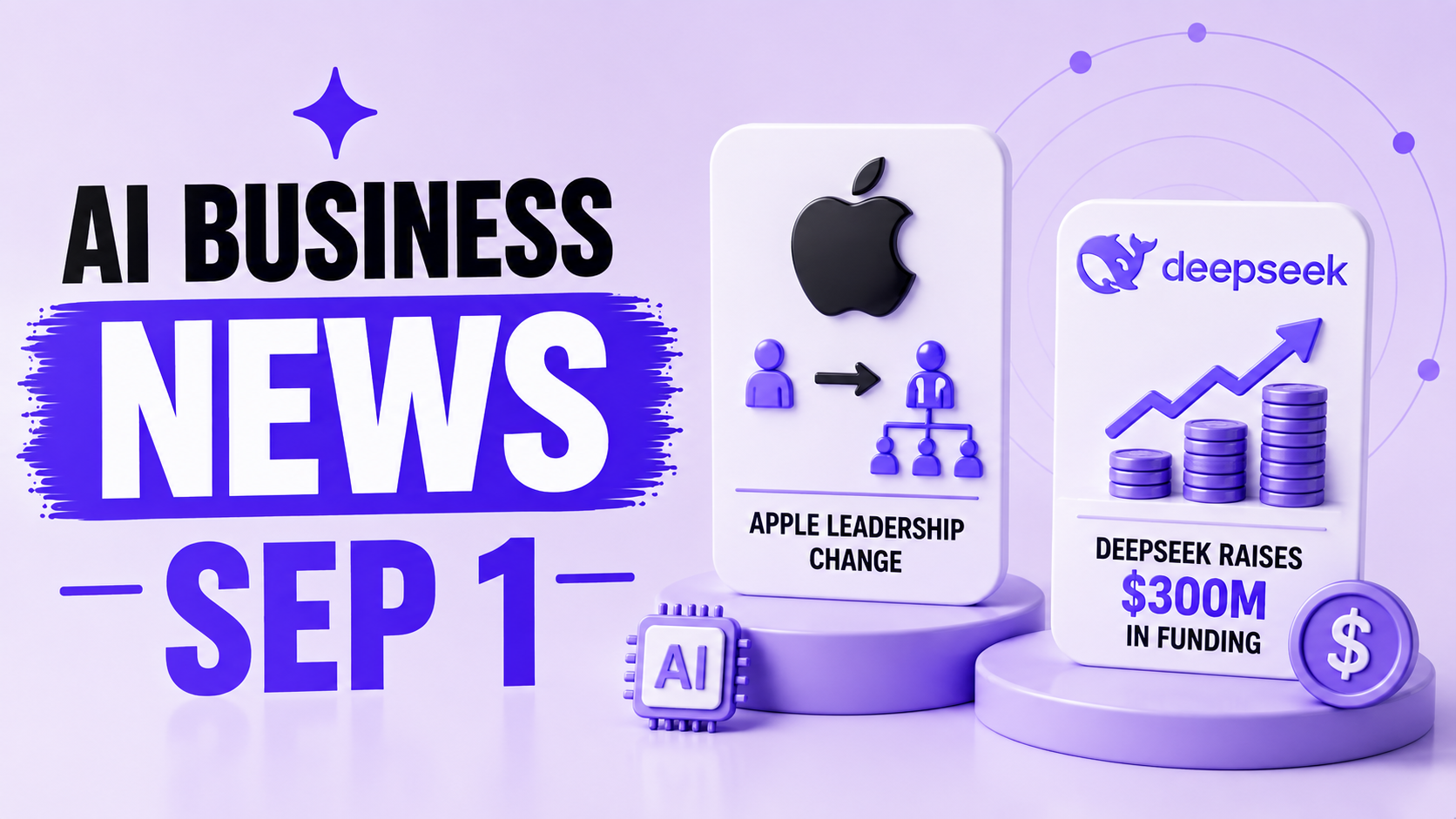
Today is a big day for AI business news. John Ternus officially became Apple's CEO, ending Tim Cook's 15 year run at the top and inheriting a company that many analysts say has fallen behind on AI. Chinese lab DeepSeek is closing in on a funding round that would value it at roughly 74 billion dollars, and Nvidia is reportedly in talks to invest in the search startup Perplexity at a valuation above 30 billion dollars.
On the model side, Alibaba previewed the architecture behind its next generation Qwen4 models, Moonshot's Kimi K3 became the company's only current flagship as older models were retired, and Anthropic's agent connection standard passed 400 million monthly downloads. There is also a new $399 desktop robot, a fresh set of AI earbuds, and new classroom tools from Google and Khan Academy. Here are the 13 stories that matter most from today's AI news, explained in plain English.
Apple hands the CEO job to John Ternus, and AI is his first big test
John Ternus officially became Apple's chief executive today, September 1, 2026, ending Tim Cook's 15 year run at the top of the company. Cook moves into the role of executive chairman, and the change was described by Apple as the result of long term succession planning approved unanimously by the board.
Ternus spent 24 years at Apple, most recently as the senior vice president running hardware engineering, and he is widely respected as an engineer rather than a software
or AI specialist. That matters because the most pressing question waiting for him is whether Apple can catch up on AI. Apple agreed earlier this year to pay Google roughly 1 billion dollars a year to license a custom version of Gemini to power a rebuilt Siri, a bet that rival companies spending well over 100 billion dollars each on their own AI infrastructure have chosen not to make.
Ternus has only about a week before his first major test: Apple is expected to unveil the rebuilt Siri alongside its first foldable iPhone on September 9. Even Tim Cook admitted on his final earnings call that Apple still does not have a complete plan for what the computing costs of that AI push will actually be, which leaves Ternus to figure out, in public, whether Apple's strategy of buying AI from outside partners can hold up against companies building everything themselves. One analyst summed up the situation by pointing out that Ternus is fundamentally a hardware leader now being asked to prove that Apple's whole future is a hardware and software integration problem, not just an AI model problem, at exactly the moment his rivals are betting the opposite.
DeepSeek closes in on a funding round that would value it at 74 billion dollars
Chinese AI lab DeepSeek is close to completing a funding round that would value the company at roughly 500 billion yuan, or about 74 billion dollars, before the new money comes in, according to the Wall Street Journal and the South China Morning Post. DeepSeek is reportedly seeking around 50 billion yuan, or about 7.4 billion dollars, with the round expected to close before the end of August.
The round brings back investors from DeepSeek's earlier financing, including local venture funds Monolith and Shixiang Capital, along with battery maker CATL. A valuation this size would make DeepSeek one of the most valuable AI companies in China, and the fresh capital is expected to fund roughly a gigawatt of new computing capacity as DeepSeek races Alibaba's Qwen team, Tencent, and Zhipu for both talent and compute.
The financing is also being read as preparation for a possible listing on Shanghai's STAR Market, with a filing possible before the end of 2026 and a public debut targeted for 2027. That would be a major shift for a lab that only closed its first ever outside funding round back in June, and it would give ordinary investors their first chance to buy a stake in one of the companies that touched off this year's intense competition between American and Chinese AI labs.
The Pentagon presses ahead with dropping Claude even after this week's court loss
Even though a federal judge struck down the Pentagon's blacklisting of Anthropic as illegal just days ago, the Defense Department is reportedly still moving off Anthropic's Claude models and expects to finish that process by September 30, 2026. Government lawyers told the court last month that the transition was already underway and would be complete by that date regardless of how the case was decided.
That distinction matters because the court ruling voided the legal designation that started the fight, but it does not force the Pentagon to actually use Claude again. OpenAI struck its own deal with the Defense Department for classified systems within hours of the original blacklist back in February, and xAI already had an existing Pentagon contract in place, so both companies are positioned to keep filling the gap Anthropic is being pushed out of.
Anthropic still has a second, separate Pentagon designation being contested in a Washington DC court, meaning the underlying dispute over whether the military can use Claude is far from settled even with last week's win. The core disagreement has not moved: Anthropic will not let Claude be used for fully autonomous weapons or mass domestic surveillance, and the Pentagon has argued that no outside contractor should be able to set those kinds of limits on how the military uses its tools.
Nvidia is in talks to invest in Perplexity at a valuation above 30 billion dollars
Nvidia is reportedly in talks to invest in the AI search startup Perplexity as part of a funding round that would value the company at more than 30 billion dollars, according to The Information. That would be a jump of more than 50 percent from the 20 billion dollar valuation Perplexity reached in a funding round back in September 2025.
Nvidia has backed Perplexity since 2023 and has a close working relationship with the company, which now runs its AI agent workloads on Nvidia's chips. Perplexity's annualized revenue has climbed to around 750 million dollars, up from under 250 million dollars at the start of the year, growth that people close to the deal say is being driven heavily by Perplexity Computer, a cloud based AI agent that can carry out multi step
tasks from a single instruction.
Critics have pointed out that a Nvidia investment in Perplexity looks similar to other deals this year where Nvidia funds a company that then turns around and spends much of that money on Nvidia chips, feeding concerns about circular financing across the AI industry. Perplexity's chief executive has floated a possible public listing within the next couple of years, and a higher valuation now would set a stronger starting point for that eventual debut.
Alibaba previews the architecture behind its next generation Qwen4 models
Alibaba's Qwen team released Qwen3.8-Flash-Next, an open weight model built specifically to preview the architecture planned for the next generation Qwen4 models. The model has 125 billion total parameters but activates only 6 billion of them for any given piece of text, plus a separate 51 billion parameter component that can run on regular computer memory instead of expensive graphics card memory.
Activating only a small slice of a much larger model is the same trick several efficient models use this year, but Alibaba paired it with a new kind of layer that stores common word patterns almost like a phrase dictionary, which the company says keeps costs low without giving up much capability. Alibaba says the model beats its own larger Qwen3.7-Plus model on coding and office tasks while costing roughly one ninth as much to train.
The timing is notable: Z.ai's GLM-5.3-Flash, released just days earlier, uses several strikingly similar design choices to cut costs while keeping performance high, even though the two labs developed their models independently. That kind of convergence, where competing labs land on similar technical solutions around the same time, suggests the industry may be settling on a shared playbook for building cheaper, more efficient models rather than always chasing raw size.
Kimi K3 becomes Moonshot's only current model as older versions retire
Moonshot AI's Kimi K3 is now effectively the company's only current model, after kimi-k2.5 and the older moonshot-v1 series stopped accepting new users and are being fully
retired by the end of August. Kimi K3 has been publicly available since July 27, 2026, and remains the top ranked open weight model on independent tracker Artificial Analysis, with an Intelligence Index of 60.
Retiring the older, cheaper models the same month a pricier flagship becomes the only option is a notable bet by Moonshot: Kimi K3 costs roughly five times more per token than its predecessor, reversing a year of Chinese labs competing mainly on rock bottom prices. Moonshot appears to be betting that developers value K3's performance, which currently ranks second on the WebDev Arena leaderboard and third on the Agent leaderboard, enough to accept the higher cost.
The catch for anyone hoping to run K3 themselves is size: the open weights ship as 96 separate files totaling about 1.56 terabytes under a custom license, putting real self hosting out of reach for all but the largest teams even though the weights are technically public. For most developers, using K3 in practice means going through Moonshot's own API rather than downloading and running the model locally.
Anthropic's agent connection standard passes 400 million monthly downloads
Anthropic's Model Context Protocol, the open standard that lets AI models like Claude connect to outside tools and data sources, has passed 400 million monthly software downloads, a fourfold increase over the past year. The milestone comes alongside one of the protocol's most significant spec updates to date.
The new spec version moves MCP from a constantly connected, back and forth protocol to a simpler request and response model, which means developers can now run MCP servers on serverless and edge infrastructure instead of needing a server that stays online around the clock. The update also adds a formal framework for interactive tools inside MCP and tightens how MCP servers connect to enterprise login systems like Microsoft Entra or Okta.
MCP has effectively become the industry's default way for AI agents to reach outside tools since Anthropic first released it as an open standard, with competitors including OpenAI and Google now building support for it into their own products. The 400 million download figure is a rough proxy for how deeply that standard has been adopted across the wider AI agent ecosystem, not just inside Anthropic's own products.
GPT-5.6 Sol runs even faster on Cerebras's newest chip
OpenAI's fastest serving tier for GPT-5.6 Sol, called Ultrafast, is scaling up on Cerebras Systems's newest wafer scale chip, the CS-4, with early unverified reports putting its speed at roughly 1,300 output tokens per second. That would be nearly double the 750 tokens per second Ultrafast delivered when it first launched in mid August.
Ultrafast runs the full, unmodified GPT-5.6 Sol model rather than a smaller or simplified version, which is the point: normally getting a faster response means switching to a smaller, less capable model, but Cerebras's chip design keeps the entire model's weights stored directly on the chip instead of shuttling them back and forth from separate memory, which is what removes the usual speed penalty.
Access to Ultrafast remains limited to a small group of API customers, with no public pricing or general availability date confirmed yet. Even so, the jump toward 1,300 tokens per second points to a broader shift this year toward specialized chips built specifically for running already trained models quickly, rather than the general purpose graphics processors that have dominated AI computing until now.
Two rival Chinese labs land on the same new model design at the same time
Independent analysts have noticed that GLM-5.3-Flash from Z.ai and Qwen3.8-Flash-Next from Alibaba, released within days of each other in late August, share a strikingly similar approach: both use a mix of attention techniques designed to process very long text cheaply, and both keep only a small fraction of their total parameters active for any given request.
Neither company has said the other influenced its design, and the two labs work independently, which makes the overlap more interesting rather than less. When separate research teams converge on similar solutions around the same time, it is usually a sign that a particular technical approach has become the obvious next step for the whole field, the same way multiple labs adopted mixture of experts designs around the same time a couple of years ago.
For developers, the practical upshot is that both models offer strong performance for a fraction of the computing cost of larger, older models, and open weight options at this
price and performance level are becoming more common by the month. It also suggests that the next big jump in AI capability may come less from simply building bigger models and more from finding cheaper ways to get similar results out of smaller ones.
Hugging Face's robotics arm launches a 399 dollar desktop companion robot
Pollen Robotics, the robotics team now owned by Hugging Face, launched a small companion robot called the Microduck, priced at 399 dollars and available to preorder in four colors ahead of shipping before Christmas 2026. The robot stands under 10 inches tall, balances on a single wheel like a one eyed biped, and can roll around, pick up small objects, and follow a laser pointer.
Each Microduck generates its own unique voice the first time it is turned on and keeps that same voice for the rest of its life, a small touch meant to make each unit feel individual rather than identical to every other one sold. It runs on a Rockchip RK3566 processor with a camera, LiDAR, and motion sensors, and it can be controlled with an ordinary game controller.
The robot's software is fully open source, which fits Hugging Face's broader identity as the home of open AI development rather than a closed hardware company. A 399 dollar price point puts real physical AI hardware within reach of hobbyists and small robotics teams who could never afford research grade robots, continuing a trend this year of cheaper, more accessible physical AI devices reaching ordinary consumers rather than just labs.
Plaud launches AI earbuds that record and summarize your conversations
Hardware company Plaud launched Plaud One, a pair of AI powered earbuds priced at 249.99 dollars that can record, transcribe, and summarize conversations. The earbuds are available for preorder now, with shipping expected to start in late September.
The earbuds pack three microphones and can record from up to two meters away, with about six hours of battery life and built in 4G connectivity, meaning they do not need to stay paired to a phone to keep recording. That combination is aimed at people who
want to capture meetings, lectures, or conversations throughout the day without having to hold a separate recording device.
Plaud has built its business specifically around AI transcription hardware, competing with a growing crop of AI wearables that hope to become the next major way people interact with AI assistants, following smart glasses and AI pins released by other companies earlier this year. Always on recording devices like this also raise familiar privacy questions about consent when the people around the wearer do not know a conversation is being captured.
Google and Khan Academy roll out new AI tools for the classroom
Google and Khan Academy launched new Gemini powered classroom tools ahead of the back to school season, built into Khanmigo, Khan Academy's existing AI tutor. The update adds interactive diagrams that generate charts and geometric shapes in real time as students work through math and science problems.
A second new feature, called Practice My Knowledge, lets teachers work together with Gemini to draft and edit assignments, then approve the final version before students ever see it, keeping a human in the loop rather than letting the AI generate coursework unsupervised. Six Google engineers spent six months embedded with Khan Academy through a Google.org fellowship to help build the new features.
The launch adds to a growing list of education specific AI tools rolling out this year as schools look for ways to use AI that teachers and parents can actually trust. Real time interactive diagrams in particular respond to a common complaint about AI tutors: that they explain concepts in text when a student would understand faster by seeing the idea drawn out step by step.
A developer's call for weekly AI free days goes viral
A manifesto called No AI Fridays, written by Carson Gross, the creator of the popular web development tool HTMX, has been trending on Hacker News after gathering more than 240 points and over 150 comments. The manifesto argues that developers should
deliberately avoid using AI coding tools one day a week.
Gross's argument centers on what he calls cognitive debt, the idea that leaning on AI for every coding task, even simple ones, can quietly erode a developer's own problem solving skills over time. He frames a weekly AI free day not as a rejection of AI tools but as a small, deliberate way to keep those underlying skills sharp rather than letting them atrophy.
The manifesto's popularity reflects a wider, ongoing conversation in the software industry about how much day to day coding work should be handed to AI assistants, especially as tools like Claude Code and GitHub Copilot become standard parts of many developers' workflows. It is a reminder that not every AI story this year is about a new model or a funding round: some of the most discussed AI news is simply about how people are choosing, or choosing not, to use the tools already available to them, and whether a habit built around constant AI assistance quietly changes how well someone can work without it.
Quick Recap
John Ternus became Apple's CEO today, inheriting the company's unresolved AI strategy.
DeepSeek is closing in on a funding round that would value it at roughly 74 billion dollars.
The Pentagon is still moving off Anthropic's Claude by September 30 despite this week's court ruling.
Nvidia is reportedly in talks to invest in Perplexity at a valuation above 30 billion dollars.
Alibaba released Qwen3.8-Flash-Next, an open weight preview of the coming Qwen4 architecture.
Kimi K3 is now Moonshot's only current model as older, cheaper versions were retired.
Anthropic's Model Context Protocol passed 400 million monthly downloads with a major spec update.
GPT-5.6 Sol's Ultrafast tier is scaling toward roughly 1,300 tokens per second on a new Cerebras chip.
GLM-5.3-Flash and Qwen3.8-Flash-Next converged on strikingly similar efficient model
designs.
Hugging Face's Pollen Robotics launched a 399 dollar companion robot called the Microduck.
Plaud launched 249.99 dollar AI earbuds that record and summarize conversations.
Google and Khan Academy rolled out new Gemini powered classroom tools for back to school.
A developer's No AI Fridays manifesto went viral on Hacker News.
Frequently Asked Questions
What is the top AI news today?
The biggest story is John Ternus becoming Apple's CEO today, taking over a company under pressure to fix its AI strategy. DeepSeek's approaching 74 billion dollar funding round is a close second.
Who is Apple's new CEO?
John Ternus became Apple's CEO on September 1, 2026, succeeding Tim Cook after a 15 year run. Ternus previously led Apple's hardware engineering team for 24 years.
Is DeepSeek closing a new funding round?
Yes. DeepSeek is close to completing a funding round of roughly 50 billion yuan, or about 7.4 billion dollars, that would value the company at around 74 billion dollars, according to the Wall Street Journal and South China Morning Post.
Is the Pentagon still dropping Anthropic's Claude?
Yes. Even though a federal judge ruled the Pentagon's blacklisting of Anthropic illegal, the Defense Department is reportedly still on track to finish moving off Claude by September 30, 2026.
What is Qwen3.8-Flash-Next?
Qwen3.8-Flash-Next is an open weight model from Alibaba's Qwen team, released to preview the architecture planned for the next generation Qwen4 models. It has 125 billion total parameters but activates only 6 billion per token.
Recommended Blogs
ChatGPT Free for Beginners 2026
Learn AI in 5 Minutes a Day
Keeping up with AI does not require reading every release note yourself. Unrot delivers the day's biggest AI developments in a 5 minute daily lesson, written in plain English for beginners, students, and working professionals who want to stay current without the jargon.
References
Apple hands over to new CEO John Ternus
New Apple CEO John Ternus takes over Sept 1
Apple new CEO John Ternus AI focus
DeepSeek nears 7.4 billion funding round
DeepSeek eyes 74 billion valuation ahead of IPO
AI News Today August 31 roundup
Judge blocks Pentagon's Anthropic blacklist
Nvidia discusses Perplexity investment
Nvidia in talks to invest in Perplexity
Alibaba releases Qwen3.8-Flash-Next
Qwen3.8-Flash-Next targeting ultimate cost efficiency
Best AI models rankings August 2026
Claude developer platform updates