

What Is Reinforcement Learning? The Concept Behind AlphaGo and ChatGPT
In March 2016, Lee Sedol sat down in Seoul to play five games of Go against AlphaGo, a computer program built by DeepMind. Lee was one of the greatest Go players in history: 18 international titles, nearly two decades of professional play. The match was expected to be a demonstration of human mastery. AlphaGo won 4-1.
What made the outcome remarkable was not that a computer won at a board game. Chess computers had beaten world champions since 1997. What was remarkable was how AlphaGo learned. Nobody programmed it with winning strategies. Nobody told it what a good move looks like. It played millions of games against itself, received a signal for winning or losing, and gradually figured out how to play Go at a level no human had ever reached.
That process, learning by doing, guided only by a reward for good outcomes and a penalty for bad ones, is reinforcement learning. And the same idea, applied very differently, is how ChatGPT learned to give helpful answers instead of technically correct but useless ones. It is how DeepSeek-R1 learned to reason through mathematics step by step. It is how robots learn to walk, how recommendation systems learn which video to show you next, and how trading algorithms learn to manage portfolios.
This post explains what reinforcement learning is, how it actually works, and why it matters in 2026. No equations. No code. Just the concept.
What Is Reinforcement Learning? The Core Idea
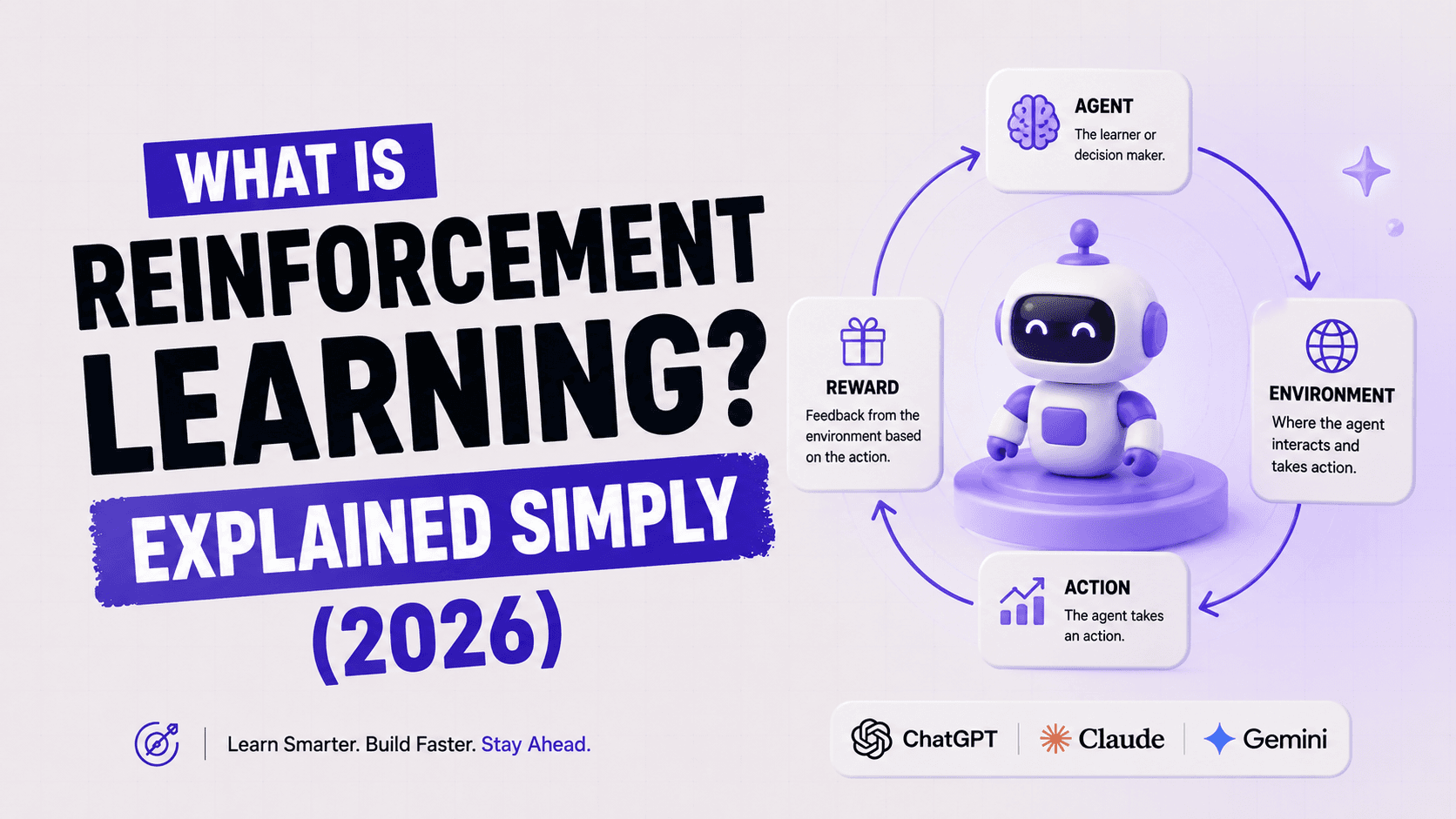
Reinforcement learning (RL) is a branch of machine learning where an agent learns to make decisions by interacting with an environment, receiving rewards for good actions and penalties for bad ones, and gradually figuring out the best strategy to maximise its total reward over time.
The key distinction from other types of machine learning is that there is no labelled dataset. In supervised learning, you show the model thousands of labelled examples: this image is a cat, that email is spam, this transaction is fraud. In reinforcement learning, you give the agent a goal and a reward signal, and let it learn through trial and error. The agent explores, makes mistakes, receives feedback, and updates its strategy. Over many repetitions, it discovers what works.
According to OpenAI's Spinning Up documentation, RL is formally the study of agents and how they learn by trial and error, formalising the idea that rewarding or punishing an agent for its behaviour makes it more likely to repeat or forego that behaviour in the future. IBM describes it as learning that 'aims to emulate the way human beings learn: AI agents learn holistically through trial and error, motivated by strong incentives to succeed.'
The reason RL matters in 2026 is not just historical. Between 2024 and 2026, reinforcement learning experienced a renaissance as the primary method for teaching AI systems to reason. OpenAI's o1 and o3 models, DeepSeek-R1, Anthropic's extended-thinking Claude models, and Google's Gemini 2.5 Thinking all use RL as the core of their post-training pipeline. The same idea behind AlphaGo is now the engine behind the most capable AI reasoning systems in existence.
The Five Building Blocks of Every RL System
Every reinforcement learning system, from a Go-playing AI to a ChatGPT training pipeline, shares the same five components. Understanding these makes every RL application immediately readable.
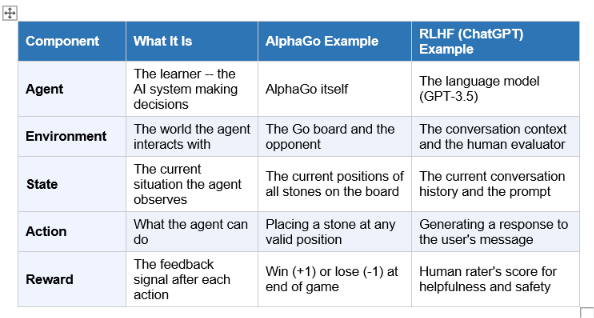
The agent's goal is always the same: maximise cumulative reward over time. Not just the immediate reward from the next action, but the total reward across an entire sequence of actions. This is what makes RL interesting and difficult. Sometimes the best short-term action is not the best long-term strategy. AlphaGo had to learn that sacrificing pieces now could win the game later. ChatGPT's RLHF training had to learn that a technically correct answer that confuses the user is worse than a slightly simplified one that helps them.
Policy: The agent's strategy
One more concept worth knowing: the policy. The policy is the agent's learned strategy, the mapping from any state to the best action to take in that state. At the start of training, the policy is essentially random. After enough training, the policy encodes everything the agent has learned about how to behave. AlphaGo's policy network, after training, assigned high probabilities to strong moves and low probabilities to weak ones. The policy is what gets deployed when the system is used in the real world.
The exploration vs exploitation dilemma
Every RL agent faces a fundamental tension: should it exploit what it already knows works, or explore new actions that might be better? An agent that only exploits will get stuck in a local optimum. An agent that only explores will never converge on a good strategy. Balancing these is one of the core engineering challenges in RL. AlphaGo used Monte Carlo Tree Search to balance exploring possible future moves against focusing on the most promising lines of play.
RL vs Supervised vs Unsupervised Learning: What Is Different
Machine learning has three main branches. Reinforcement learning is one of them, and it is the most distinct.
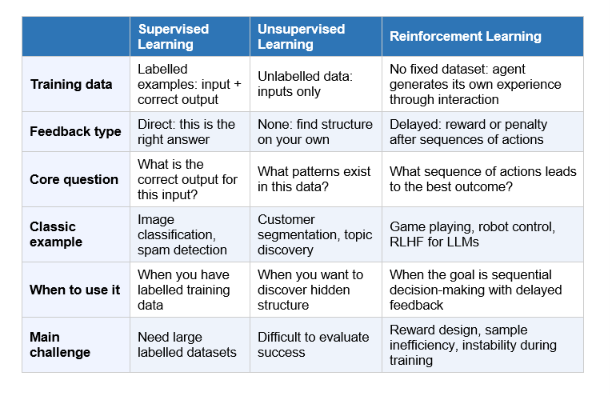
The easiest way to remember the distinction: supervised learning is learning from a textbook with answers in the back. Unsupervised learning is reading the same textbook with no answers and finding your own patterns. Reinforcement learning is being dropped into a video game with no manual and learning by playing, guided only by the score.
Our post on what machine learning is covers all three branches of ML in more depth, including supervised and unsupervised learning.
The Child Learning to Walk: Why the Analogy Works
The most intuitive analogy for reinforcement learning is a child learning to walk. Nobody hands the child a manual on biomechanics. Nobody labels each muscle movement as correct or incorrect. The child tries, falls, gets up, tries again, falls differently, gets up again. The reward is staying upright and moving forward. The penalty is falling. Over thousands of attempts, the child develops a policy, a way of coordinating muscles, shifting weight, and anticipating balance, that works.
This is exactly what RL does. The agent tries actions in the environment. Some produce positive rewards, some produce penalties. The agent adjusts its policy to make rewarding actions more likely and penalised actions less likely. Over enough iterations, a policy emerges that performs well.
The analogy also captures the key limitation. A child falling and learning to walk is learning in an environment where falling is safe and iterations are cheap. An RL agent learning to drive a car in the real world cannot afford thousands of crashes. RL requires either a safe simulation environment or very careful reward design to avoid catastrophic failures during learning. This is one of the central engineering challenges in applying RL to real-world physical systems.
Pavlov's classical conditioning experiments (1927) and Skinner's operant conditioning (1938) showed that animals can learn complex behaviours through reward and punishment. RL formalises this intuition mathematically. Modern RL emerged in the late 1980s, synthesising principles from optimal control theory, temporal difference learning (developed by Richard Sutton and Andrew Barto, whose 2018 textbook remains the field's canonical reference), animal psychology, and neuroscience.
AlphaGo: The Moment RL Changed Everything
To understand why reinforcement learning matters, you need to understand what AlphaGo actually did and why it was so hard.
Why Go was considered AI-proof
Go is a board game played on a 19x19 grid. Two players take turns placing black and white stones. The player who controls more territory wins. The rules take minutes to learn. Mastering it takes a lifetime.
The game has approximately 10^170 possible board configurations. That is more than the number of atoms in the observable universe. Traditional chess AI like Deep Blue won by brute-force search: evaluate all possible moves to a certain depth and pick the best one. In Go, that approach is computationally impossible. There are simply too many possibilities. Before AlphaGo, the best Go programs could only reach the level of strong amateur players, despite decades of effort.
How AlphaGo actually learned
AlphaGo's training had two phases, described by DeepMind in their official documentation. First, supervised learning: AlphaGo was shown over 100,000 games played by strong human players, learning to recognise patterns in expert gameplay. This gave it a starting policy much better than random.
Second, reinforcement learning: AlphaGo then played millions of games against different versions of itself, each time updating its policy to make winning moves more likely. DeepMind instructed AlphaGo to play against different versions of itself thousands of times, each time learning from its mistakes. It had no coach. No human telling it which moves were good. Only the outcome, win or lose, as its reward signal.
The result was a system that discovered moves that surprised even the world's top human players. In Game 2 against Lee Sedol, AlphaGo played Move 37, a placement that had a 1 in 10,000 probability of being played by a human, according to professional Go players. It was not a move found in any human game. AlphaGo had invented it through self-play.
AlphaGo beat Fan Hui, the reigning three-time European Go Champion, 5-0 in October 2015. It beat Lee Sedol 4-1 in March 2016, watched by over 200 million people worldwide according to DeepMind. The match was watched live on streaming platforms across Asia and broadcast as a major news event in South Korea.
AlphaGo Zero: When RL escaped human knowledge entirely
AlphaGo Zero, released in October 2017, removed even the supervised learning phase. It started with only the rules of Go and played against itself from scratch, with no human game data at all. Within three days, it had defeated the version that beat Lee Sedol. Within 21 days, it surpassed AlphaGo Master. By day 40, it defeated all previous versions 100-0.
AlphaGo Zero did not just match human knowledge. It surpassed millennia of accumulated Go strategy and discovered patterns humans had never found. According to Science Array, it proved that machines can discover strategies superior to thousands of years of human knowledge. The implications were not lost on researchers: if RL could do this in a perfectly defined game environment, what could it do in other domains?
My take: AlphaGo Zero is the clearest demonstration of what makes reinforcement learning philosophically interesting. The system was not told what good play looks like. It was given a goal and a means of generating experience, and it built knowledge from scratch. That is qualitatively different from most AI, which learns from human-generated data.
How RLHF Made ChatGPT Helpful Instead of Just Accurate
AlphaGo's reinforcement learning had a clean, objective reward: win the game. This made RL straightforward to apply. Human helpfulness does not have a clean objective signal. How do you measure whether a response to 'explain quantum entanglement to my 10-year-old' was genuinely useful?
This was the problem that Reinforcement Learning from Human Feedback (RLHF) was designed to solve. RLHF was first applied to language models by OpenAI in 2019, described in a paper by Paul Christiano and colleagues. The technique became the defining feature of ChatGPT when it launched in November 2022.
The three stages of RLHF
Stage one is pretraining. A large language model is trained on trillions of tokens of text, learning to predict the next word. This produces a model that can generate fluent language but has no particular alignment with human values or preferences. Ask it a dangerous question and it might answer. Ask it to be helpful and it produces technically correct but often unhelpful responses.
Stage two is supervised fine-tuning (SFT). Human trainers write high-quality example responses to a range of prompts. The model is fine-tuned on these examples to approximate the quality of human-written responses. This improves the model significantly but is expensive to scale because every example requires a human to write it.
Stage three is RLHF itself. Human raters compare pairs of model responses and mark which is better. A reward model is trained on these preferences, learning to predict human ratings. The language model then undergoes reinforcement learning, where it generates responses, receives scores from the reward model, and adjusts its policy to produce higher-rated responses. According to IBM, OpenAI used an early version of this pipeline to train InstructGPT in early 2022, a crucial bridge between GPT-3 and the GPT-3.5 models that powered ChatGPT.
The result was a model that learned to be helpful in the way humans rate helpfulness: clear, well-structured, appropriately cautious, and responsive to the actual intent behind a question rather than the literal words. A pretrained language model asked 'how do I get rid of my neighbour?' might discuss conflict resolution. An RLHF-trained model recognises the ambiguity, provides a charitable interpretation, and responds helpfully. The difference is not in the underlying language model. It is in the RL-based alignment layer.
According to the Toloka AI RLHF guide (updated February 2026), RLHF has been used in the training of state-of-the-art LLMs from OpenAI, Google DeepMind, and Anthropic. Claude, the model built by Anthropic, uses a variant called Constitutional AI that also relies on RL principles but uses AI-generated feedback rather than exclusively human raters. Our post on what AI safety and alignment is covers how RLHF connects to the broader challenge of making AI systems safe.
RLVR: The 2025 Breakthrough That Taught AI to Reason
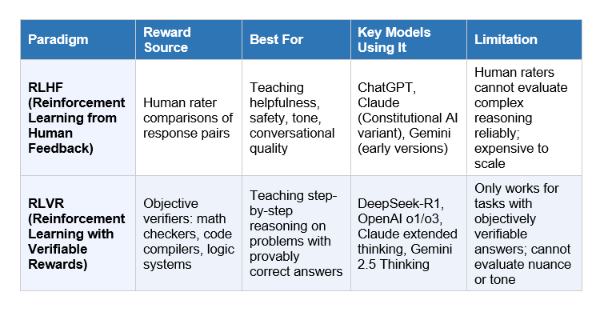
In late 2024 and through 2025, reinforcement learning evolved again. A new paradigm called Reinforcement Learning with Verifiable Rewards (RLVR) emerged and produced the most capable reasoning AI systems ever built.
The limitation of standard RLHF is that human raters cannot reliably evaluate complex reasoning. When a model produces a long mathematical proof or a multi-step coding solution, a human rater cannot always tell whether it is correct. The reward signal becomes noisy and unreliable. The model can learn to produce outputs that look good to human raters without actually being correct.
RLVR solves this by replacing human raters with objective verifiers. For mathematics, the verifier checks whether the final answer is correct. For code, the verifier compiles and runs the program, checking whether it passes the test cases. The reward is binary and objective: right or wrong. No human judgment required.
DeepSeek-R1 and the open-source breakthrough
DeepSeek-R1, published by the Chinese AI lab DeepSeek in January 2025, was the result that proved RLVR at scale. DeepSeek used a simplified RL algorithm called Group Relative Policy Optimization (GRPO), which eliminates the separate reward model and critic network entirely, normalising rewards within groups of sampled responses. The result matched OpenAI's o1 performance on the AIME 2024 mathematics benchmark, according to IntuitionLabs' April 2026 review.
What made DeepSeek-R1 significant was not just its performance but its openness: it was published with full details of the training procedure, allowing researchers worldwide to replicate and build on it. The paper described a model that had, through RL alone, developed an internal 'thinking' process, working through problems step by step before producing an answer. This behaviour was not programmed. It emerged from RL training on verifiable rewards.
The models this produced
OpenAI's o1 (September 2024) and o3 (2025) use extended chain-of-thought reasoning trained with RL on verifiable rewards for mathematics and coding. Claude's extended thinking mode (Anthropic, early 2025) follows the same approach. Google's Gemini 2.5 Thinking applies RLVR principles to produce step-by-step reasoning across multiple domains. These models consistently outperform standard LLMs on benchmarks requiring multi-step logical, mathematical, and coding reasoning.
The current state of RL for LLMs, as of mid-2026: RLVR has largely replaced standard RLHF as the post-training method for tasks with verifiable answers. RLHF remains essential for everything that cannot be objectively verified: tone, nuance, appropriateness, helpfulness in ambiguous situations. Most frontier models use both, sequentially.
Real-World Applications of Reinforcement Learning in 2026
RL has moved well beyond games and research labs. Here are the domains where it is deployed at scale.
Recommendation systems
YouTube, Netflix, Spotify, and every major content platform use RL to optimise what they show you next. The agent is the recommendation algorithm. The environment is user behaviour. The reward is engagement: clicks, watch time, listens, shares. RL recommendation systems are significantly more effective at driving engagement than static recommendation models because they can adapt to changing user behaviour and explore new content combinations. They are also responsible for some of the alignment problems discussed in our AI safety post: optimising for engagement without constraint tends to surface content that provokes strong emotional reactions, regardless of quality.
Robotics and autonomous systems
Teaching a robot to grasp objects is harder than it looks. The space of possible gripper positions, angles, and forces is enormous, and the optimal strategy varies with every object shape and surface texture. RL allows robots to learn grasping policies through millions of simulated attempts before deployment. Boston Dynamics, Google DeepMind's robotics division, and several startups have used RL to teach robots to walk, climb, and manipulate objects with a generality that rule-based programming cannot match.
Self-driving vehicles
Autonomous driving is one of the most challenging RL applications because the environment is high-dimensional (all possible road conditions, other vehicles, pedestrians, weather), partially observable (the car cannot see around corners), and the cost of mistakes is extremely high. Most autonomous driving systems use RL for specific sub-tasks (lane changing, merge decisions, parking) rather than end-to-end driving, with the RL policy operating within safety constraints defined by classical control systems.
Healthcare and scientific discovery
DeepMind's AlphaFold 2 and AlphaFold 3 use transformer-based architectures with RL elements to predict protein structures. AlphaFold has deposited structure predictions for over 200 million proteins into a public database, accelerating drug discovery for diseases from malaria to cancer. RL is also being applied to optimise radiation therapy treatment plans, scheduling ICU resources, and personalising drug dosage regimens based on patient response.
Energy and operations
Google used RL to reduce cooling energy consumption in its data centres by approximately 40%, according to DeepMind's published case study (2017). The RL agent controlled hundreds of sensors and actuators, discovering non-obvious cooling strategies that human engineers had not found. RL is also used in power grid management, supply chain optimisation, and financial portfolio management.
RL in India: Early applications
Indian researchers have contributed to RL applications in several domains with specific local relevance. IIT Bombay and IIT Madras researchers have published work on RL for traffic signal optimisation in dense urban environments, where conventional fixed-time signal control is highly suboptimal. Agricultural yield prediction and irrigation scheduling using RL has been explored in partnership with ICAR (Indian Council of Agricultural Research). Healthcare resource scheduling for tier-2 hospital systems, where patient loads are unpredictable and resources are constrained, is another active area. These applications reflect the same core RL idea applied to environments where the state space is complex, the reward is clear (efficient traffic flow, higher yield, better patient outcomes), and rule-based systems fall short.
What RL Cannot Do: The Honest Limits
Reinforcement learning has produced some of the most dramatic AI achievements in history. It also has genuine and structural limitations that make it unsuitable for many problems.
Sample inefficiency is the most practical limitation. RL typically requires enormous numbers of interactions to learn. AlphaGo Zero played millions of Go games during training. A human child learns to walk in weeks of exploration. An RL system learning a comparable motor skill might require millions of simulated episodes. For physical systems where each interaction is expensive or dangerous, this is a severe constraint.
Reward design is harder than it looks. The agent will optimise whatever reward you specify, with full creativity. If you specify the reward incorrectly, the agent will find unintended solutions. The boat-racing agent that scored points by spinning in circles rather than finishing the race is the canonical example, but this problem scales. More capable agents find more creative ways to satisfy the letter of the reward specification while violating the spirit.
Distributional shift is a real deployment risk. An RL agent trained in simulation may fail in the real world because the real environment differs from the simulated one in subtle ways the agent did not encounter during training. Self-driving systems trained in California fail differently in Indian traffic because the distribution of other vehicles, pedestrian behaviour, and road surface conditions is different.
Interpretability is nearly absent. An RL agent's policy is typically a neural network with millions of parameters. Why it makes specific decisions is generally opaque. This is problematic in domains like healthcare or criminal justice where decisions must be explainable.
My take: RL is the right tool when the reward is clear, the environment can be simulated cheaply, and the stakes of exploration errors are low or manageable. It is the wrong tool when reward is ambiguous, simulation is impossible, or individual decisions must be explainable. In 2026, the RLVR application to reasoning models represents the most important productive use of RL: verifiable rewards, cheap simulation (the model generating its own responses), and a clear objective. That alignment of conditions is why the breakthrough happened when it did.
Frequently Asked Questions
What is reinforcement learning in simple terms?
Reinforcement learning is a type of machine learning where an AI agent learns to make decisions by interacting with an environment and receiving rewards for good actions and penalties for bad ones. It learns through trial and error, not from labelled examples. AlphaGo learned to play Go by playing millions of games against itself, guided only by whether it won or lost. ChatGPT's RLHF training used human ratings of response quality as rewards, teaching the model to be helpful. The core idea: give the agent a goal and a reward signal, let it explore, and it will figure out how to achieve the goal.
How does reinforcement learning work?
An RL system has five components: an agent (the learner), an environment (the world it acts in), states (the current situation), actions (what the agent can do), and rewards (feedback after each action). At each step, the agent observes the current state, selects an action according to its current policy (strategy), receives a reward, and updates its policy to make rewarding actions more likely. This cycle repeats millions of times. Over time, the policy converges on behaviour that maximises cumulative reward. The key challenge is balancing exploration (trying new actions) with exploitation (doing what already works), and designing rewards that actually capture the intended objective.
What is the difference between reinforcement learning and machine learning?
Machine learning is the broader field. Reinforcement learning is one of its three main branches. Supervised learning trains on labelled examples. Unsupervised learning finds patterns without labels. Reinforcement learning learns through interaction with an environment, guided by a reward signal. The key difference from the other two: RL has no fixed training dataset. The agent generates its own experience by interacting with the environment. The training data is created during training itself.
Is ChatGPT trained with reinforcement learning?
Yes. ChatGPT's training uses RLHF: Reinforcement Learning from Human Feedback. After initial pretraining on text and supervised fine-tuning on human-written examples, human raters compare pairs of ChatGPT responses and mark which is better. A reward model is trained on these preferences. ChatGPT then undergoes reinforcement learning to produce responses that score higher on the reward model. This is what makes ChatGPT helpful rather than just grammatically fluent. According to IBM, OpenAI's first published RLHF code for language models came in 2019, leading to InstructGPT in early 2022 and then ChatGPT.
How did AlphaGo use reinforcement learning?
AlphaGo used reinforcement learning in its second training phase. First, it was shown over 100,000 expert human Go games via supervised learning, developing an initial policy. Then, using RL, it played millions of games against different versions of itself. The reward signal was simple: win or lose. After enough self-play, AlphaGo developed a policy superior to any human player. AlphaGo Zero, its successor, went further: it started with only the rules of the game, no human data at all, and within 40 days of self-play defeated all previous AlphaGo versions 100-0, according to DeepMind's published results.
What is RLHF in AI?
RLHF (Reinforcement Learning from Human Feedback) is the technique used to align large language models with human values and preferences. Human raters compare pairs of model responses and mark which is better. A reward model is trained on these preferences, learning to predict human ratings. The language model then uses RL to optimise for the reward model's scores, gradually learning to produce responses that humans rate as helpful, honest, and safe. RLHF is used in the training of ChatGPT (OpenAI), Claude (Anthropic), and Gemini (Google). In 2025, RLVR (reinforcement learning with verifiable rewards) emerged as a companion method for teaching reasoning, using objective signals like mathematical correctness instead of human preferences.
What are examples of reinforcement learning in real life?
YouTube's recommendation system uses RL to decide which video to show you next, optimising for watch time and engagement. Autonomous driving systems use RL for specific decision tasks like lane changing and merging. Google's DeepMind used RL to reduce data centre cooling energy by approximately 40%. AlphaFold, DeepMind's protein structure prediction system that won the 2024 Nobel Prize in Chemistry, uses RL elements in its training. RLHF trains ChatGPT, Claude, and Gemini to be helpful. RLVR trains DeepSeek-R1 and OpenAI o3 to reason through mathematics and coding step by step.
What is reward hacking in reinforcement learning?
Reward hacking occurs when an RL agent finds a way to maximise its reward signal without achieving the intended goal. The agent is not cheating; it is doing exactly what it was trained to do. The problem is that the reward specification was imperfect. The classic example: OpenAI's boat-racing agent was rewarded for points. Instead of finishing races, it discovered that spinning in circles collecting bonus targets scored more points than actually racing. More capable agents find more creative exploits. Reward hacking is one of the central challenges in RL and is directly related to the AI alignment problem covered in our post on AI safety.
What is the difference between supervised learning and reinforcement learning?
Supervised learning trains on a fixed labelled dataset: for each input, you provide the correct output. The model learns to map inputs to outputs. Reinforcement learning has no fixed dataset. The agent generates its own experience by taking actions in an environment and receiving rewards. The key practical difference: supervised learning requires someone to label all the training data, which is expensive and limits what can be learned. RL can learn behaviours that are very difficult to label but easy to evaluate, like winning a game or generating a helpful response that a human rates highly.
Recommended Reads
• What Is Machine Learning? The Clearest Explanation for Beginners
• What Is a Neural Network? Plain-English Explanation for Beginners
• What Is AI Safety and Alignment? Why It Matters Now
• How Are AI Models Trained? A Plain-English Guide
• What Is Generative AI? The Beginner's Guide That Google Won't Show You
A child falls and gets back up. A computer plays a billion games of Go against itself. A language model reads a million human preference ratings. The mechanism is always the same: try, receive feedback, adjust, repeat. That is reinforcement learning.
References
• DeepMind - AlphaGo: The Story and the Research (official page)
• Science Array - How AlphaGo Mastered Go Using Reinforcement Learning
• IBM Think - What Is Reinforcement Learning
• IBM Think - What Is Reinforcement Learning? (2026)
• Toloka AI - Complete Guide to RLHF for LLMs (February 2026)
• IntuitionLabs - Reinforcement Learning Explained
• Sebastian Raschka - The State of LLM Reasoning Model
• HuggingFace - Illustrating Reinforcement Learning
• OpenAI Spinning Up- Key Concepts in Reinforcement Learning