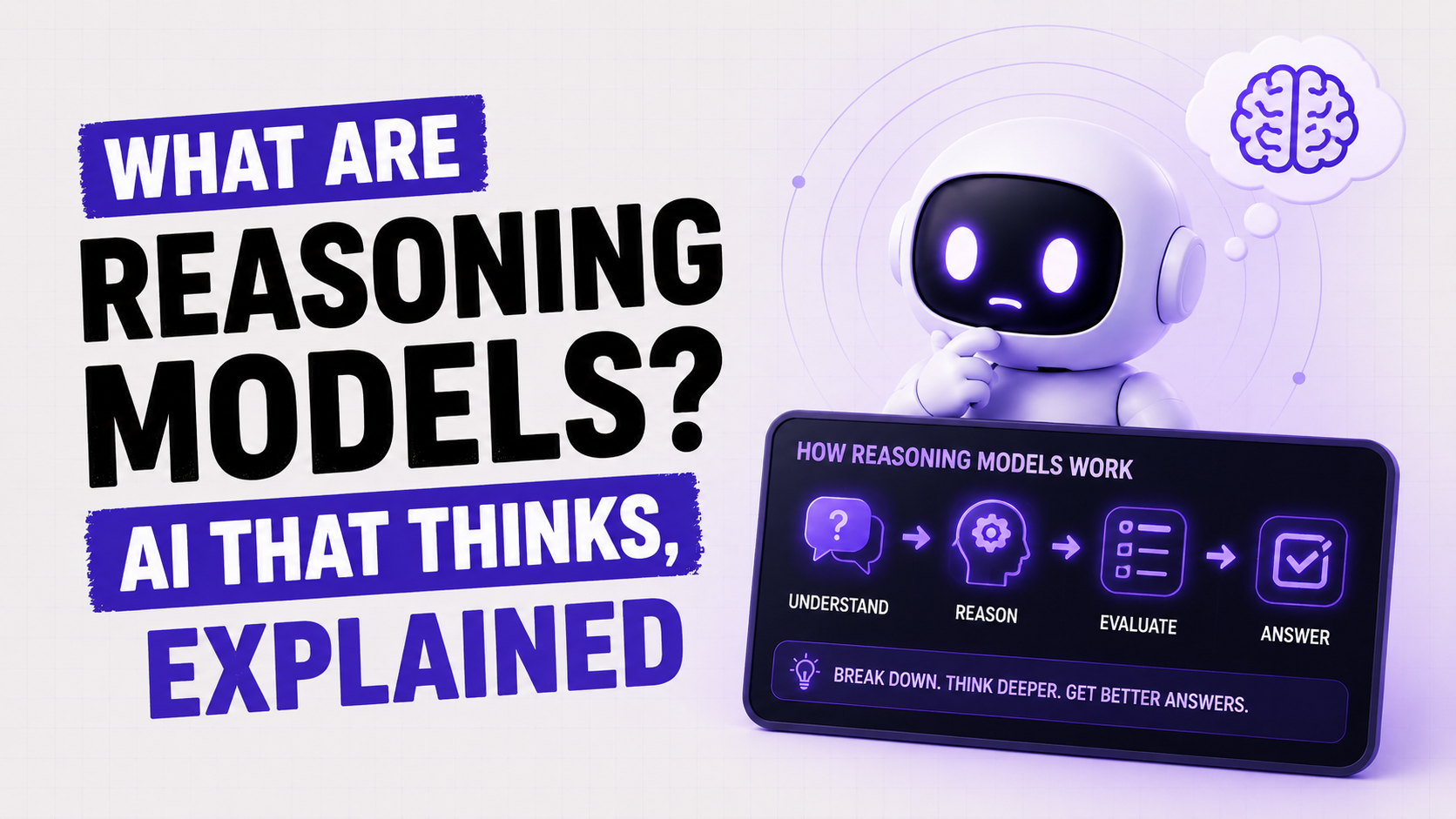
What Are Reasoning Models? Why AI Now Thinks First
Give a regular AI model a hard maths problem and it blurts out an answer instantly, the way a student guesses without working. On AIME 2024, a brutal high-school maths contest, that approach scored GPT-4o around 12 percent. Then a new kind of model was told to slow down and think step by step before answering. Its score on the same test jumped to around 74 percent.
Same underlying technology. Six times better. The only thing that changed was that the model was allowed to think first. That shift, from answering instantly to reasoning before responding, is the single biggest change in AI since transformers arrived, and it created a whole new category: reasoning models.
You have met them even if you did not know the name. When ChatGPT shows a thinking spinner, when a model takes 10 seconds and then nails a problem it used to fail, that is a reasoning model at work. This guide explains what they actually are, how the thinking trick works, why it costs more and takes longer, and, importantly, when you should not use one, because they are not better at everything.
What Is a Reasoning Model?
A reasoning model is an AI that generates a chain of internal thinking before it gives a final answer, instead of responding in one quick pass. It spends extra effort at the moment you ask, working through a problem step by step, checking itself, and sometimes backtracking, and only then commits to a reply.
Underneath, it is still a large language model. The difference is not a new brain, it is a new habit. A standard model is trained to produce the answer directly. A reasoning model is trained to first produce a long stretch of private reasoning, called thinking tokens, and use that working-out to reach a better final answer. Same foundation, different behavior.
The everyday analogy is a student taking a maths exam. One student reads the question and immediately writes down whatever answer pops into their head. The other reads the question, works through it on scratch paper, checks the steps, catches a mistake, fixes it, and then writes the answer. On easy questions they tie. On hard ones, the second student wins every time. Reasoning models are the second student.
A standard model guesses fast. A reasoning model works it out first. On hard problems, working it out wins.
The reason this matters so much is that many valuable tasks, maths, coding, logic, planning, science, are exactly the kind where a snap answer fails and careful step-by-step work succeeds. Reasoning models unlocked those tasks, which is why they took over the frontier in barely a year.
The Old Way vs the New Way
The core difference is where the AI spends its effort. A standard model does almost all its work during training and then answers instantly and cheaply. A reasoning model does extra work at the moment you ask, spending time and compute to think, which is why it is slower and pricier but far stronger on hard problems.
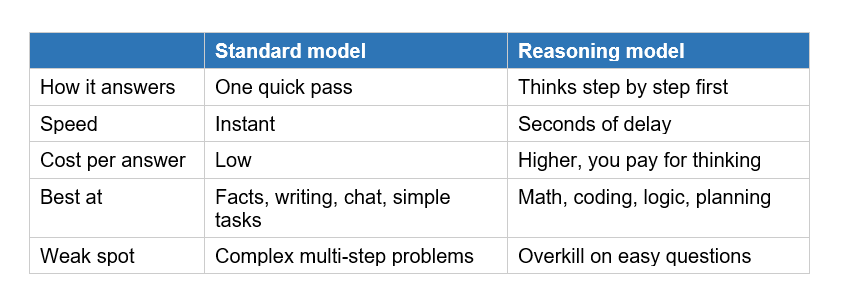
Notice that neither column is simply better. This is the point people miss most often. A reasoning model is not an upgraded standard model you should always prefer. It is a different tool tuned for a different job. Using one for a simple task is like hiring a mathematician to add up your grocery bill: slower, costlier, and no more correct.
How Thinking First Actually Works
Reasoning models work by generating intermediate reasoning steps, called chain of thought, before the final answer, and this behavior is trained into them with reinforcement learning. Three ideas combine to make it work, and you do not need maths to follow any of them.
Chain of thought
Chain of thought means the model writes out its reasoning as a series of steps, the way you would show your working on paper. Instead of jumping to an answer, it produces something like: first this, which means that, but wait, check this, therefore the answer. Making the steps explicit dramatically reduces careless mistakes, because each step builds on a checked one rather than a guess.
Crucially, the model is not just told to do this with a clever prompt. It is trained to reason using reinforcement learning, where it practices on problems, gets rewarded when its reasoning leads to correct answers, and gradually learns to think in ways that work. The thinking habit is baked in during training, not bolted on at the end.
Self-checking and backtracking
A reasoning model can notice its own errors mid-thought. It explores a path, realizes it leads nowhere, says something like that is wrong, let me try another way, and switches. DeepSeek's R1 model became famous partly because its reasoning transcripts read almost like a human working through a problem out loud, complete with second-guessing and course-correction. That ability to catch and fix its own mistakes is a large part of the accuracy gain.
The hidden thinking phase
Most of this reasoning happens privately, before you see anything. That is the pause behind the thinking spinner. The model may generate thousands of words of internal working that you never read, then hand you a clean final answer. You are paying for all those hidden words, which is the key to understanding both the power and the cost of these models.
Test-Time Compute: The New Way to Make AI Smarter
Test-time compute is the idea that an AI can get smarter by thinking longer when you ask, rather than only by being trained bigger, and it opened an entirely new way to improve AI. Many researchers call it the most important shift since transformers replaced older network designs.
For years, the only recipe to make AI smarter was to train a bigger model on more data, which costs a fortune and takes months. Test-time compute added a second lever: take an existing model and simply let it think for longer at the moment of the question. More thinking, better answers, no retraining required. That is a genuinely new axis of progress, and a cheaper one to pull.
This is a real change from the scaling story that drove earlier AI. If you have read about how AI models are trained, the old picture was bigger training equals smarter model. Test-time compute says you can also get smarter by spending more effort per answer, which is why a smaller reasoning model can now beat a much larger standard one on hard problems.
The trade is direct and worth remembering: you are swapping time and money for intelligence, on demand. Need a quick answer? Think briefly. Need to crack a hard problem? Think longer and pay more. For the first time, you can dial an AI's effort up or down per question, which is a genuinely different way to use a computer.
Old rule: to make AI smarter, train it bigger. New rule: you can also just let it think longer. That second lever changed everything.
The Big Names: o-series, DeepSeek-R1, and Thinking Models
The reasoning-model era started in late 2024 with OpenAI's o1 and DeepSeek's R1, and by 2026 nearly every major AI lab offers a thinking mode. Recognizing the main names helps you follow the field and pick the right tool.
• OpenAI o-series: the models that launched the category, built specifically to reason before answering, and still among the strongest on hard maths and coding.
• DeepSeek-R1: the open-source breakthrough that showed powerful reasoning did not have to be secret or hugely expensive, with public reasoning transcripts that made the how visible to everyone.
• Thinking modes on standard models: Claude's extended thinking, Gemini's thinking variants, and others now let one model switch reasoning on or off depending on the task.
That last point is where the field is heading: not separate reasoning models, but one model that decides how hard to think per question. If you want to see how the major families compare on this and other capabilities, our guide on ChatGPT vs Claude vs Gemini lays out where each one stands.
One head-to-head to give a feel for the differences: in one comparison, OpenAI's o1 reasoned more strongly than DeepSeek-R1, answering 18 of 27 hard questions correctly to R1's 11. The leaders trade places constantly, which is exactly why you should judge by your own task, not by last month's leaderboard.
The Catch: Slower, Pricier, and Not Always Better
Reasoning models cost more and run slower because you pay for every thinking token, and on simple tasks they add expense with no benefit. This is the honest limitation that hype tends to skip, and it matters for anyone actually paying for AI.
The cost gap is not small. In one case, Gemini 3 Flash with reasoning turned on used 160 million tokens to run a set of benchmarks, while the same model without reasoning used 7.4 million. That is more than twenty times the token usage, and since you pay per token, more than twenty times the cost for that work. Extended thinking is often billed at the higher output-token rate, so the meter runs fast.
Speed is the other tax. Early reasoning models in 2025 took 30 to 120 seconds on many queries. By early 2026 the faster ones handle most reasoning in 3 to 15 seconds, a big improvement, but still far slower than the instant reply of a standard model. For anything interactive, that delay is felt.
And here is the part that surprises people: reasoning models are not more accurate on easy tasks. For simple question answering, translation, and pulling information out of text, they cost more and take longer for no gain in correctness. The extra thinking is wasted when there was nothing hard to think about. More thinking only helps when the problem actually needs thought.
This is also why you should read reasoning-model benchmark scores carefully, since a model can post a huge number by spending a fortune in thinking tokens. Our explainer on what AI benchmarks really measure covers why a high score is not always the win it looks like.
When to Use a Reasoning Model (and When Not To)
Use a reasoning model when the task genuinely requires multi-step thinking, and use a standard model when it does not. The right question is not which model is smarter, but does this specific task need careful step-by-step work.
Reach for a reasoning model when you are doing:
• Hard maths, logic puzzles, or multi-step calculations where one wrong step ruins the answer.
• Complex coding, debugging, or anything where the model must plan before writing.
• Careful analysis, scientific problems, or strategy that rewards weighing options and checking work.
Stick with a standard model when you are doing:
• Simple questions, quick facts, or definitions where a fast answer is already correct.
• Writing, brainstorming, summarizing, or chatting, where fluency matters more than deliberation.
• Translation and information extraction, where reasoning adds cost and delay with no accuracy benefit.
My practical rule: default to the fast standard model, and reach for reasoning only when you catch the task making you think hard too. If you would need scratch paper, the AI probably needs its thinking mode. If you would answer off the top of your head, so should it. Match the tool to the difficulty and you get the best of both, speed when you want it and depth when you need it.
Frequently Asked Questions
Q: What is a reasoning model in AI?
A reasoning model is an AI that generates a chain of internal step-by-step thinking before giving its final answer, rather than responding in one quick pass. This lets it solve hard math, coding, and logic problems far more accurately. On the AIME 2024 math contest, this approach lifted scores from around 12 percent to about 74 percent compared to a standard model.
Q: What is the difference between a reasoning model and a normal LLM?
A normal LLM answers instantly in a single pass, which is fast and cheap and great for facts, writing, and chat. A reasoning model first works through the problem step by step, which makes it slower and more expensive but much stronger on math, coding, and multi-step logic. They are different tools for different jobs, not one being universally better.
Q: What is test-time compute?
Test-time compute is the idea that an AI can get smarter by thinking longer at the moment you ask, rather than only by being trained on more data. It added a new way to improve AI without retraining: give an existing model more time and effort per question and it produces better answers. Many researchers call it the most important shift since transformers.
Q: What is chain of thought in AI?
Chain of thought is when an AI writes out its reasoning as a series of steps before answering, like showing your working on a math problem. Making each step explicit reduces careless mistakes because the model builds on checked steps instead of guessing. Reasoning models are trained to do this automatically using reinforcement learning.
Q: Are reasoning models always better?
No. Reasoning models are stronger on hard tasks like math, coding, and logic, but on simple question answering, translation, and extraction they cost more and run slower with no gain in accuracy. The extra thinking only helps when the problem genuinely requires it. For easy tasks, a standard model is the better and cheaper choice.
Q: Why are reasoning models slower and more expensive?
Because you pay for every thinking token they generate, and they generate a lot. In one example, Gemini 3 Flash with reasoning used 160 million tokens versus 7.4 million without, more than twenty times as many. All that hidden thinking also takes time, typically 3 to 15 seconds in 2026, compared with the near-instant reply of a standard model.
Q: What are examples of reasoning models?
The category launched in late 2024 with OpenAI's o1 and DeepSeek's R1. By 2026, most major models offer a thinking mode, including Claude's extended thinking and Gemini's thinking variants. DeepSeek-R1 was notable for being open-source and showing its reasoning transcripts, which helped the whole field understand how these models work.
Q: When should I use a reasoning model?
Use one for hard math, complex coding and debugging, logic puzzles, careful analysis, and planning, any task where one wrong step ruins the result. Use a standard model for simple questions, writing, brainstorming, translation, and chat. A good rule: if you would need scratch paper to solve it, the AI probably needs its reasoning mode too.
Recommended Reads
• What Is a Large Language Model? (Explained Simply)
• What Is Reinforcement Learning? Explained Simply
• What Are AI Benchmarks? MMLU and SWE-bench Explained
• How Are AI Models Trained? A Plain-English Guide
The best AI users know which tool fits which task. Five minutes a day is enough to always pick the right one.
References
• DeepLearning.AI - Reasoning Models, Beginning With o1 and DeepSeek-R1
• Turing Post - Reasoning Models Explained: o1, DeepSeek-R1 and How They Work
• Taskade - AI Reasoning Models and Test-Time Compute Explained