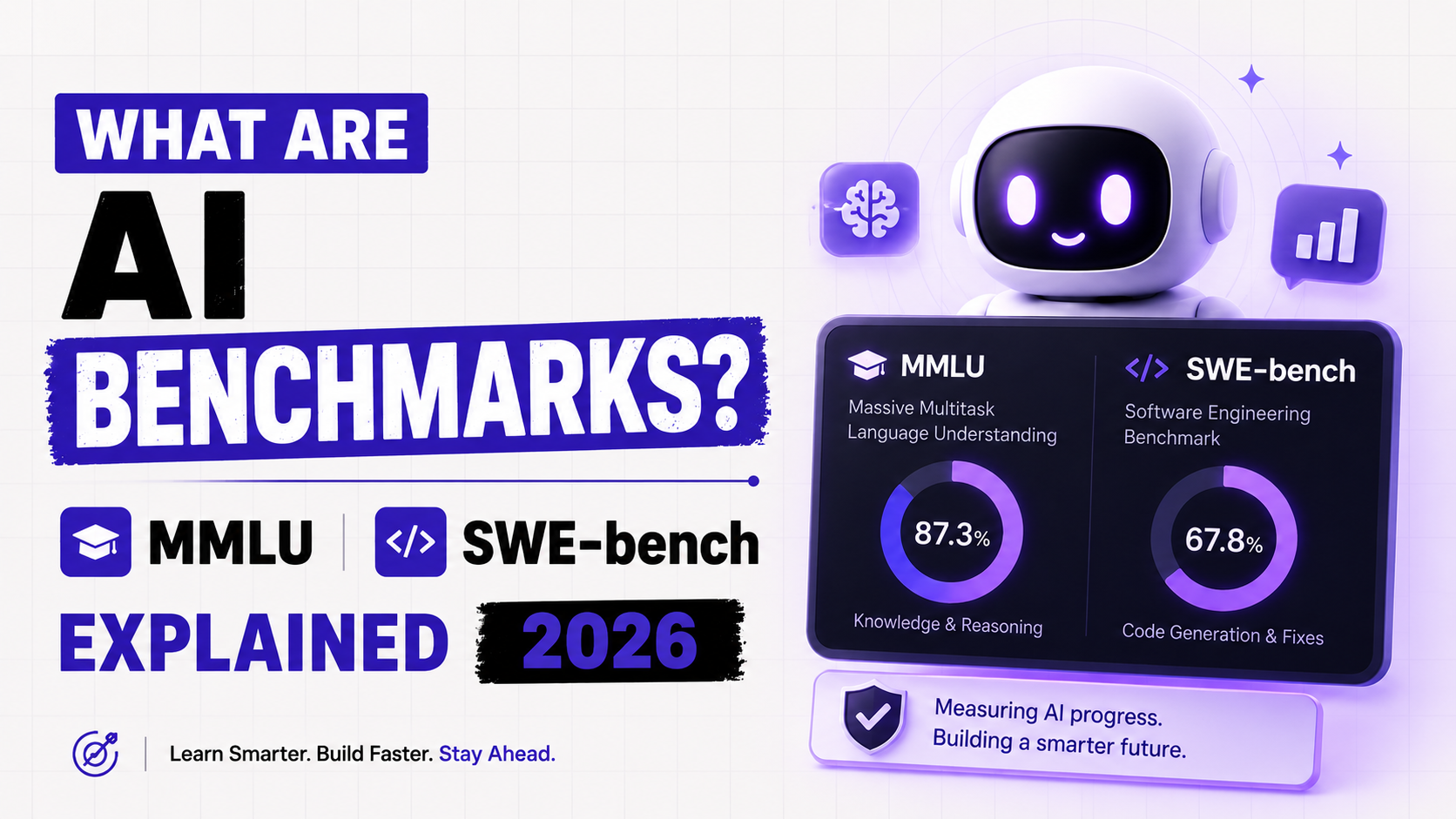
What Are AI Benchmarks? MMLU and SWE-bench Explained
In 2020, GPT-3 scored 43.9 percent on a test called MMLU and researchers were impressed. By 2026, frontier models cluster in the low 90s on the same test, packed within two percentage points of each other. That looks like a triumph. It is actually the sound of a ruler breaking.
Every time you read that a new model is the smartest yet, that claim rests on a benchmark, a standardized test that scores how well an AI performs a task. MMLU and SWE-bench are two of the most cited, and they get quoted in launch posts, news headlines, and Twitter arguments as if the numbers were self-explanatory. They are not. Some of the most quoted scores in AI are quietly meaningless, and a few are close to fraudulent.
I read benchmark tables for a living and I still see people, including smart ones, draw exactly the wrong conclusion from a leaderboard. So this guide does two jobs. First, plain-English explanations of what AI benchmarks are and how MMLU and SWE-bench actually work. Second, the part almost nobody teaches: how these tests get gamed, why the scores keep breaking, and how to read a number without being fooled by it.
What Is an AI Benchmark?
An AI benchmark is a standardized test that measures how well an AI model performs a specific skill, using a fixed set of questions and an automatic scoring method. It exists so that different models can be compared on the same tasks under the same rules, instead of everyone trusting marketing claims.
Every benchmark has four parts, and once you see them you can never unsee them:
A dataset: a fixed collection of questions or tasks, like 15,908 exam questions or 500 real coding problems.
A task definition: exactly what the model has to do, answer a multiple-choice question, write a code patch, solve a maths problem.
A metric: how correctness is measured, usually accuracy, the percentage the model gets right.
A score: the single number that lands on the leaderboard and the launch slide.
Benchmarks measure large language models the way standardized exams measure students. And they carry the exact same flaw a standardized exam does: a high score proves the model is good at the test, which is only useful if the test resembles the real thing you care about. Hold that thought, because it is the key to everything that follows.
Benchmarks matter because the alternative is worse. Without them, every AI lab would simply assert it built the best model and you would have no way to check. A flawed shared ruler still beats no ruler. The trouble starts when people treat the ruler as perfect, and the numbers as truth rather than as evidence.
A benchmark score tells you how good a model is at the benchmark. Whether that means anything for your work is a separate question, and it is the only one that matters.
MMLU: The Test That Defined an Era, Then Broke
MMLU, short for Massive Multitask Language Understanding, is a benchmark that tests an AI across 57 academic subjects using roughly 16,000 multiple-choice questions spanning maths, law, medicine, history, and more. For years it was the default measure of how much a model knows, and it was the number everyone quoted.
The design is simple. Each question has four answer choices, the model picks one, and its score is the percentage it gets right. Because the subjects range from elementary maths to professional law and medicine, a high MMLU score signalled broad general knowledge rather than a narrow skill. That breadth is why it became the headline benchmark of the 2020 to 2023 era.
Then progress destroyed it. GPT-3 scored 43.9 percent in 2020. By 2026, the best models sit in the low 90s, clustered less than two percentage points apart on a roughly 16,000-question test, which is well inside the range of random measurement noise. When the top ten models are all within a rounding error, the benchmark has stopped telling you who is better. It has run out of room.
The successor is MMLU-Pro, a harder version with around 12,000 questions across 14 disciplines and ten answer choices per question instead of four, designed to reward reasoning over memorized facts. It discriminates better between top models, for now, though frontier systems are already nearing 90 percent on it too, with Gemini 3 Pro around 90.1 percent. The knowledge benchmarks keep getting solved, which is a genuinely strange kind of problem to have. If you follow model launches like ChatGPT, Claude, and Gemini, you will notice MMLU quietly vanishing from the slides and MMLU-Pro taking its place.
The lesson from MMLU is not that it was bad. It was excellent, and it drove years of real progress. The lesson is that every knowledge benchmark has a shelf life, and a score only means something relative to when it was measured. A 90 on MMLU in 2022 was extraordinary. The same 90 in 2026 is table stakes.
SWE-bench: Can the AI Fix a Real Bug?
SWE-bench is a benchmark that tests whether an AI can fix real software bugs by giving it actual GitHub issues from open-source projects and checking if its code patch passes the existing tests. Unlike knowledge quizzes, it measures something concrete: can this model do a real engineering job end to end?
The task is genuinely hard, which is what makes it valuable. The model receives a real bug report and the full code repository, then has to understand the codebase, locate the problem, write a fix as a code diff, and produce something that makes the project's existing test suite pass. There is no multiple choice and no partial credit. The patch either fixes the bug and passes the tests or it does not.
This is why SWE-bench predicts real-world usefulness better than almost any other benchmark. Writing a small function in isolation, which older coding tests measured, is nothing like navigating a large unfamiliar codebase to fix an actual issue. SWE-bench measures the second thing, which is the thing you actually want from an AI coding assistant.
The version people quote is SWE-bench Verified, a human-checked subset of 500 tasks with ambiguous or unsolvable problems removed. As of early 2026 the leaders are tight: Claude Opus 4.5 at 80.9 percent, Claude Opus 4.6 at 80.8, and Gemini 3.1 Pro at 80.6, while the average across all ranked models sits near 62 percent. An 80 percent score means the model resolves roughly four out of five real GitHub issues on its own, which a few years ago would have sounded like science fiction.
These models reach that level through training that combines many techniques, including reinforcement learning tuned specifically for coding and tool use. But hold your applause on that 80 percent, because the next three sections are about why a number like it can be far less impressive than it looks.
The Other Benchmarks Worth Knowing
Beyond MMLU and SWE-bench, a handful of benchmarks come up constantly, and recognizing them by name is enough to follow any model launch. Each measures a different slice of capability, which is exactly why no single score can summarize a model.
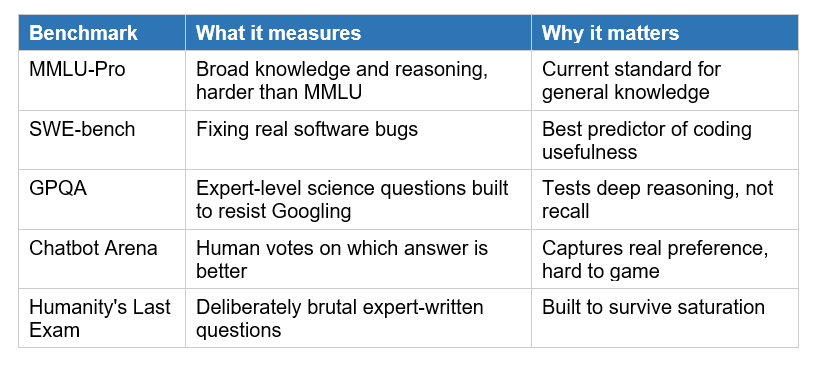
Two of these deserve a note. Chatbot Arena is different from the rest because it uses human judgement: real people compare two anonymous model responses and vote for the better one, producing an Elo rating like chess. That is harder to game with memorization because there is no fixed answer key to leak, though it rewards models that are charming as much as correct, which is its own kind of bias.
Humanity's Last Exam is the direct response to saturation. Its questions are written by experts to be so hard that even frontier models fail most of them, buying the benchmark a longer useful life before it too gets solved. The very existence of a benchmark named for the end of human advantage tells you how fast this field is moving.
Benchmark Saturation: When a Test Gets Too Easy
Benchmark saturation happens when models score so high that the test can no longer tell them apart, making the scores meaningless at the top. It is the first of three reasons a benchmark number can lie to you, and MMLU is the textbook case.
The pattern is always the same. A benchmark launches, models score low, and there is plenty of room to improve. Progress eats that room. Within a few years the leaders bunch up near the ceiling, the gaps between them shrink below measurement noise, and a one-point difference on the leaderboard reflects luck, not capability. MMLU and MMLU-Pro are both functionally saturated above roughly 88 percent for frontier models.
Here is why saturation quietly misleads people. When the top five models all score between 90 and 92, a headline can truthfully crown any of them the leader by cherry-picking that benchmark, and the ranking flips from month to month on noise alone. The number is real. The conclusion drawn from it is fiction.
Two models a point apart on a saturated benchmark are not one better than the other. They are two coin flips that happened to land differently.
The practical defense is simple: when scores on a benchmark are all crowded near the top, ignore the ranking on that benchmark entirely. It has finished its useful life. Look for a harder test where the models still spread out, because spread is the only thing that carries information.
Benchmark Contamination: When the AI Has Seen the Answers
Benchmark contamination is when the test questions, or close copies of them, end up in a model's training data, so the model is partly remembering answers rather than working them out. It is the most serious integrity problem in AI evaluation, and it is far more common than the leaderboards admit.
The mechanism is almost innocent. Benchmarks are published openly so researchers can use them. Models are trained on giant scrapes of the internet. So the benchmark, its questions, and often its answers get swept into the training data, and later the model faces a test it has effectively already seen. Studies confirm models score measurably higher on questions that were in their training data than on ones that were not.
SWE-bench gave us the clearest proof. An internal OpenAI audit found that every major frontier model could reproduce verbatim the exact human-written fix for some SWE-bench Verified tasks, because those 500 Python problems existed on GitHub, and in training data, before the benchmark was assembled. The model was not solving those bugs. It was reciting the answer it had memorized.
The response was SWE-bench Pro, a harder benchmark from Scale AI with 1,865 multi-language tasks chosen to avoid contamination. The results are sobering: models that score above 80 percent on Verified drop to roughly 46 to 57 percent on Pro. That gap is the size of the memorization illusion. Understanding how AI models are trained makes it obvious why contamination is nearly impossible to avoid entirely, because you cannot fully audit what went into a trillion-token training set.
The honest state of things in 2026: there are no industry standards for detecting contamination, no agreed thresholds, and no enforcement. Every lab checks its own homework with its own method. So when you see a benchmark score, the correct question is not just how high, but was the test possibly in the training data, and nobody is required to tell you.
Benchmaxxing: When Companies Game the Test
Benchmaxxing is the practice of tuning a model specifically to score well on popular benchmarks in ways that do not carry over to real work. It is the third way a number lies, and unlike contamination, which can happen by accident, this one is a choice.
The incentive is brutal and obvious. Benchmark scores drive headlines, funding, and adoption, so there is enormous pressure to optimize for the test rather than the underlying ability. A model can be trained to recognize the format, phrasing, and quirks of a specific benchmark and post an impressive score without becoming genuinely better at the skill the benchmark was meant to measure.
The most credible warning came from Andrej Karpathy, a former Tesla and OpenAI engineer, who described becoming suspicious after a top-ranked Gemini model underperformed in his own private testing relative to its leaderboard position. When someone of that stature says the leaderboard and reality have diverged, it confirms what practitioners quietly know: at the top, leaderboards increasingly measure optimization effort, not capability.
The numbers back him up. Enterprise deployments show around a 37 percent gap between lab benchmark scores and real-world performance, with up to 50 times cost variation for similar accuracy. A model that dazzles on paper can stumble on your actual workload, and the benchmark gave you no warning, because the benchmark was the thing being optimized.
When a measure becomes a target, it stops being a good measure. AI benchmarks are the most expensive live demonstration of that law ever built.
How to Actually Read an AI Benchmark
The right way to read an AI benchmark is to treat it as a coarse filter, not a verdict: use it to rule out weak models, never to crown a winner. A single score should lower your uncertainty a little, not decide anything on its own. Here is the method I actually use.
10. Use benchmarks to eliminate, not to select. A model scoring poorly on a relevant benchmark probably has a real weakness. But among the top handful, small score differences tell you almost nothing, so do not let them decide.
11. Match the benchmark to your task. SWE-bench matters if you want a coding assistant and is irrelevant if you want a writing partner. A high score on the wrong benchmark is noise dressed as signal.
12. Distrust crowded leaderboards. If the top models are within a couple of points, that benchmark is saturated and its ranking is noise. Find a harder test where they still spread out.
13. Ask whether the test could be in the training data. Prefer newer, contamination-resistant benchmarks like SWE-bench Pro or Humanity's Last Exam, and be skeptical of near-perfect scores on old public tests.
14. Run your own private test. This is the one that cannot be gamed. Give each model five real tasks from your actual work and judge the outputs yourself. The model has never seen your prompts, so it cannot have memorized them.
That last step is the whole game, and it is more approachable than it sounds. You do not need to be technical to run a private eval, you just need a few real tasks and honest judgement. Building that habit is exactly the kind of practical AI skill our machine learning explainer and the rest of the Unrot library are meant to give you, one concept at a time.
My blunt summary after years of reading these tables: benchmarks are indispensable and untrustworthy at the same time. They are the only shared language we have for comparing models, and they are gamed, saturated, and contaminated. Use them the way a good doctor uses a single lab result, as one input among several, never as the diagnosis. The score is where your thinking starts, not where it ends.
Frequently Asked Questions
Q: What are AI benchmarks in simple terms?
AI benchmarks are standardized tests that measure how well an AI model performs a specific skill, like answering exam questions or fixing code. Each has a fixed dataset, a task, a scoring metric, and a final number that lands on leaderboards. They exist so different models can be compared under the same rules instead of trusting marketing claims.
Q: What is the MMLU benchmark?
MMLU, or Massive Multitask Language Understanding, tests an AI across 57 academic subjects using around 16,000 multiple-choice questions covering maths, law, medicine, history, and more. It was the leading knowledge benchmark from 2020 to 2023, but by 2026 frontier models cluster in the low 90s, making it saturated and no longer useful for comparing top models.
Q: What is SWE-bench?
SWE-bench is a benchmark that tests whether an AI can fix real software bugs. It gives the model an actual GitHub issue and the full code repository, and the model must write a code patch that makes the project's existing tests pass. It predicts real-world coding usefulness far better than older tests that only asked models to write small isolated functions.
Q: What is a good MMLU score?
In 2026, frontier models score in the low 90s on MMLU, so anything below the high 80s signals a real capability gap. However, because top models are bunched within about two points of each other, the exact MMLU number no longer distinguishes the best models. Reviewers now use the harder MMLU-Pro, where scores still spread out more meaningfully.
Q: Why are AI benchmarks unreliable?
Three reasons: saturation, where scores bunch near the top and stop telling models apart; contamination, where test questions leak into training data so models memorize answers; and benchmaxxing, where companies tune models to ace tests without improving real ability. Enterprise deployments show around a 37 percent gap between benchmark scores and real-world performance.
Q: What is benchmark contamination?
Benchmark contamination is when test questions, or close paraphrases, appear in a model's training data, so the model partly remembers answers instead of solving problems. An OpenAI audit found major models could reproduce exact fixes for some SWE-bench tasks. On the contamination-resistant SWE-bench Pro, models that score above 80 percent on the standard version drop to roughly 46 to 57 percent.
Q: What is the difference between MMLU and MMLU-Pro?
MMLU has around 16,000 questions with four answer choices each and tests mostly knowledge recall. MMLU-Pro is the harder successor, with roughly 12,000 questions across 14 disciplines and ten answer choices each, designed to reward reasoning over memorization. MMLU-Pro discriminates better between top models, although frontier systems are already approaching 90 percent on it too.
Q: Which AI benchmark matters most for coding?
SWE-bench, specifically SWE-bench Verified, is the most respected coding benchmark because it tests fixing real GitHub issues rather than writing toy functions. As of early 2026, leaders like Claude Opus 4.5 score around 80.9 percent. For a contamination-resistant view, SWE-bench Pro is harder and more realistic, with top scores in the 46 to 57 percent range.
Q: How should I read an AI leaderboard?
Use benchmarks to eliminate weak models, not to crown a winner. Match the benchmark to your actual task, distrust rankings where top models are within a couple of points, prefer newer contamination-resistant tests, and above all run your own private evaluation on real tasks the model has never seen. A single public score should start your thinking, not end it.
Recommended Reads
• What Is a Large Language Model? (Explained Simply)
• ChatGPT vs Claude vs Gemini (2026): Which AI Should You Use?
• How Are AI Models Trained? A Plain-English Guide
• What Is Machine Learning? The Clearest Beginner Guide
The people who see through AI hype are the ones who understand the numbers behind it. Five minutes a day is enough to become one of them.
References
• Analytics Vidhya - Guide to AI Benchmarks: MMLU, HumanEval and More
• Nanonets - AI Benchmarks Explained: GPQA, SWE-bench and Arena Elo
• IntuitionLabs - MMLU-Pro: The Advanced AI Benchmark Explained
• Epoch AI - SWE-bench Verified
• Scale AI - SWE-bench Pro Leaderboard and Methodology
• CTAIO - What Is Benchmaxxing? The AI Benchmark Gaming Problem
• Kili Technology - AI Benchmarks 2026 and Why They Are Not Enough