

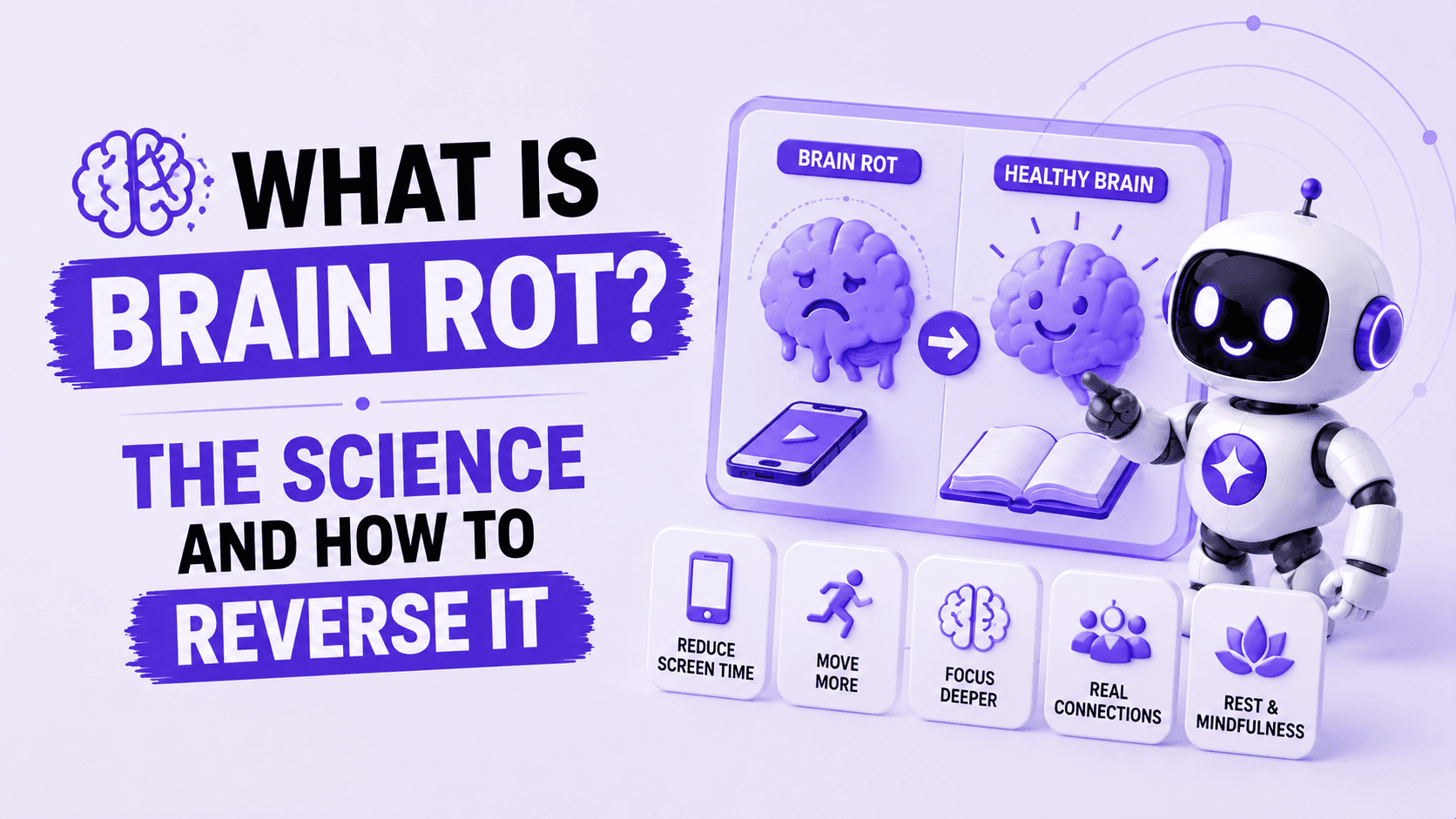
What Is Brain Rot? The Science and How to Reverse It
You open your phone to check one thing. Forty minutes later you surface from a feed of videos you will not remember, feeling foggy and somehow more tired than before. Then you try to read a page of a book and your eyes bounce off it. That feeling has a name now, and in 2024 Oxford University Press made it their Word of the Year: brain rot.
The phrase exploded because it named something millions of people were quietly experiencing. But most articles about it are either panicked doom or dismissive it is just a meme. The truth sits in between, and it is genuinely useful to know. Some of the fear is overblown, and some of it is backed by real research you should take seriously.
This guide gives you the honest science: what brain rot actually is, what the studies really found, whether the damage is permanent (it is not), and a practical, week-by-week plan to reverse it that does not require deleting every app or moving to a cabin. If you have felt your attention slipping, this is the clearest explanation you will read.
What Is Brain Rot, Really?
Brain rot is a perceived deterioration in mental and intellectual functioning caused by overconsuming low-quality, highly stimulating digital content. It describes the foggy, scattered, can't-focus feeling that heavy scrolling leaves behind, and it spread fastest among Gen Z and Gen Alpha, the generations who grew up inside the feed.
The term is doing two jobs at once, and separating them clears up most of the confusion. As internet slang, brain rot also refers to the absurd, low-effort content itself, the meaningless memes and clips people binge. As a description of a mental state, it points at the cognitive fatigue and attention problems that binge leaves behind. This guide is about the second meaning, the effect on your mind.
One thing to be clear about upfront: brain rot is not a clinical diagnosis. No doctor will diagnose you with it, and your brain is not literally rotting. What researchers actually study under this label are three real, measurable things: problematic short-form video use, attention fragmentation, and cognitive fatigue. The slang is new. The underlying phenomenon is real and researched.
Your brain is not rotting. Your attention is being trained, thousands of times a day, to want the next thing before you have finished the last one.
Is It Real? What 71 Studies Actually Found
Yes, the effect is real, and the evidence is stronger than most people assume. A large review pulled together 71 studies covering 98,299 participants and found consistent patterns: heavy consumption of short-form video is linked to poorer cognitive function and worse mental health outcomes. This is not one shaky study, it is a broad body of research pointing the same direction.
The specific findings are worth knowing, because they are precise rather than vague:
Weaker sustained attention. Frequent short-form video use is linked to a decline in the ability to hold focus on one thing over time.
Reduced working memory. The mental scratchpad you use to hold and manipulate information gets measurably weaker.
Lower inhibitory control. This is your ability to resist impulses and distractions, and it drops, which is exactly why you keep reaching for your phone.
Worse sleep, higher anxiety. Intensive use is associated with poorer sleep quality and higher anxiety and depression scores.
A 2025 American Psychological Association study reinforced this, linking heavy TikTok-style scrolling to the same attention and mood problems. So the honest answer to is brain rot real is a clear yes, with one important caveat: the research shows association, not always proof of cause, and heavy scrolling tends to travel with other things like poor sleep and stress. But the pattern is consistent enough that treating it as real is the sensible move.
This matters especially if you are trying to learn anything demanding, like a new skill or AI from scratch, because the exact abilities brain rot weakens, sustained attention and working memory, are the ones deep learning of any subject depends on most.
The Dopamine Loop: Why You Can't Stop Scrolling
You can't stop scrolling because short-form video platforms are engineered to hijack your brain's dopamine reward system with unpredictable bursts of novelty. Dopamine is not the pleasure chemical people think it is, it is the wanting chemical, the one that drives you to seek the next reward, and the feed is a perfect machine for triggering it.
Here is the loop in plain terms. Each swipe delivers a small, unpredictable reward, a funny clip, a surprising fact, an attractive face. Because you never know if the next video will be great or boring, your brain stays hooked, exactly like a slot machine. That unpredictability is the key ingredient. A feed where every video was equally good would be less addictive than one where you are always gambling on the next swipe.
Over time, this trains your brain to expect constant, effortless stimulation. Slower rewards, like reading a book, having a long conversation, or focusing on hard work, start to feel unbearably dull by comparison, because they cannot compete with the drip-feed of novelty. You have not lost the ability to focus. You have taught your brain that focus is not worth it, because something more stimulating is always one swipe away.
The feed did not break your attention. It made a deal with it: give me every spare second, and I will make everything else feel boring.
Understanding this is oddly freeing. The problem is not that you are lazy or weak. You are up against systems designed by thousands of engineers specifically to capture your attention, and they are very good at their job. Willpower alone was never going to be a fair fight, which is exactly why the fix below is about changing your environment, not just trying harder.
The Real Signs of Brain Rot
The clearest signs of brain rot are difficulty focusing, a shrinking attention span, and a constant, almost automatic urge to check your phone. If several of these feel familiar, your attention habits have likely been reshaped by heavy scrolling, and the plan below is worth trying.
You can't focus on one thing. Reading, working, or watching a full movie feels hard, and you reach for a second screen to fill the gap.
Your attention span has shrunk. You feel restless within seconds of any slow moment, and long content feels impossible to sit through.
You check your phone automatically. Your hand reaches for it without a decision, in every queue, elevator, and pause.
You feel foggy after scrolling, not refreshed. Sessions leave you tired and vaguely empty rather than relaxed.
You remember almost nothing you consumed. Hours of content leave no trace, because passive, rapid input barely forms memory.
Boredom feels intolerable. Even a few unstimulated minutes trigger an itch to grab your phone.
Notice that none of these mean something is wrong with you. They are the predictable result of a specific input, and the same brain that learned these habits can unlearn them. That is the whole basis of recovery, and it is more reliable than most people fear.
Is the Damage Permanent? The Reassuring Answer
No, the effects of brain rot are not permanent, and this is the most important thing to understand. There is no evidence that ordinary heavy scrolling causes lasting structural damage to your brain. The attention and memory problems it is linked to appear to be functional and reversible, meaning they come from changed habits, not broken hardware.
Think of it like fitness. If you stop exercising for a few months, you get weaker and out of breath climbing stairs. Your body is not damaged, it is untrained, and it comes back when you start moving again. Attention works the same way. Heavy scrolling detrained your focus, and focused practice retrains it. Your brain remains capable of deep attention; it just got out of the habit.
The science backs this up with actual timelines. Most people begin noticing improvements within 7 to 14 days of reducing high-stimulation input, and fuller recovery of attention and a reset baseline typically arrives within 3 to 4 weeks. That is remarkably fast for something that feels so entrenched. A few weeks of consistent change, and the fog genuinely lifts.
This is exactly the principle behind learning in small, consistent doses, the idea our whole approach is built on. Our 30-day plan to learn AI uses the same logic in reverse: short, daily, focused sessions that rebuild your ability to concentrate while teaching you something real.
How to Reverse Brain Rot: A 4-Week Plan
The most effective way to reverse brain rot is to gradually reduce high-stimulation input while actively rebuilding your focus with small, consistent practice, over about four weeks. Crucially, this is not a single dramatic detox. A one-week dopamine fast followed by a return to old habits produces no lasting change. Steady environmental change beats heroic willpower every time.
Week 1: Change your environment, not your willpower
Make scrolling harder and boredom safer. Move social apps off your home screen and into a folder, turn off non-essential notifications, and charge your phone outside your bedroom. Do not try to quit anything cold turkey. The goal this week is simply to add friction, so that reaching for the feed takes a deliberate choice instead of a reflex. You will slip constantly, and that is fine.
Week 2: Reintroduce slow rewards
Your brain needs to relearn that non-instant activities are worth it. Each day, do one slow, absorbing thing for at least 20 minutes: read a physical book, take a walk without headphones, cook, draw, or have a real conversation. It will feel boring at first, because you are comparing it to the feed. Push through, because that boredom is the exact feeling of your attention resetting.
Week 3: Train focus like a muscle
Start deliberate focus practice. Pick one task and work on it for a set block, starting at just 15 minutes with your phone in another room, and add 5 minutes every few days. Ten to fifteen minutes of daily mindfulness also helps; a two-week mindfulness course was shown in research to reduce mind-wandering and improve working memory and reading comprehension. You are rebuilding the muscle you let weaken.
Week 4: Lock in the new baseline
By now the fog is lifting and focus feels more natural. Protect it. Keep one phone-free evening a week, keep the bedroom a no-phone zone, and add movement, since exercise is one of the most reliable natural boosters of dopamine and the brain-growth factor BDNF. The aim is not zero screen time, it is a life where you decide when to scroll, instead of the feed deciding for you.
You do not beat the feed by trying harder. You beat it by making the good things easy and the feed slightly annoying, then letting time do the rest.
What Actually Works vs What's a Myth
The single biggest myth is that a dramatic one-time dopamine detox resets your brain chemistry. It does not. You cannot fast your way to a new brain in a weekend, and the science is clear that quick fixes followed by relapse change nothing. What works is smaller, less exciting, and far more effective: consistent habit and environment change.
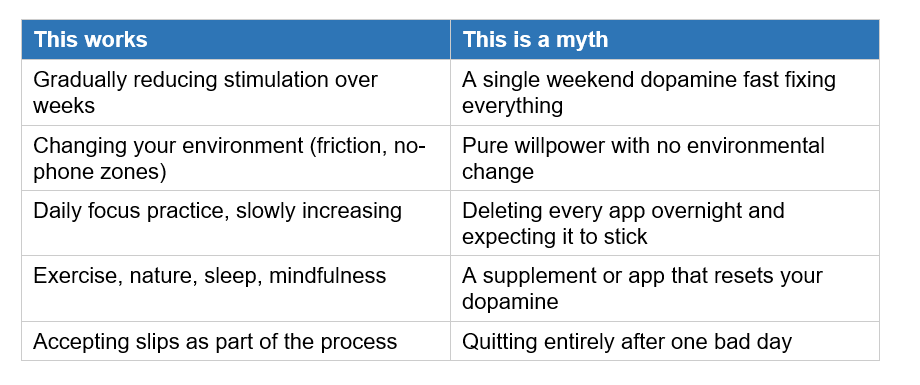
The honest framing is that reversing brain rot is a training process, not a cleanse. Willpower alone is exhausting and temporary, which is why the plan above leans so heavily on changing your surroundings and building tiny habits that compound. Ten minutes of focus today, fifteen tomorrow, a phone-free evening next week, and one day you realize you read for an hour without reaching for your phone. That is what recovery actually looks like.
This is the entire philosophy behind Unrot, learning in small, focused daily doses that rebuild attention instead of shredding it. If you want to see how five minutes a day can replace mindless scrolling with something that compounds, our honest review of the approach explains it.
Frequently Asked Questions
Q: What is brain rot in simple terms?
Brain rot is the foggy, scattered, hard-to-focus feeling caused by overconsuming low-quality, highly stimulating digital content like short-form video. It was Oxford's 2024 Word of the Year. It is a cultural term rather than a medical diagnosis, but it points at real, researched effects on attention, memory, and mood.
Q: Is brain rot real or just a meme?
Both. The word started as internet slang, but the effect it describes is backed by research. A review of 71 studies covering 98,299 people links heavy short-form video use to weaker attention, reduced working memory, and lower self-control. So the term is playful, but the underlying phenomenon is real and measurable.
Q: What causes brain rot?
It is caused mainly by heavy use of short-form video and endless feeds that exploit your brain's dopamine reward system. Each swipe delivers an unpredictable little reward, which keeps you scrolling and trains your brain to crave constant stimulation. Over time, slower activities like reading or focused work start to feel boring by comparison.
Q: Can brain rot be reversed?
Yes. There is no evidence of permanent structural damage from ordinary heavy scrolling, and the attention and memory effects appear functional and reversible. By reducing high-stimulation input and practicing focus, most people recover. Think of it like retraining an out-of-shape muscle rather than fixing broken hardware.
Q: How long does it take to recover from brain rot?
Most people notice improvements within 7 to 14 days of cutting back on short-form content, with fuller recovery of attention and a reset baseline typically within 3 to 4 weeks. Consistency matters more than intensity, so steady daily change beats a single dramatic detox followed by relapse.
Q: Does short-form video really damage your brain?
It does not cause permanent physical damage, but research consistently links heavy short-form video use to poorer sustained attention, weaker working memory, lower impulse control, worse sleep, and higher anxiety. These effects are real but mostly functional and reversible, meaning they improve when you change your habits.
Q: What are the signs of brain rot?
Common signs include difficulty focusing on one task, a shrinking attention span, automatically reaching for your phone, feeling foggy rather than refreshed after scrolling, remembering little of what you consumed, and finding boredom intolerable. If several feel familiar, your attention habits have likely been reshaped by heavy scrolling.
Q: Is a dopamine detox actually effective?
A gradual reduction in high-stimulation activities is effective, but the myth of a dramatic one-weekend detox resetting your brain chemistry is not. Real recovery comes from consistent environmental and habit changes over weeks, supported by exercise, sleep, nature, and mindfulness, not from a single fast that is followed by a return to old patterns.
Recommended Reads
Unrot Review: Learn AI in 5 Minutes a Day
How to Learn AI in 30 Days: Free Day-by-Day Plan
How to Learn AI From Scratch in 2026
The 20 Most Important AI Terms Every Beginner Must Know
You reversed brain rot by making better things easy. Five focused minutes a day, learning something real, beats an hour of scrolling you will not remember.