

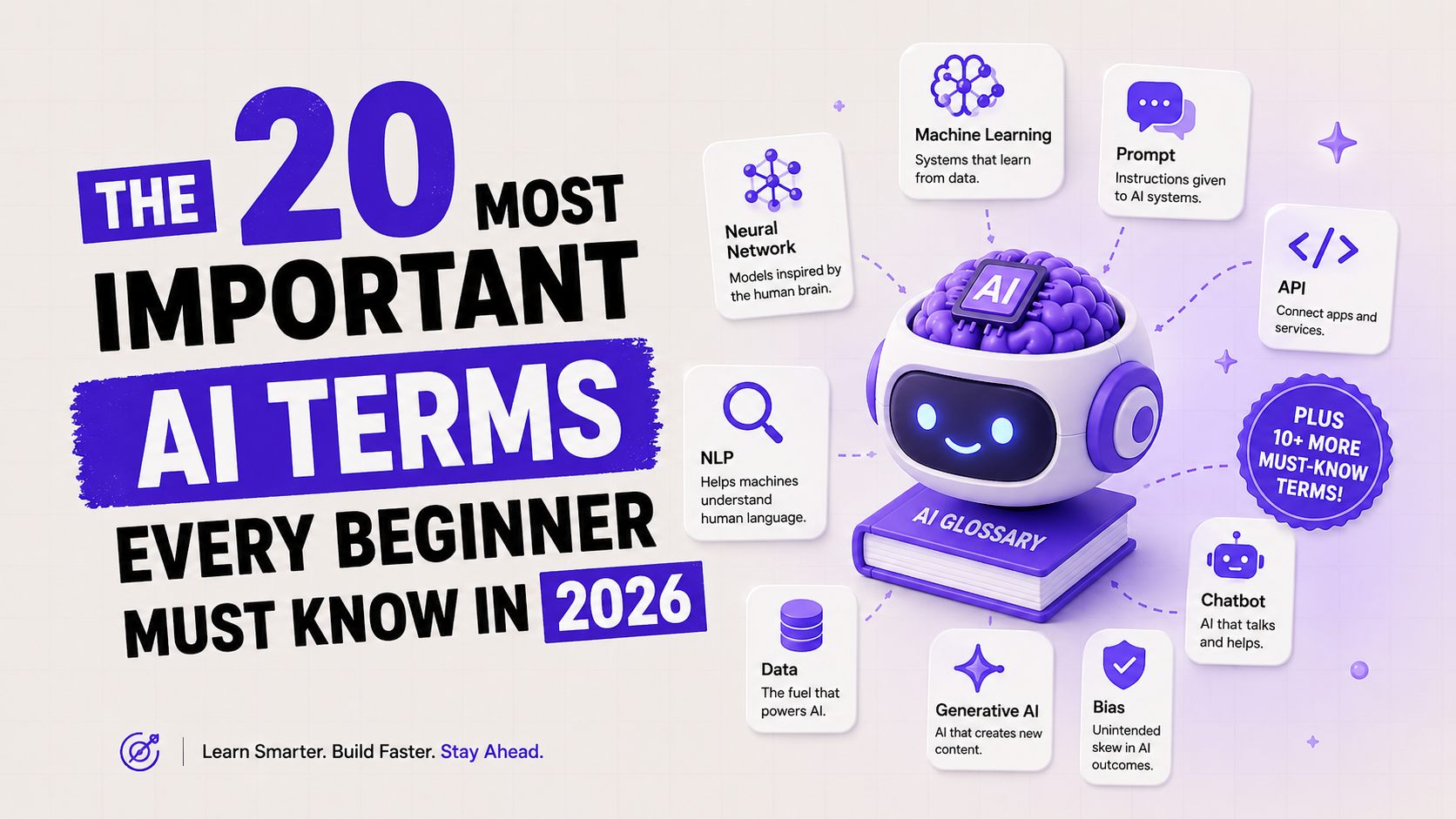
The 20 Most Important AI Terms Every Beginner Must Know in 2026
You open a tech article about AI. Two sentences in, you hit a wall of terms — LLM, RAG, embeddings, tokens, inference, fine-tuning. You either power through half-understanding it, or you close the tab.
In 2026, that wall is costing people. Job interviews. Project decisions. Conversations with colleagues. The ability to evaluate whether the AI tools they're using are actually good. AI literacy is no longer optional — it's the difference between being the person in the room who understands what's being built and the person who nods along and Googles everything later.
This is your fix for that. 20 terms, each explained in plain English with a real example. No math. No computer science degree required. Bookmark this page — you will come back to it.
HOW TO USE THIS GLOSSARY
→ Scanning: Each term has a bold definition you can read in 10 seconds.
→ Deep reading: The example puts each term in a context you will recognise.
→ Going deeper: Each term links to the relevant Unrot course or blog post.
→ Bookmarking: This is designed to be a reference you return to, not a one-time read.
→ Sharing: Forward this to anyone who keeps asking you what these AI words mean.
Quick Answers (For the People Also Ask Questions)
Before the full glossary, here are direct answers to the most searched questions that land on this page:
What are the 7 main types of AI?
The 7 types are classified by capability level: Reactive Machines (IBM Deep Blue — no memory), Limited Memory AI (ChatGPT — uses recent context), Theory of Mind AI (experimental, not deployed), Self-Aware AI (theoretical only), Artificial Narrow Intelligence (ANI) (all AI tools you use today), Artificial General Intelligence (AGI) (doesn't exist yet), and Artificial Superintelligence (ASI) (theoretical). In 2026, every AI tool you actually use — ChatGPT, Claude, Gemini — falls under ANI (Narrow AI) / Limited Memory. AGI and above are research objectives, not products.
What are the 7 stages of AI development?
The 7 stages mark AI's historical evolution: Stage 1 — Rule-Based Systems (1950s-80s). Stage 2 — Statistical Learning (1990s). Stage 3 — Domain-Specific Mastery / Narrow AI (2000s-2010s, e.g. AlphaGo). Stage 4 — Generative AI / Foundation Models (2020-now). This is where we are today — ChatGPT, Claude, Gemini are Stage 4. Stage 5 — AGI (theoretical). Stage 6 — Superintelligence (theoretical). Stage 7 — The AI Singularity (purely speculative). We are currently in Stage 4 with early movement toward Stage 5.
What are the 5 pillars of AI?
There are several frameworks, but the most widely used in enterprise AI adoption circles in 2026 covers: Data (the fuel — quality data is prerequisite for everything), Algorithms (the engine — the methods that process data), Compute (the power — GPUs and cloud infrastructure), Human Expertise (the direction — people who can design, deploy, and evaluate AI), and Governance (the guardrails — policies, ethics, and regulatory compliance). IEEE's research framework identifies multidisciplinarity, task decomposition, symbol grounding, similarity measure, intention awareness, and trustworthiness as the future pillars of AI research.
The 20 AI Terms — Full Glossary
Terms are grouped by theme, not alphabetically. This makes them easier to understand as related concepts rather than isolated definitions.
GROUP 1: The Foundation — What AI Actually Is
#1 — Artificial Intelligence (AI) [Foundation]
Definition: AI is a branch of computer science that enables machines to perform tasks that normally require human intelligence — recognising patterns, understanding language, making decisions, and generating content. It is the broad umbrella under which all other terms in this glossary live.
Example: When ChatGPT writes an email for you, or Spotify recommends a song you didn't know you'd like, or a camera app recognises your face — that is AI at work.
→ Deep dive: Unrot course: What Is Generative AI?
#2 — Machine Learning (ML) [Foundation]
Definition: Machine learning is the most widely used approach within AI. Instead of following hand-coded rules, a machine learning system learns from data — identifying patterns across millions of examples until it can make accurate predictions or decisions on new, unseen inputs. It gets better with more data and more training time.
Example: A spam filter that learns which emails are junk by studying thousands of examples of spam and non-spam is machine learning. It was never explicitly programmed with rules — it learned them.
→ Deep dive: Unrot course: How LLMs Work
#3 — Large Language Model (LLM) [Foundation]
Definition: An LLM is the type of AI model that powers most of the AI tools you use in 2026 — ChatGPT, Claude, Gemini, Llama. It is trained on enormous amounts of text data (books, websites, code) to learn patterns in language. When you type a message, it predicts the most useful continuation of your text, one token at a time. 'Large' refers to both the amount of training data and the number of mathematical parameters — GPT-5.5 and Claude Opus 4.7 contain hundreds of billions.
Example: GPT-5.5 (ChatGPT), Claude Sonnet 4.6, Gemini 3.1 Pro, and Llama 4 Maverick are all large language models. The model is the engine; the chatbot interface is the car.
→ Deep dive: Unrot blog: What Is a Large Language Model? (Explained Simply)
#4 — Generative AI [Foundation]
Definition: Generative AI is the category of AI that creates new content — text, images, audio, video, code — rather than just classifying or analysing existing content. This is the technology behind the AI tools that have taken the world by storm since 2022. ChatGPT, Claude, Midjourney, Sora, and ElevenLabs are all generative AI products.
Example: Ask ChatGPT to write a poem about your dog. The poem did not exist anywhere before — the AI generated it from scratch based on patterns learned during training. That is generative AI.
→ Deep dive: Unrot course: What Is Generative AI?
GROUP 2: How You Talk to AI
#5 — Prompt [Text Generation]
Definition: A prompt is the input you give to an AI model — the question, instruction, or text you type to get it to respond. Everything about how the AI responds depends on how you write your prompt. A vague prompt produces a generic answer. A specific, well-structured prompt produces output you can actually use.
Example: Bad prompt: 'Write an email.' Better prompt: 'Write a 100-word follow-up email to a client who missed our call. Goal: reschedule within 48 hours. No vague closing lines.' The second prompt leaves the AI with far fewer decisions to guess.
→ Deep dive: Unrot blog: How to Write a Perfect ChatGPT Prompt (10 Templates)
#6 — Prompt Engineering [Text Generation]
Definition: Prompt engineering is the skill of crafting prompts that consistently produce high-quality, useful AI output. It involves techniques like assigning the AI a role, providing context, specifying output format, and setting constraints. In 2026, prompt engineering is one of the most in-demand AI skills across every profession.
Example: A prompt engineer might transform 'summarise this report' into 'Act as a management consultant. Summarise this 40-page report in 5 bullet points for a CEO audience. Each bullet must start with a number. No jargon.' The structured version consistently outperforms the vague one.
→ Deep dive: Unrot course: Prompt Engineering Basics
#7 — Token [Text Generation]
Definition: A token is the unit of text that AI models actually process. A token is roughly three-quarters of a word in English — approximately 4 characters. The word 'understanding' is one token; 'ChatGPT' is one token; 'hello' is one token. AI models do not read words — they read tokens. Pricing for AI APIs is almost always measured in tokens. Context windows are measured in tokens.
Example: ChatGPT charges approximately $2-15 per million tokens depending on the model. A typical work email is around 100-200 tokens. A 500-page novel is approximately 650,000 tokens.
→ Deep dive: Unrot course: Tokens and AI Pricing
GROUP 3: AI Memory and Knowledge
#8 — Context Window [Knowledge & Memory]
Definition: The context window is the maximum amount of text an AI model can process in a single conversation. Everything in your current session counts toward this limit: your messages, the AI's replies, documents you uploaded, and any instructions you gave at the start. When you hit the limit, the oldest parts of the conversation get dropped to make room for new content. Claude Sonnet 4.6 and GPT-5.5 both offer 1 million token context windows as of May 2026.
Example: You upload a 200-page legal contract to Claude and ask questions about it. That contract takes up roughly 270,000 tokens. You have 730,000 tokens remaining for the conversation before older content starts dropping out.
→ Deep dive: Unrot blog: What Is a Context Window in AI? (And Why It Matters)
#9 — Hallucination [Knowledge & Memory]
Definition: An AI hallucination is when a language model generates information that is factually wrong, but presents it with complete confidence. It happens because LLMs are trained to produce plausible text, not to verify facts. They can invent names, citations, statistics, court cases, and events that never existed — and do so with total conviction. Hallucination rates vary widely: top models show 0.7-6% on structured tasks, but can reach 60-80% on niche factual queries.
Example: A lawyer submitted a legal brief to court that included ChatGPT-invented case citations. The cases did not exist. The lawyer was sanctioned. The AI was not wrong on purpose — it produced the most statistically plausible-sounding output.
→ Deep dive: Unrot blog: Why Does ChatGPT Make Up Facts? (AI Hallucinations Explained)
#10 — RAG (Retrieval-Augmented Generation) [Knowledge & Memory]
Definition: RAG is a technique that connects a language model to an external knowledge source at the time of a query. Instead of generating an answer from training data alone — which can be outdated or wrong — a RAG system first retrieves relevant documents from a database, then generates an answer grounded in that retrieved content. RAG reduces hallucinations by approximately 71% compared to standard LLMs. NotebookLM, Perplexity, and Claude with document upload all use RAG.
Example: You upload your company's 200-page operations manual to a RAG-powered chatbot. When employees ask about leave policies, the system retrieves the exact policy clause and answers from it — no guessing, no hallucination. That is RAG in action.
→ Deep dive: Unrot blog: What Is RAG? How AI Stops Making Things Up
#11 — Embedding [Knowledge & Memory]
Definition: An embedding is a numerical representation of text (or images, audio, or video) that captures meaning. Instead of storing the word 'cat' as a string, an embedding model converts it into a list of hundreds of numbers that represent its meaning and relationships to other words. 'Cat' and 'kitten' will have similar embeddings. 'Cat' and 'airplane' will have very different ones. Embeddings are what make RAG systems work — they allow AI to search by meaning rather than exact keywords.
Example: When you search 'how to fix a leak' in a RAG system, the embedding of your query matches documents about plumbing repair even if those documents never use the phrase 'fix a leak' — because the meanings are semantically similar.
→ Deep dive: Unrot course: Embeddings: AI's Secret Language
#12 — Vector Database [Knowledge & Memory]
Definition: A vector database stores embeddings — the numerical representations of text and other data. It is the library that makes RAG retrieval possible. When a query arrives, the vector database finds the stored embeddings most semantically similar to the query and returns the corresponding documents. Popular vector databases include Pinecone, Weaviate, Chroma, and pgvector. They power the search that underpins NotebookLM, Perplexity, and enterprise AI systems.
Example: A vector database does not find 'data privacy policy' by keyword-matching. It finds documents about data privacy even if they use terms like 'user data rights' or 'information governance' — because those concepts have similar numerical representations.
→ Deep dive: Unrot blog: What Is a Vector Database? The AI Memory System Explained
GROUP 4: How AI Learns
#13 — Training [Learning Methods]
Definition: Training is the process by which an AI model learns from data. During training, the model is exposed to vast amounts of text (or images, or other data) and adjusts its internal mathematical parameters millions of times until it can predict outputs accurately. Training a frontier LLM like GPT-5.5 or Claude Opus 4.7 requires thousands of specialised chips and costs tens to hundreds of millions of dollars. Once trained, the model is frozen — its knowledge is from that data snapshot.
Example: GPT-3's training in 2020 required 175 billion parameters to be adjusted over months using massive datasets. The result was a model that could generate coherent text — but that didn't know anything that happened after its training cutoff.
→ Deep dive: Unrot course: How LLMs Work
#14 — Fine-Tuning [Learning Methods]
Definition: Fine-tuning takes a pre-trained model and trains it further on a smaller, specific dataset to specialise it for a particular task, domain, or style. Instead of training from scratch (prohibitively expensive), fine-tuning adjusts only parts of the existing model. It is used to teach a model to behave differently — not to give it new factual knowledge. Fine-tuning GPT-4o-mini costs approximately $25 per million training tokens at OpenAI's API.
Example: A legal firm fine-tunes a base LLM on thousands of past contract templates. The resulting model writes in legal drafting style and uses correct legal terminology — because fine-tuning taught it how to behave, not just what to know.
→ Deep dive: Unrot course: Fine-Tuning LLMs
#15 — RLHF (Reinforcement Learning from Human Feedback) [Learning Methods]
Definition: RLHF is the training technique used to make AI models like ChatGPT and Claude helpful and safe, not just good at predicting text. Human evaluators rate model outputs for helpfulness, accuracy, and safety. Those ratings train a 'reward model,' which then teaches the main AI to produce outputs humans prefer. RLHF is the primary reason modern AI assistants are polite, follow instructions, and decline harmful requests — rather than just maximising statistical plausibility.
Example: Without RLHF, an LLM asked to 'write me instructions for making something dangerous' might comply because such instructions exist in training data. RLHF-trained models have learned that humans prefer helpful AND safe responses, making them refuse.
→ Deep dive: Unrot course: RLHF Explained
GROUP 5: Modern AI Architecture
#16 — Transformer [Architecture]
Definition: The transformer is the neural network architecture that powers virtually every modern LLM. Introduced in a landmark 2017 Google paper titled 'Attention Is All You Need,' transformers use a mechanism called 'attention' that lets them understand relationships between words across an entire document simultaneously — rather than reading word by word. GPT stands for 'Generative Pre-trained Transformer.' Every major AI model you use runs on transformer architecture.
Example: When you write 'I sat on the river bank with a fishing rod,' a transformer understands that 'bank' means riverbank (not financial institution) because of its attention to 'river' and 'fishing rod' simultaneously. Earlier models could miss this without sequential context.
→ Deep dive: Unrot course: How LLMs Work
#17 — AI Agent [Modern AI]
Definition: An AI agent is an AI system that can take actions in the world — not just answer questions. While a standard chatbot responds to prompts, an agent browses the web, writes and runs code, reads files, calls APIs, sends emails, and executes multi-step tasks with minimal human input. 2025 and 2026 are widely called 'the era of AI agents.' Examples include Claude Code (writes and deploys code), GitHub Copilot Workspace, and OpenAI's Operator.
Example: You ask an AI agent to 'find the three cheapest flights from Mumbai to London next month, compare their luggage policies, and email me a comparison.' It searches flights, reads policy pages, formats the comparison, and sends the email — all without you doing anything else.
→ Deep dive: Unrot course: Agents vs Chatbots: The Real Difference
#18 — Multimodal AI [Modern AI]
Definition: A multimodal AI model processes multiple types of input — text, images, audio, and video — rather than just text. The standard for frontier AI in 2026 is multimodal. ChatGPT can see images and hear voice. Claude can analyse uploaded documents and images. Gemini can process video, audio, and text simultaneously. Multimodal AI is what allows a doctor to show an AI a medical scan and describe symptoms in text — and get a response that considers both.
Example: You photograph a broken appliance and ask your AI 'what's wrong with this and how do I fix it?' The AI sees the image, reads your question, cross-references repair knowledge, and gives you specific repair instructions. That is multimodal AI.
→ Deep dive: Unrot course: Multimodal Models: See, Hear, Speak
#19 — Open Source vs Closed Source AI [Modern AI]
Definition: Open source AI models release their weights (the mathematical parameters learned during training) publicly, allowing anyone to download, modify, and run them. Closed source models are proprietary — you can only access them through an API or product. Open source examples: Llama 4 (Meta), Mistral, DeepSeek V4. Closed source: GPT-5.5 (OpenAI), Claude Opus 4.7 (Anthropic), Gemini 3.1 Pro (Google). Open source offers privacy, customisability, and zero API costs. Closed source offers cutting-edge performance and managed infrastructure.
Example: A hospital that cannot send patient data to external servers runs Llama 4 (open source) on their own hardware — complete data privacy. A startup that needs the best performance and fast iteration uses Claude or GPT-5.5 through the API.
→ Deep dive: Unrot course: Open vs Closed Source Models
#20 — Inference [Architecture]
Definition: Inference is what happens when you actually use an AI model. When you type a message and the AI responds, that is inference — the model is using its learned parameters to generate a new output. Training is learning; inference is applying what was learned. Inference costs scale with how many people are using the model and how large it is. The 'inference cost' war between AI companies in 2026 — who can serve responses fastest and cheapest — is one of the defining competitive dynamics of the industry.
Example: Every time you send a message to Claude or ChatGPT and receive a response, you are consuming one inference. Behind the scenes, a server is running billions of mathematical operations through the model's parameters to generate those words.
→ Deep dive: Unrot course: Tokens and AI Pricing
Bonus: 5 AI Terms That Keep Appearing in the News
These five terms were not in the original 20 but come up constantly in 2026 AI coverage. Short definitions only:
AGI (Artificial General Intelligence): A theoretical AI system that could perform any intellectual task a human can. Does not exist yet. Every major AI company claims to be working toward it.
Context Engineering: The emerging successor to prompt engineering — instead of improving how you ask, you improve what information the model has access to. 82% of IT leaders say prompt engineering alone is no longer enough for production AI (DataHub 2026).
MCP (Model Context Protocol): An open standard created by Anthropic that lets AI models connect to external tools and data sources using a standardised interface — sometimes described as 'USB for AI.'
Agentic AI: AI that can plan, take actions, and complete multi-step tasks autonomously. The dominant trend in 2026 enterprise AI deployment.
AI Slop: A 2025-coined term for low-quality, mass-produced AI-generated content — generic blog posts, soulless images, robotic narration. The term exists because the quality bar for AI content has become a real problem as volume scales.
Frequently Asked Questions
Q: What are the most basic AI terms a beginner needs to know?
Start with five: (1) LLM — the type of AI model behind ChatGPT and Claude. (2) Prompt — the instruction you give the AI. (3) Token — the unit AI models process text in. (4) Hallucination — when AI confidently states something false. (5) Context Window — how much text the AI can see at once. Those five terms will make 80% of AI articles and conversations immediately more understandable.
Q: What are the 7 main types of AI?
The 7 types are classified by capability: Reactive Machines (no memory, responds only to current input), Limited Memory AI (uses recent context — all current chatbots), Theory of Mind AI (experimental — understands human mental states), Self-Aware AI (theoretical only), Artificial Narrow Intelligence or ANI (all deployed AI in 2026 — highly capable but limited to specific tasks), Artificial General Intelligence or AGI (theoretical — human-level across all domains), and Artificial Superintelligence or ASI (theoretical — surpasses humans in everything). Every AI tool you use in 2026 — ChatGPT, Claude, Gemini — is ANI.
Q: What is the difference between AI and machine learning?
AI is the broad field of building machines that can perform tasks requiring human-like intelligence. Machine learning is one specific approach within AI — the most widely used approach — where systems learn from data rather than following hand-coded rules. All machine learning is AI, but not all AI is machine learning. Rule-based AI systems, for example, are AI without machine learning. In 2026, when people say 'AI' in everyday conversation, they almost always mean systems built using machine learning.
Q: What is the difference between GPT and LLM?
LLM (Large Language Model) is the category. GPT (Generative Pre-trained Transformer) is a specific family of LLMs built by OpenAI. The relationship is like 'car' versus 'Toyota.' GPT-5.5 is an LLM. Claude Opus 4.7 is also an LLM. Llama 4 is also an LLM. GPT is just one brand within that category — it happens to be the most famous, which is why many people use 'GPT' and 'LLM' interchangeably, even though they are not the same thing.
Q: What are common AI words to avoid in writing?
In essays, blog posts, and academic writing, the following words are widely flagged as overused AI output markers: 'utilize' (use instead), 'leverage' (use instead), 'delve into,' 'it is worth noting,' 'in today's rapidly evolving landscape,' 'game-changer,' 'paradigm shift,' 'groundbreaking,' 'cutting-edge,' 'comprehensive,' and 'In conclusion.' These phrases appear so frequently in AI-generated content that human editors and AI-detection tools both flag them. Replace them with direct, specific language.
Q: What are the 5 pillars of AI?
The most widely referenced enterprise AI framework in 2026 identifies 5 pillars: Data (quality training and operational data), Algorithms (the methods and model architectures), Compute (hardware infrastructure — GPUs, cloud), Human Expertise (the teams who design, deploy, and evaluate), and Governance (policies, ethics, regulation, and oversight). The EU AI Act, which came into force in 2024 and began enforcement in 2026, has made Governance the most urgent pillar for European organisations and global companies operating in Europe.
Q: What is generative AI in simple words?
Generative AI is AI that creates new content — text, images, audio, video, code — rather than just analysing or categorising existing content. When you ask ChatGPT to write an email, ask Midjourney to generate an image, or use ElevenLabs to clone a voice, you are using generative AI. The 'generative' part means the AI produces something new each time, based on patterns learned from vast amounts of training data. It is the category of AI that has driven most of the public excitement and economic disruption since ChatGPT launched in November 2022.
Recommended Articles — Go Deeper on Any Term
This glossary gives you the foundation. These posts go much deeper on each concept:
Knowing the terms is the starting point. Understanding them is the skill.
Unrot teaches every term on this list in under 5 minutes per concept — with examples, quizzes, and practical exercises. The courses are organised into Beginner, Intermediate, and Advanced paths so you always know what to learn next.
app.unrot.co → Start the Beginner Path — free
References
ClipboardAI (January 2026). AI Glossary 2026. Context rot, context drift, and key AI terminology.
Undetectable AI (February 2026). AI Glossary: 50 Must-know Terms For Beginners.
Published on Unrot.co | May 2026