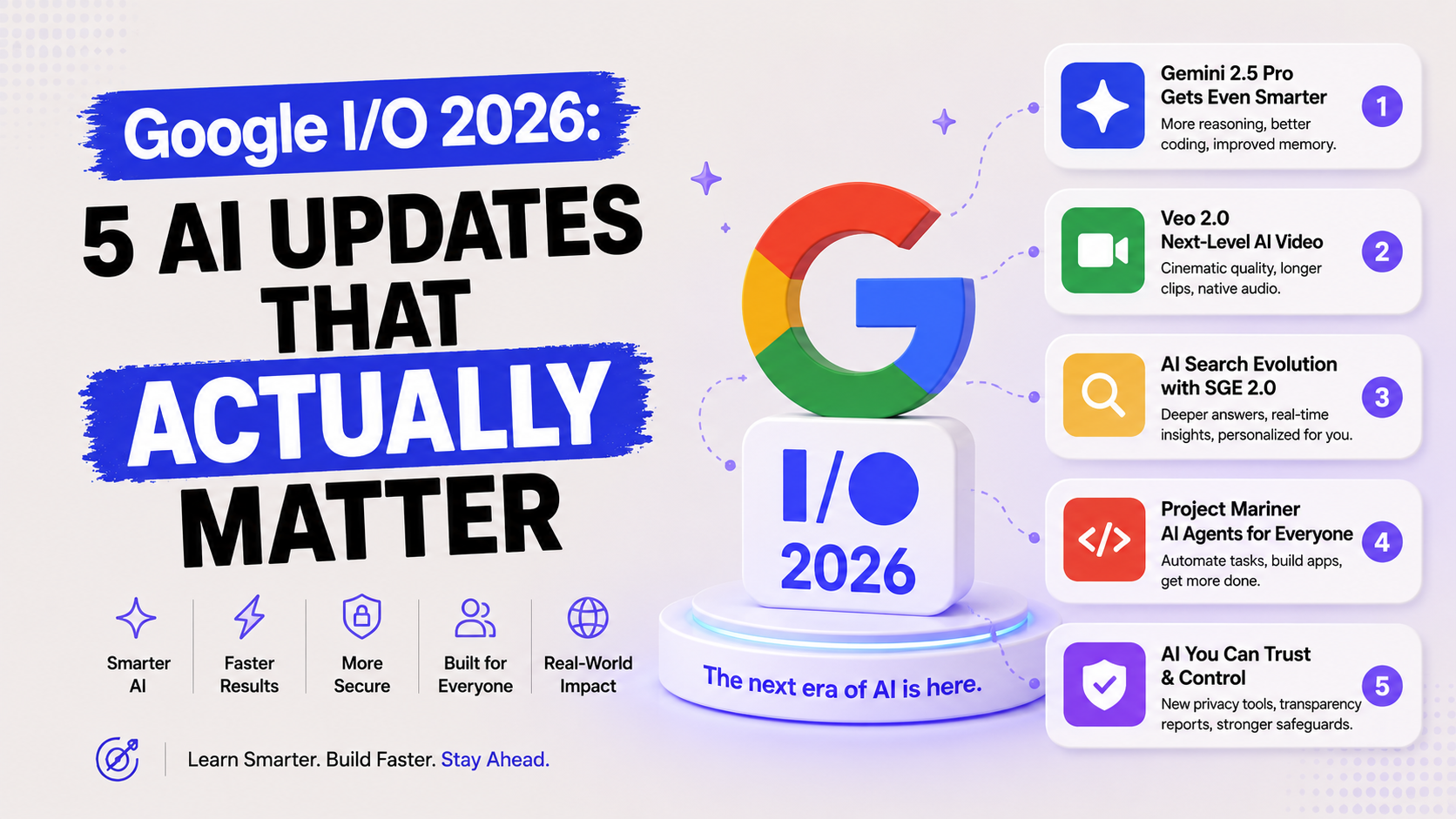
Google I/O 2026: 5 AI Updates That Change Your Day
Every May, Google holds a massive conference called I/O. Thousands of developers fly to Mountain View, California. Google spends two hours announcing things. And then about 99% of news coverage is written for those developers.
This post is for everyone else.
On May 19, 2026, Google I/O happened. And I spent the day sorting through the announcements to answer one question: what will a normal person actually notice six months from now?
Five things. Here they are.
1. Gemini Spark: An AI That Works While You Sleep
Gemini Spark is Google's new AI agent that runs 24/7 in the cloud, even when your phone is off.
Every other AI assistant — ChatGPT, Claude, the standard Gemini — waits for you to open an app, type a question, and stare at the screen while it responds. That's fine for quick questions. It's frustrating for anything that takes more than a minute.
Spark changes the model entirely. You give it a task, close your laptop, go to bed, and it finishes the job. Not because your device is running in the background. Because Spark lives on Google's servers, not yours.
Some real examples Google showed on stage:
"Draft a status update email using info from my recent Gmail threads and Docs."
"Watch my inbox and flag anything from the legal team."
"Scan my credit card statement every month and flag new subscription charges."
You can send Spark a task by email (it has its own dedicated Gmail address). You can also track what it's doing through a new Android interface called Android Halo, which shows live task progress without opening Gemini.
I think the privacy angle here matters more than the feature itself. Spark has read access to your Gmail, Calendar, Docs, and Sheets. That's a lot of trust to hand to any software, let alone something that can take actions on your behalf. Google requires approval before it sends emails or spends money. But you should know what you're enabling before you turn it on.
Spark rolls out to Google AI Ultra subscribers in the US starting next week. The $100/month AI Ultra plan (new at I/O 2026) is the cheapest tier that includes it.
2. Google Search Got Its Biggest Upgrade in 25 Years
Google Search is becoming more like a conversation and less like a keyword box — and that change is already live.
Google's CEO Sundar Pichai called it "the biggest upgrade to Search in 25 years." That's a bold claim. But when you see what changed, it's at least defensible.
The search box now expands as you type. It supports longer, natural queries — not just "best pizza NYC" but "I have a dinner tonight with a client who keeps halal, near Times Square, and we want somewhere quiet enough to have a real conversation." It can handle images, files, and even Chrome tabs as search inputs.
More significantly, Search now has information agents. These are small AI workers you can set up to monitor a topic for you around the clock. Example: "Alert me if the price of this flight drops" or "Tell me if there are any new studies on intermittent fasting." The agent runs in the background, checks the web for you, and surfaces what matters.
AI Overviews — the AI summaries that appear at the top of Google results — now have 2.5 billion monthly active users. That number tells you more about where search is headed than any product demo.
My take: Google Search has been the same basic thing for two decades. A box, a list of links. What's happening now is that the list of links is being replaced by an AI layer that tries to answer, not just point. Whether that's better depends entirely on how accurate the answers are. The pizza glue incident from last year is a reminder that accuracy is still not guaranteed.
3. Gemini Omni: Make Videos Just by Talking
Gemini Omni Flash is a new AI model that turns text, images, audio, and existing videos into new video — and you can edit it by describing what you want changed.
For context: most AI video tools today work like this. You type a prompt. A video gets generated. If you don't like it, you type a different prompt and generate a new video from scratch. Every edit is really just a regeneration.
Omni works differently. You generate a clip, then edit it by talking to it. "Move the scene to a beach." "Make the glass look like water when it's touched." "Swap the background for a city at night." Each instruction builds on the last. The characters stay consistent. The physics hold up across edits.
One concrete detail worth knowing: clips are capped at 10 seconds for now. Google says this is a choice, not a technical limit. They want to roll it out slowly while demand is high.
Where you can try it today:
Free: YouTube Shorts and YouTube Create (rolling out this week)
Paid: Gemini app and Google Flow for AI Plus, Pro, and Ultra subscribers
The audio editing feature — where you'd change speech or voice in an existing video — is deliberately held back. Google says they're still figuring out how to release it responsibly. That's code for: deepfakes are the obvious risk, and they're not ready to manage it yet.
4. Daily Brief: Your Morning AI Summary
Daily Brief is a new Gemini feature that reads your Gmail, Calendar, and task list every morning and hands you a short, prioritized summary of your day.
This is the quietest announcement from I/O 2026, and probably the one most people will notice first in daily life.
Every morning, before you've opened a single app, Daily Brief runs in the background. It reads your incoming emails, checks your calendar for what's coming up, looks at your tasks, and builds a short digest. Not a dump of everything — it prioritizes. "Here are the three things that need your attention today. Here's a reply your boss is waiting on. Here's the conflict in your schedule."
I've been watching various "AI morning summary" features come and go for two years. Most of them surface too much, miss the point, or require you to configure them so specifically that the configuration takes longer than just checking your own inbox. Daily Brief doesn't have a public track record yet, so I'll reserve judgment — but the architecture is right. Gemini has direct access to your Gmail and Calendar, which means it can actually surface the specific email your boss sent at 11pm last night, not just "you have 47 unread messages."
Rolling out now to AI Plus, Pro, and Ultra subscribers in the US.
5. Google's AI Smart Glasses Are Real
Google announced audio-focused AI glasses at I/O 2026, developed with fashion brands Warby Parker and Gentle Monster, launching this fall with Android and iOS support.
These are Google's answer to Meta's Ray-Ban glasses. They look like normal frames, they have a camera and a microphone, and Gemini lives inside them.
Point them at something and ask: "What building is this?" Look at a menu in a foreign language and ask for a translation. They also support live language translation, so you can have a conversation with someone and hear what they're saying translated in real time through the earpiece.
A few things they are NOT (yet):
They don't have a display. You hear information, you don't see it overlaid on the world.
They're audio-only for now. The display-equipped version is still a couple years out.
They're not available to buy yet — fall 2026 is the target.
The partnership with Warby Parker and Gentle Monster is important. These are actual fashion brands, not tech company glasses with an obvious camera bolted on. Whether they look good enough for regular people to wear is a different question than whether the technology works.
One pattern I noticed: Google, Meta, Samsung, and Apple are all rushing toward glasses at the same time. That convergence usually means something. It doesn't mean glasses will replace your phone tomorrow. But it suggests that the form factor is getting close to viable.
The One Big Picture Takeaway
Every single announcement at Google I/O 2026 pointed in the same direction: AI that does things for you, not just AI that answers you.
Spark runs tasks. Search has agents. Omni edits video on command. Daily Brief reads your inbox. Even the glasses are about taking actions — translating, identifying, directing — without you having to stop and interact with a screen.
That shift, from AI as a question-answerer to AI as a task-doer, is the actual story of 2026. Not the model names. Not the benchmarks. The change in what AI is for.
Frequently Asked Questions
Q: What is Google I/O 2026?
Google I/O is Google's annual developer conference, held May 19–20, 2026, at the Shoreline Amphitheatre in Mountain View, California. Google uses it to announce major product updates across Gemini, Android, Search, and its developer tools. The 2026 edition was focused almost entirely on AI and agentic features.
Q: What is Gemini Spark?
Gemini Spark is Google's new 24/7 AI agent that runs on Google Cloud servers, not your device. You give it a task — drafting an email, monitoring your inbox, scanning a credit card statement — and it works continuously, even after you close your phone. It connects to Gmail, Google Docs, Sheets, and third-party apps. It's rolling out to US Google AI Ultra subscribers ($99.99/month) starting next week.
Q: Is Gemini Omni free?
Yes, partially. Gemini Omni Flash is free on YouTube Shorts and the YouTube Create app, rolling out this week. Paid access in the Gemini app and Google Flow starts with the AI Plus plan at $7.99/month. Developer API access is not available yet — Google says it's coming in the coming weeks.
Q: What is the Daily Brief feature in Gemini?
Daily Brief is an AI agent inside the Gemini app that reads your Gmail, Calendar, and tasks each morning and generates a short, prioritized summary of your day. It highlights urgent emails, upcoming meetings, and suggested next steps. It's rolling out now to US subscribers on AI Plus, Pro, and Ultra plans.
Q: Are Google AI smart glasses available to buy?
Not yet. Google revealed its first audio glasses at I/O 2026, developed with Warby Parker and Gentle Monster. They look like regular frames, work with Android and iOS, and support Gemini voice interactions, a camera, and live language translation. Launch is expected fall 2026. Display-equipped glasses are still further out.
Q: How is Google Search changing in 2026?
Google Search now has a wider search box that handles natural, conversational queries. It supports image and file inputs. AI Mode — powered by Gemini 3.5 Flash — is now the default experience. Information agents let you set up background monitors on specific topics that alert you when something changes. AI Overviews has 2.5 billion monthly active users.
Q: What is Gemini 3.5 Flash?
Gemini 3.5 Flash is Google's newest AI model, launched May 19, 2026. It is four times faster than comparable frontier models and now powers the Gemini app, Google Search, and Gemini Spark by default. It outperforms the previous Gemini 3.1 Pro model on coding and agentic tasks despite being the faster, cheaper tier.
Recommended Reading on Unrot
AI learning isn't about cramming once and hoping it sticks. Five minutes today, five minutes tomorrow. That's how you build something real.