Back to blogs

Is AI a Bubble? The 2026 Signs Explained Simply

AI infrastructure spending hits $2.59 trillion while 95% of firms see zero ROI. Is AI a bubble? Here are the real 2026 signs, both sides, in plain English.

Share:
Is AI a Bubble? The 2026 Signs Explained Simply

Table of Contents

Is AI a Bubble? The 2026 Signs, Explained Simply

Here are two numbers that should not exist in the same year. The world is on track to spend around 2.59 trillion dollars on AI in 2026. And according to MIT research, 95 percent of companies using generative AI report zero measurable return on it. Trillions going in. Almost nothing measurable coming out. Yet.

That gap is why the word bubble is suddenly everywhere. When Nvidia revealed it was in talks to guarantee up to 250 billion dollars of OpenAI's spending, CNBC's Jim Cramer said it reminded him of the financing tricks that came right before the dot-com crash. Nvidia's own shares wobbled on the unease. And ordinary people started asking a fair question: is this real, or is it about to pop?

I am not going to tell you the answer, because nobody honestly knows it. What I can do is lay out the evidence cleanly, the strong case that AI is a bubble, the strong case that it is not, and the real 2026 numbers behind both, so you can judge for yourself. No finance degree required. By the end you will read every AI-bubble headline with a much clearer eye.

What Does AI Bubble Even Mean?

An economic bubble is when the price and spending around something races far ahead of the real value it produces, until reality catches up and the whole thing corrects, often painfully. The technology can be completely real and still be in a bubble, because a bubble is about money getting ahead of results, not about the thing being fake.

This is the part people get wrong. Asking is AI a bubble is not the same as asking is AI useful. AI is obviously useful, hundreds of millions of people use it daily. The bubble question is narrower and sharper: is the money being poured in wildly larger than the money coming back out, and is that gap being held up by hype and clever financing rather than real demand?

The dot-com era is the classic example. The internet was genuinely revolutionary, and it still changed the world exactly as promised. But around 2000, investment stampeded so far ahead of actual internet revenue that the market crashed, wiping out trillions, even though the internet itself went on to win. Both things were true: real technology, real bubble. That is the shape people are watching for in AI.

A bubble is not the technology being fake. It is the money running so far ahead of the results that reality eventually yanks it back.

The Scariest Sign: Circular Financing

The single sign that worries experts most in 2026 is circular financing, where companies fund each other in a loop that can make demand look bigger than it really is. The Nvidia and OpenAI arrangement is the clearest example, and it is worth understanding because it sits at the heart of the whole debate.

Here is the loop in plain terms. Nvidia would guarantee up to 250 billion dollars of OpenAI's data center spending, plus reportedly up to 350 billion more toward chip purchases. OpenAI uses that backing to buy chips. The chips it buys are Nvidia's. So Nvidia is helping fund the money that comes back to Nvidia as sales. The supplier is underwriting its own customer.

Why is that dangerous? Because it can manufacture the appearance of demand. If a chipmaker funds the customers who buy its chips, sales look strong even if the underlying, independent demand is weaker than it seems. Cramer pointed straight at this, noting it echoes the late 1990s, when telecom equipment makers financed customers' big purchases to keep growth going, right before that sector collapsed.

To see why all this money flows toward chips in the first place, it helps to understand why AI is so hardware-hungry. Our explainer on why AI needs GPUs breaks down the Nvidia and OpenAI deal and the simple reason AI runs on these expensive chips at all.

None of this proves fraud or failure. Locking in supply with long-term commitments is a normal business move, and Nvidia can afford it. But circular deals make an industry fragile, because if one big player stumbles, the loop can unwind fast, and everyone in the circle feels it at once.

The Case That AI Is a Bubble

The bubble case rests on a simple mismatch: staggering spending, thin returns, and money propping up money. Laid out plainly, the warning signs are hard to wave away.

  •   The ROI is missing. MIT research found 95 percent of companies report zero measurable return from generative AI. Among executives who can quantify returns, many report under 5 percent.

  •   Spending dwarfs revenue. Over 500 billion dollars a year is going into AI infrastructure in 2026 and 2027, while US consumer AI revenue is only around 12 billion dollars a year. That is a chasm, not a gap.

  •   The leader is bleeding cash. OpenAI is reportedly on track to lose around 14 billion dollars in 2026, nearly triple its 2025 losses, while projecting profitability years away.

  •    Debt is creeping in. AI infrastructure firms are increasingly borrowing, like CoreWeave's 8.5 billion dollar term loan in March 2026, which adds fragility if revenue disappoints.

  •   The financing is circular. As covered above, companies guaranteeing each other's spending can inflate the appearance of demand.

Put together, the bubble case is this: the industry is spending trillions on a promise, the promised returns have not shown up at scale, and some of the demand is being propped up by the sellers themselves. If the real revenue does not arrive soon enough, the correction could be severe.

The Case That AI Is Not a Bubble

The opposite case is just as serious, and it argues that this build-out is different from past bubbles in ways that matter. The strongest points are about who is paying and whether the capacity is actually being used.

  •    It is mostly self-funded. Unlike the dot-com bust, which was driven by debt-heavy startups, today's spending is largely funded by hugely profitable giants like Google, Microsoft, and Amazon out of real cash flow.

  •    The capacity is being absorbed. All five major hyperscalers report that AI computing capacity is being used up as fast as they can build it, which is not what you see when demand is fake.

  •    The usage is real and enormous. Hundreds of millions of people use AI tools every day, and many businesses pay real subscriptions for them. There is a genuine product here, not just a promise.

  • The assets are real. Data centers, chips, and power plants are physical, reusable infrastructure, not the vaporware of some past manias.

There is also a timing argument. Big technology shifts often lose money for years before they pay off, because the tools have to mature and companies have to learn to use them. If you understand how AI models are trained and how fast they are improving, the thin early ROI looks less like failure and more like the awkward early stage of something real.

The not-a-bubble case, in short: the spending is coming from companies that can afford it, the capacity is genuinely being used, and history says transformative technology often looks unprofitable right before it pays off enormously.

AI 2026 vs the Dot-Com Crash: How Similar Really?

The AI boom rhymes with the dot-com bubble in some ways and breaks from it in others, and the differences are the reason smart people disagree. Comparing them directly is the clearest way to weigh the risk.
What Does AI Bubble Even Mean?
An economic bubble is when the price and spending around something races far ahead of the real value it produces, until reality catches up and the whole thing corrects, often painfully. The technology can be completely real and still be in a bubble, because a bubble is about money getting ahead of results, not about the thing being fake.
This is the part people get wrong. Asking is AI a bubble is not the same as asking is AI useful. AI is obviously useful, hundreds of millions of people use it daily. The bubble question is narrower and sharper: is the money being poured in wildly larger than the money coming back out, and is that gap being held up by hype and clever financing rather than real demand?
The dot-com era is the classic example. The internet was genuinely revolutionary, and it still changed the world exactly as promised. But around 2000, investment stampeded so far ahead of actual internet revenue that the market crashed, wiping out trillions, even though the internet itself went on to win. Both things were true: real technology, real bubble. That is the shape people are watching for in AI.
A bubble is not the technology being fake. It is the money running so far ahead of the results that reality eventually yanks it back.

The Scariest Sign: Circular Financing
The single sign that worries experts most in 2026 is circular financing, where companies fund each other in a loop that can make demand look bigger than it really is. The Nvidia and OpenAI arrangement is the clearest example, and it is worth understanding because it sits at the heart of the whole debate.
Here is the loop in plain terms. Nvidia would guarantee up to 250 billion dollars of OpenAI's data center spending, plus reportedly up to 350 billion more toward chip purchases. OpenAI uses that backing to buy chips. The chips it buys are Nvidia's. So Nvidia is helping fund the money that comes back to Nvidia as sales. The supplier is underwriting its own customer.
Why is that dangerous? Because it can manufacture the appearance of demand. If a chipmaker funds the customers who buy its chips, sales look strong even if the underlying, independent demand is weaker than it seems. Cramer pointed straight at this, noting it echoes the late 1990s, when telecom equipment makers financed customers' big purchases to keep growth going, right before that sector collapsed.
To see why all this money flows toward chips in the first place, it helps to understand why AI is so hardware-hungry. Our explainer on why AI needs GPUs breaks down the Nvidia and OpenAI deal and the simple reason AI runs on these expensive chips at all.
None of this proves fraud or failure. Locking in supply with long-term commitments is a normal business move, and Nvidia can afford it. But circular deals make an industry fragile, because if one big player stumbles, the loop can unwind fast, and everyone in the circle feels it at once.

The Case That AI Is a Bubble
The bubble case rests on a simple mismatch: staggering spending, thin returns, and money propping up money. Laid out plainly, the warning signs are hard to wave away.
•	The ROI is missing. MIT research found 95 percent of companies report zero measurable return from generative AI. Among executives who can quantify returns, many report under 5 percent.
•	Spending dwarfs revenue. Over 500 billion dollars a year is going into AI infrastructure in 2026 and 2027, while US consumer AI revenue is only around 12 billion dollars a year. That is a chasm, not a gap.
•	The leader is bleeding cash. OpenAI is reportedly on track to lose around 14 billion dollars in 2026, nearly triple its 2025 losses, while projecting profitability years away.
•	Debt is creeping in. AI infrastructure firms are increasingly borrowing, like CoreWeave's 8.5 billion dollar term loan in March 2026, which adds fragility if revenue disappoints.
•	The financing is circular. As covered above, companies guaranteeing each other's spending can inflate the appearance of demand.
Put together, the bubble case is this: the industry is spending trillions on a promise, the promised returns have not shown up at scale, and some of the demand is being propped up by the sellers themselves. If the real revenue does not arrive soon enough, the correction could be severe.

The Case That AI Is Not a Bubble
The opposite case is just as serious, and it argues that this build-out is different from past bubbles in ways that matter. The strongest points are about who is paying and whether the capacity is actually being used.
•	It is mostly self-funded. Unlike the dot-com bust, which was driven by debt-heavy startups, today's spending is largely funded by hugely profitable giants like Google, Microsoft, and Amazon out of real cash flow.
•	The capacity is being absorbed. All five major hyperscalers report that AI computing capacity is being used up as fast as they can build it, which is not what you see when demand is fake.
•	The usage is real and enormous. Hundreds of millions of people use AI tools every day, and many businesses pay real subscriptions for them. There is a genuine product here, not just a promise.
•	The assets are real. Data centers, chips, and power plants are physical, reusable infrastructure, not the vaporware of some past manias.
There is also a timing argument. Big technology shifts often lose money for years before they pay off, because the tools have to mature and companies have to learn to use them. If you understand how AI models are trained and how fast they are improving, the thin early ROI looks less like failure and more like the awkward early stage of something real.
The not-a-bubble case, in short: the spending is coming from companies that can afford it, the capacity is genuinely being used, and history says transformative technology often looks unprofitable right before it pays off enormously.

AI 2026 vs the Dot-Com Crash: How Similar Really?
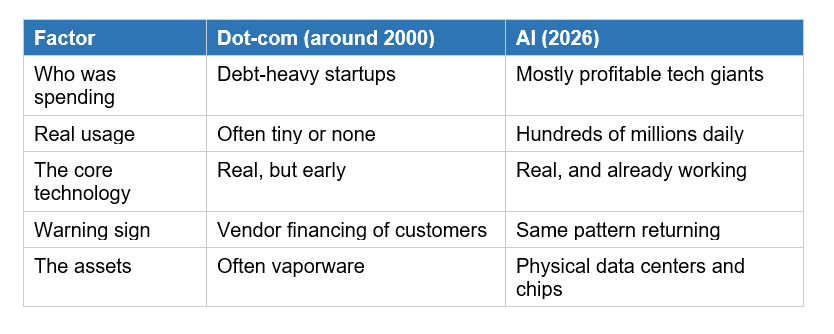
The AI boom rhymes with the dot-com bubble in some ways and breaks from it in others, and the differences are the reason smart people disagree. Comparing them directly is the clearest way to weigh the risk.

Factor	Dot-com (around 2000)	AI (2026)
Who was spending	Debt-heavy startups	Mostly profitable tech giants
Real usage	Often tiny or none	Hundreds of millions daily
The core technology	Real, but early	Real, and already working
Warning sign	Vendor financing of customers	Same pattern returning
The assets	Often vaporware	Physical data centers and chips

Read the table honestly and you get a split verdict, which is the truth. On who is paying and whether people actually use the product, AI looks sturdier than the dot-com era. On the circular financing and the spending-versus-revenue gap, it looks uncomfortably familiar. The internet was real and still crashed. AI can be real and still correct.
My honest read: this is probably not a fake bubble that vanishes, but it may well be an overheated boom that cools hard. The technology stays and keeps growing. Some of these 250 billion dollar bets still look reckless in hindsight. Both can be true, and I would be suspicious of anyone who sounds certain in either direction.

What Happens If It Pops?
If the AI bubble corrects, the likeliest outcome is a painful financial reset, not the disappearance of AI. Overextended companies would fail or shrink, investors would lose money, and spending would slow sharply, while the useful technology itself keeps running and improving.
That is the dot-com lesson worth holding onto. The 2000 crash was brutal, it erased trillions and killed countless companies. And yet the internet not only survived, it went on to produce Google, Amazon, and the entire modern web. The crash cleared out the hype and the weak players; the real thing continued. A serious AI correction would probably follow the same script.
For everyday users, a correction might even bring some upside: less frantic hype, more focus on tools that genuinely work, and possibly cheaper access as the market rationalizes. The scary headlines would be about investors and balance sheets, not about your ability to use AI, which would carry on.

What This Means for You
Whether or not AI is a bubble, the smartest personal move is identical: learn how AI actually works and how to use it well, because that skill pays off in every scenario. The financial drama is about investors and mega-corporations. Your ability to use these tools is yours regardless of what markets do.
A few grounded takeaways:
•	Do not panic and do not worship. Ignore both the doomers saying it is all fake and the hype merchants saying it changes everything overnight. The truth sits in between, and clear-eyed users win either way.
•	Skills survive corrections. If the market cools, the people who understand AI become more valuable, not less, because the froth clears and real capability stands out.
•	Free tools are not going anywhere. The models already exist and run cheaply. A financial reset does not delete them from the internet.
The people who read this era best are the ones who understand what is under the hype. Knowing what a large language model really is, or why benchmark scores can mislead you, is what separates someone who panics at headlines from someone who sees clearly. That understanding is the one asset no market crash can take away.
So let the giants place their 250 billion dollar bets. Your job is simpler and safer: understand the technology, use it well, and keep your head while everyone else is losing theirs in one direction or the other.

Frequently Asked Questions
Q: Is AI a bubble in 2026?
Nobody knows for certain, and honest analysts admit it. There are real bubble warning signs, including 2.59 trillion dollars in AI spending against thin returns, and circular financing like Nvidia guaranteeing OpenAI's spending. There are also strong counterpoints: the spending is mostly from profitable giants, and capacity is being used as fast as it is built. It may be a real technology in an overheated boom at the same time.
Q: What is circular financing in AI?
Circular financing is when companies fund each other in a loop that can inflate the appearance of demand. The clearest 2026 example is Nvidia reportedly guaranteeing up to 250 billion dollars of OpenAI's spending, which OpenAI then uses partly to buy Nvidia's chips. Critics warn this lets a supplier prop up its own sales, echoing patterns seen before the dot-com crash.
Q: Why do people think AI is a bubble?
Mainly because spending massively outpaces returns. Over 500 billion dollars a year is going into AI infrastructure while US consumer AI revenue is only around 12 billion, MIT found 95 percent of companies report zero measurable ROI from generative AI, and OpenAI is reportedly losing around 14 billion dollars in 2026. Add circular financing and the picture worries many experts.
Q: How is the AI boom different from the dot-com bubble?
The biggest difference is who is paying. The dot-com bubble was driven by debt-heavy startups, while today's AI spending comes largely from profitable giants like Google, Microsoft, and Amazon. AI also has real, massive daily usage and physical assets like data centers. The similarity that worries people is the return of vendor financing, where sellers help fund their own customers.
Q: Is OpenAI losing money?
Yes. OpenAI is reportedly on track to lose around 14 billion dollars in 2026, nearly triple its 2025 losses, even as it projects roughly 100 billion dollars in revenue by 2029. Large losses while chasing growth are common for ambitious tech companies, but the scale here is a key data point in the bubble debate.
Q: What happens if the AI bubble bursts?
The likeliest outcome is a financial reset, not the end of AI. Overextended companies would fail or shrink and investors would lose money, while the useful technology keeps running, much like the internet survived the dot-com crash and went on to produce Google and Amazon. For everyday users, a correction might mean less hype and more focus on tools that actually work.
Q: How much is being spent on AI in 2026?
Global AI spending is forecast at around 2.59 trillion dollars in 2026, a 47 percent jump over 2025, with hyperscalers alone on track to spend roughly 675 billion dollars on infrastructure, up 63 percent. Cumulative investment could approach 3 to 4 trillion dollars by the end of the decade. The scale of this spending is central to the bubble concern.
Q: Should this change how I learn or use AI?
No, and if anything it is a reason to learn more. The bubble debate is about investors and corporations, not about your ability to use AI tools, which already exist and run cheaply. Understanding how AI works makes you more valuable whether the market booms or corrects, since a reset clears hype and rewards real skill.

Recommended Reads
•	Nvidia's $250B OpenAI Bet: Why AI Runs on GPUs
•	What Are AI Benchmarks? MMLU and SWE-bench Explained
•	What Is a Large Language Model? (Explained Simply)
•	How Are AI Models Trained? A Plain-English Guide

The people who stay calm in an AI panic are the ones who understand what is really happening. Five minutes a day is enough to become one of them.


References
•	CNBC - Jim Cramer Warns AI Circular Financing Echoes Dot-Com Bubble
•	CNBC - Nvidia and OpenAI in Talks for Up to $250 Billion Backstop
•	Harvard Kennedy School - AI Boom or Bubble?
•	Futurum - AI Capex 2026: The $690B Infrastructure Sprint
•	Bloomberg - AI Circular Deals: How Microsoft, OpenAI and Nvidia Keep Paying Each Other

Read the table honestly and you get a split verdict, which is the truth. On who is paying and whether people actually use the product, AI looks sturdier than the dot-com era. On the circular financing and the spending-versus-revenue gap, it looks uncomfortably familiar. The internet was real and still crashed. AI can be real and still correct.

My honest read: this is probably not a fake bubble that vanishes, but it may well be an overheated boom that cools hard. The technology stays and keeps growing. Some of these 250 billion dollar bets still look reckless in hindsight. Both can be true, and I would be suspicious of anyone who sounds certain in either direction.

What Happens If It Pops?

If the AI bubble corrects, the likeliest outcome is a painful financial reset, not the disappearance of AI. Overextended companies would fail or shrink, investors would lose money, and spending would slow sharply, while the useful technology itself keeps running and improving.

That is the dot-com lesson worth holding onto. The 2000 crash was brutal, it erased trillions and killed countless companies. And yet the internet not only survived, it went on to produce Google, Amazon, and the entire modern web. The crash cleared out the hype and the weak players; the real thing continued. A serious AI correction would probably follow the same script.

For everyday users, a correction might even bring some upside: less frantic hype, more focus on tools that genuinely work, and possibly cheaper access as the market rationalizes. The scary headlines would be about investors and balance sheets, not about your ability to use AI, which would carry on.

What This Means for You

Whether or not AI is a bubble, the smartest personal move is identical: learn how AI actually works and how to use it well, because that skill pays off in every scenario. The financial drama is about investors and mega-corporations. Your ability to use these tools is yours regardless of what markets do.

A few grounded takeaways:

  •   Do not panic and do not worship. Ignore both the doomers saying it is all fake and the hype merchants saying it changes everything overnight. The truth sits in between, and clear-eyed users win either way.

  •    Skills survive corrections. If the market cools, the people who understand AI become more valuable, not less, because the froth clears and real capability stands out.

  •   Free tools are not going anywhere. The models already exist and run cheaply. A financial reset does not delete them from the internet.

The people who read this era best are the ones who understand what is under the hype. Knowing what a large language model really is, or why benchmark scores can mislead you, is what separates someone who panics at headlines from someone who sees clearly. That understanding is the one asset no market crash can take away.

So let the giants place their 250 billion dollar bets. Your job is simpler and safer: understand the technology, use it well, and keep your head while everyone else is losing theirs in one direction or the other.

Frequently Asked Questions

Q: Is AI a bubble in 2026?

Nobody knows for certain, and honest analysts admit it. There are real bubble warning signs, including 2.59 trillion dollars in AI spending against thin returns, and circular financing like Nvidia guaranteeing OpenAI's spending. There are also strong counterpoints: the spending is mostly from profitable giants, and capacity is being used as fast as it is built. It may be a real technology in an overheated boom at the same time.

Q: What is circular financing in AI?

Circular financing is when companies fund each other in a loop that can inflate the appearance of demand. The clearest 2026 example is Nvidia reportedly guaranteeing up to 250 billion dollars of OpenAI's spending, which OpenAI then uses partly to buy Nvidia's chips. Critics warn this lets a supplier prop up its own sales, echoing patterns seen before the dot-com crash.

Q: Why do people think AI is a bubble?

Mainly because spending massively outpaces returns. Over 500 billion dollars a year is going into AI infrastructure while US consumer AI revenue is only around 12 billion, MIT found 95 percent of companies report zero measurable ROI from generative AI, and OpenAI is reportedly losing around 14 billion dollars in 2026. Add circular financing and the picture worries many experts.

Q: How is the AI boom different from the dot-com bubble?

The biggest difference is who is paying. The dot-com bubble was driven by debt-heavy startups, while today's AI spending comes largely from profitable giants like Google, Microsoft, and Amazon. AI also has real, massive daily usage and physical assets like data centers. The similarity that worries people is the return of vendor financing, where sellers help fund their own customers.

Q: Is OpenAI losing money?

Yes. OpenAI is reportedly on track to lose around 14 billion dollars in 2026, nearly triple its 2025 losses, even as it projects roughly 100 billion dollars in revenue by 2029. Large losses while chasing growth are common for ambitious tech companies, but the scale here is a key data point in the bubble debate.

Q: What happens if the AI bubble bursts?

The likeliest outcome is a financial reset, not the end of AI. Overextended companies would fail or shrink and investors would lose money, while the useful technology keeps running, much like the internet survived the dot-com crash and went on to produce Google and Amazon. For everyday users, a correction might mean less hype and more focus on tools that actually work.

Q: How much is being spent on AI in 2026?

Global AI spending is forecast at around 2.59 trillion dollars in 2026, a 47 percent jump over 2025, with hyperscalers alone on track to spend roughly 675 billion dollars on infrastructure, up 63 percent. Cumulative investment could approach 3 to 4 trillion dollars by the end of the decade. The scale of this spending is central to the bubble concern.

Q: Should this change how I learn or use AI?

No, and if anything it is a reason to learn more. The bubble debate is about investors and corporations, not about your ability to use AI tools, which already exist and run cheaply. Understanding how AI works makes you more valuable whether the market booms or corrects, since a reset clears hype and rewards real skill.

The people who stay calm in an AI panic are the ones who understand what is really happening. Five minutes a day is enough to become one of them.

References

•        CNBC - Jim Cramer Warns AI Circular Financing Echoes Dot-Com Bubble

•        CNBC - Nvidia and OpenAI in Talks for Up to $250

•        Harvard Kennedy School - AI Boom or Bubble?

•        Futurum - AI Capex 2026: The $690B

Bloomberg - AI Circular Deals: How Microsoft, OpenAI and N

You might also like...

Deepen your knowledge in AI Learning

Explore all stories →