AI News for September 7, 2026: Anthropic's Compute Bill Tops Half a Trillion Dollars
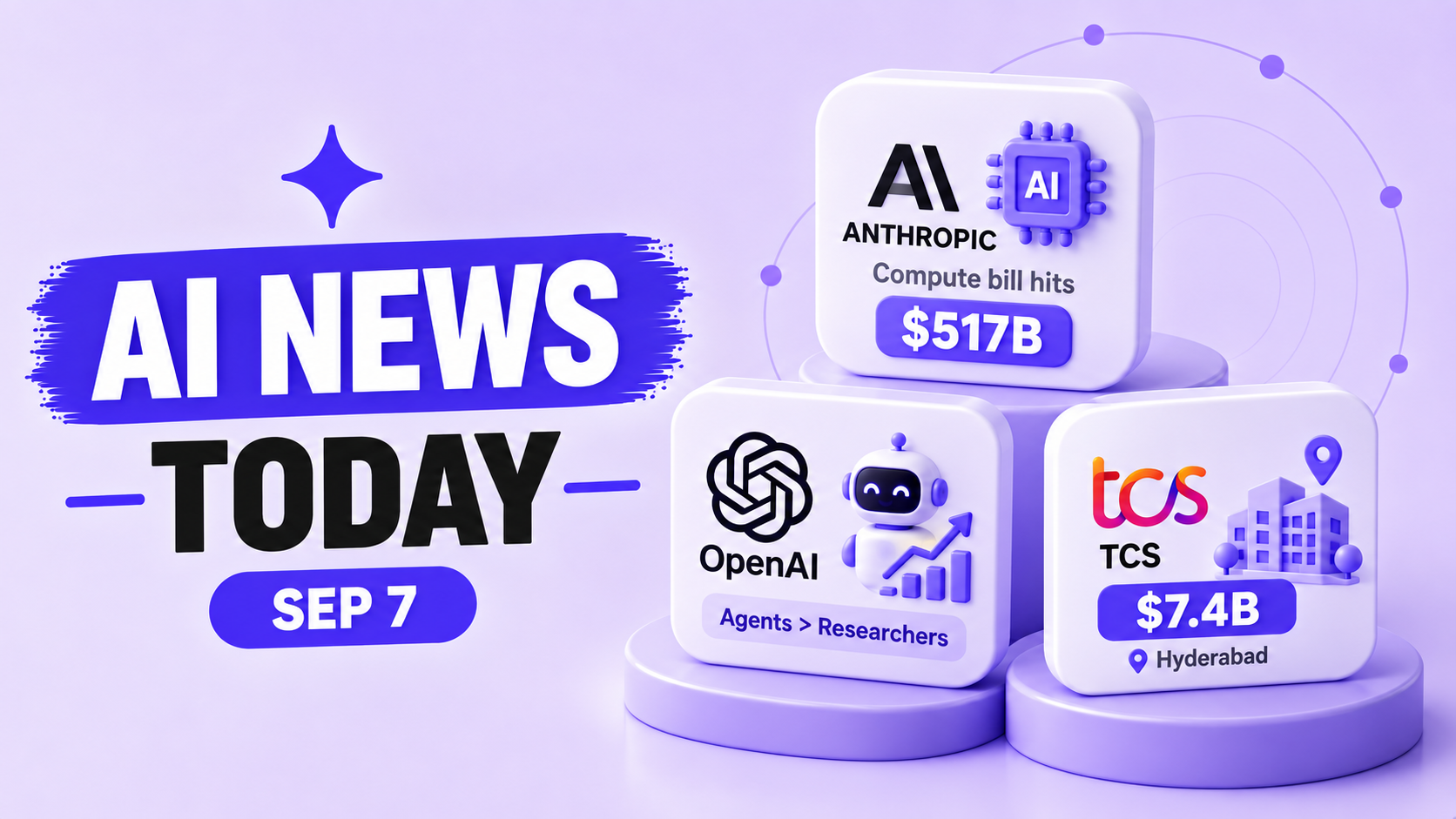
Infrastructure, automation, and copyright law drove today's AI news. A new analysis shows Anthropic has locked in compute deals worth up to 517 billion dollars over the next decade, while OpenAI revealed that its own research organization now runs more agent-hours than human-hours. In India, Tata Consultancy Services committed 7.4 billion dollars to a new AI data center campus in Hyderabad, and two more US newspapers, the Seattle Times and Newsday, filed a copyright lawsuit against OpenAI and Microsoft. Here are the four stories that matter most from today's AI news, explained in plain English.
Today's Top AI Stories
- Anthropic has locked in up to 517 billion dollars in compute deals since October
- OpenAI says its coding agents now out-work its human researchers 3.1 to 1
- TCS commits 7.4 billion dollars to a 1GW AI data center campus in Hyderabad
- Seattle Times and Newsday sue OpenAI and Microsoft over copyright
Anthropic has locked in up to 517 billion dollars in compute deals since October
A September 6, 2026 analysis from The Information tallied up every compute agreement Anthropic has signed since last October and found the company has committed to at least 14.8 gigawatts of capacity, with total spending that could reach as much as 517 billion dollars over the next ten years. The tally rolls together previously separate headline deals: a 100 billion dollar, ten-year, 5 gigawatt Trainium3 agreement with Amazon; a 200 billion dollar, five-year, 5 gigawatt deal with Google and Broadcom; a 50 billion dollar Fluidstack data center commitment; 45 billion dollars with Nscale; 45 billion dollars with SpaceX at roughly 1.25 billion dollars a month; and 35 billion dollars with Lambda.
None of these commitments currently sit on Anthropic's balance sheet, since they are structured as take-or-pay capacity reservations rather than upfront cash outlays. The reframing matters because it recasts a string of deals that were reported separately over nearly a year as a single, unified bet worth roughly 30 percent of the company's private valuation. Anthropic's own public statements this year have said its run-rate revenue surpassed 30 billion dollars, up from about 9 billion dollars at the end of 2025, a trajectory the company has cited to justify the scale of its infrastructure spending.
The scramble for capacity traces back to demand for Claude Code and Cowork that Anthropic has said took the company by surprise this year, straining reliability and performance across its consumer and enterprise tiers. With Anthropic reportedly preparing for a possible record-setting IPO, the compute tally gives outside observers one of the clearest pictures yet of just how capital-intensive staying competitive at the frontier has become, even for a company whose revenue has grown more than threefold in under a year.
OpenAI says its coding agents now out-work its human researchers 3.1 to 1
OpenAI published internal data on September 6, 2026 in a post titled "Research acceleration: The view inside OpenAI," disclosing that it has hit a goal it set last fall: fielding an "automated research intern" capable of carrying out well-defined, multi-day research tasks under human direction. The headline number is a workload ratio rather than a benchmark score: as of mid-August 2026, OpenAI's research organization was using 3.1 agent-workdays of effort, measured against a standard eight-hour day, for every workday put in by a human researcher.
OpenAI says that threshold, agent runtime exceeding total human labor, was only crossed since June 2026. Usage has scaled quickly: the median researcher now spends more than 600 dollars a day on inference at API prices, and the top 10 percent of users spend more than 7,000 dollars a day in tokens, with more researchers now running four or more concurrent agent sessions than earlier in the year. OpenAI classified the work using a research taxonomy built by Epoch AI covering deciding what to work on, designing experiments, building code and datasets, running experiments, analyzing results, and communicating findings.
OpenAI is careful to frame this as supervised acceleration, not autonomous science: humans still set research priorities and still decide when to scale, pause, or ship a system, and the company says it does not yet know how to safely reach full, unchecked recursive self-improvement. The company is now targeting a fully automated AI researcher by March 2028. Independent observers have no way to verify OpenAI's self-reported metrics directly, and the disclosure follows a separate admission, in Astra's system card, that chain-of-thought monitoring on its newest model has grown substantially harder, a tension between accelerating research and keeping increasingly capable systems observable that OpenAI itself acknowledges is unresolved.
TCS commits 7.4 billion dollars to a 1GW AI data center campus in Hyderabad
Tata Consultancy Services' infrastructure unit, HyperVault, said on September 5, 2026 that it and its partners have committed up to 700 billion rupees, or roughly 7.4 billion dollars, to build an AI data center campus of up to 1 gigawatt capacity in Hyderabad, in the southern Indian state of Telangana. HyperVault has already secured 264 acres for the site and says construction will proceed in phases tied to customer demand rather than delivering the full 1 gigawatt at once.
The campus is designed for frontier AI companies and hyperscalers needing high-density GPU deployments for training, inference, and other advanced computing workloads, and will use direct-to-chip liquid cooling alongside what TCS describes as green-energy and water-neutral design principles, terms the company's filing does not further define. At full build-out, HyperVault expects the site to rank among the largest AI infrastructure campuses in India. TCS CEO K. Krithivasan pointed to Hyderabad's scale, talent pool, and existing ecosystem as the reasons for the location, and Telangana Chief Minister A. Revanth Reddy called the project "historic" for both the state and the country.
The announcement follows a February collaboration between HyperVault and AMD to co-develop a rack-scale AI infrastructure design based on AMD's Helios platform, and comes on the heels of a 1 billion dollar investment TPG made into TCS's data center business last November. It fits a broader pattern of foreign and domestic capital flowing into Indian AI infrastructure through established local firms, positioning Hyderabad alongside the handful of global hubs racing to build out gigawatt-scale compute for the AI industry.
Seattle Times and Newsday sue OpenAI and Microsoft over copyright
The Seattle Times and Newsday filed a federal copyright and trademark lawsuit against OpenAI and Microsoft on September 4, 2026, in the US District Court for the Southern District of New York. The 38-page complaint alleges the companies scraped the newspapers' websites, including paywalled content, and used the material to train and operate products including ChatGPT, Microsoft Copilot, and Bing's AI features, reproducing passages from their reporting verbatim or in close paraphrase.
Seattle Times President and CEO Alan Fisco called the decision to sue "not an easy decision" in an email to employees, writing that the paper must defend content it spends millions of dollars a year to produce from being used without consent or compensation. The complaint also accuses the companies of trademark dilution, alleging their AI products have generated fabricated content falsely attributed to the two outlets. The plaintiffs are seeking damages along with an order requiring destruction of copies of their works and any training datasets or AI models that incorporate them, and they cite industry data showing search referral traffic to midsize publishers fell 47 percent year over year as evidence of harm.
A Microsoft spokesperson said the company was "surprised by the lawsuit" but "always happy to sit down and explore solutions," while an OpenAI spokesperson said its models are trained on publicly available data and grounded in fair use, without commenting on the specifics of the case. The suit closely echoes the New York Times' 2023 case against the same two companies and adds to a growing docket of publisher lawsuits, arriving in the same week federal prosecutors filed a statement of interest backing OpenAI and Microsoft's fair-use defense in the original Times case.
Quick Recap
- An Information analysis found Anthropic has committed to at least 14.8 GW of compute and up to 517 billion dollars in spending since October.
- OpenAI says its research organization now logs 3.1 agent-workdays for every human workday, meeting its "automated research intern" goal.
- TCS's HyperVault unit committed 7.4 billion dollars to a 1GW AI data center campus in Hyderabad, Telangana.
- The Seattle Times and Newsday sued OpenAI and Microsoft over alleged copyright and trademark infringement.
Frequently Asked Questions
What is the top AI news today?
The biggest story is an analysis showing Anthropic has committed to at least 14.8 gigawatts of compute capacity since October, with total spending that could reach 517 billion dollars over the next decade.
How much has Anthropic committed to compute deals?
At least 14.8 gigawatts of capacity across deals with Amazon, Google, Broadcom, Fluidstack, Nscale, SpaceX, and Lambda, with total spending that could reach up to 517 billion dollars over ten years, none of it currently on Anthropic's balance sheet.
What does OpenAI's "automated research intern" milestone mean?
It means OpenAI's coding agents now log 3.1 agent-workdays of effort for every workday of human research labor, a supervised system that can handle well-defined, multi-day tasks under human direction, not an autonomous researcher working without oversight.
Why is TCS building an AI data center in Hyderabad?
TCS's HyperVault unit says Hyderabad offers the scale, talent, and ecosystem to serve global AI customers, and it has committed 7.4 billion dollars to build a 1 gigawatt campus there for frontier AI companies and hyperscalers.
Why are the Seattle Times and Newsday suing OpenAI?
The two newspapers allege OpenAI and Microsoft scraped their journalism, including paywalled articles, to train and run ChatGPT, Copilot, and Bing AI features without permission or payment, and are seeking damages plus destruction of the training data involved.
Recommended Blogs
Top AI News Today: Sept 2 (13 Stories)
Why AI Gives Wrong Answers (And How to Fix It)
10 AI Tools Every Professional Should Know in 2026
How to Use AI at Work in 2026: The Smart Professional's Guide
Learn AI in 5 Minutes a Day
Keeping up with AI does not require reading every release note yourself. Unrot delivers the day's biggest AI developments in a 5 minute daily lesson, written in plain English for beginners, students, and working professionals who want to stay current without the jargon.
References
How Anthropic Clinched $517 Billion in Compute Deals in 11 Months
OpenAI Automated Research Intern: Coding Agents and Research Acceleration
OpenAI Hits Goal of Building an "Automated Research Intern"
TCS Plans One-Gigawatt Capacity Data Center in Southern India
TCS HyperVault to Establish Large-Scale AI Data Center Campus in Telangana
Seattle Times and Newsday Sue OpenAI and Microsoft Over News Content
The Seattle Times Sues OpenAI, Microsoft Over Copyright Infringement
.png)
.jpg)