What Is AGI? How Close Are We in 2026
AGI (artificial general intelligence) is a hypothetical AI that can perform any intellectual task a human can, across all domains, without being specially trained for each one. Today's AI is narrow: brilliant at specific jobs but unable to transfer that skill broadly. We are not there yet. In 2026, frontier-lab leaders like Sam Altman predict AGI within a few years (2026 to 2028), Google DeepMind's Demis Hassabis says roughly 5 to 10 years, and skeptics like Yann LeCun say current AI cannot get there at all. The blunt truth: nobody knows, and the experts cannot even agree on a definition.
In March 2026, Nvidia CEO Jensen Huang said AGI had already been achieved. The same year, Meta's chief AI scientist Yann LeCun said today's AI architectures fundamentally cannot reach it. These are two of the most informed people alive, describing the same technology, and they could not disagree more completely.
That is the strange reality of AGI in 2026. It is the goal OpenAI, Google DeepMind, and Anthropic are openly racing toward, the word behind billions of dollars of investment and a fair amount of genuine fear, and yet the people building it cannot agree on what it means or when it arrives. If you have felt confused reading AGI headlines, it is not you. The confusion is real and it goes all the way to the top.
This guide cuts through it. What AGI actually is and how it differs from the AI you use today, the real predictions from the people building it, why the definition itself is a fight, what the benchmarks show, and an honest answer to the only question that matters: how close are we, really?
What Is AGI, Exactly?
AGI, or artificial general intelligence, is an AI system able to perform any intellectual task a human can, across any domain, without needing to be trained separately for each one. The key word is general. It is the difference between a tool that does one thing brilliantly and a mind that can turn itself to anything.
Think about what a person can do. The same human brain can learn to cook, hold a conversation, do basic taxes, pick up a new language, plan a trip, and figure out a problem it has never seen before, all without being rebuilt for each task. That flexible, transfer-it-anywhere ability is the essence of general intelligence, and it is what AGI would replicate in a machine.
Today's most advanced systems, including every large language model you have used, do not have this. They are astonishing within their training, and genuinely useful, but they cannot fluidly step outside it the way a person can. AGI is the name for crossing that line, from powerful-but-narrow to broadly, flexibly capable.
Research institutions broadly agree on this core idea. Google Cloud and Stanford's Human-Centered AI institute both describe AGI as a system with general, human-level or beyond ability to learn, reason, and apply knowledge across a wide range of tasks. The disagreement, as we will see, is not really about the concept. It is about where exactly you draw the line and how you would ever know you crossed it.
Today's AI is a genius with amnesia between subjects. AGI would be the first machine that carries its intelligence wherever it goes.
Narrow AI vs AGI vs Superintelligence
There are three levels worth knowing, and keeping them straight clears up most AI confusion: narrow AI is what we have now, AGI would match a human across the board, and superintelligence (ASI) would exceed the best humans at everything. We live firmly in the first, are chasing the second, and only speculate about the third.
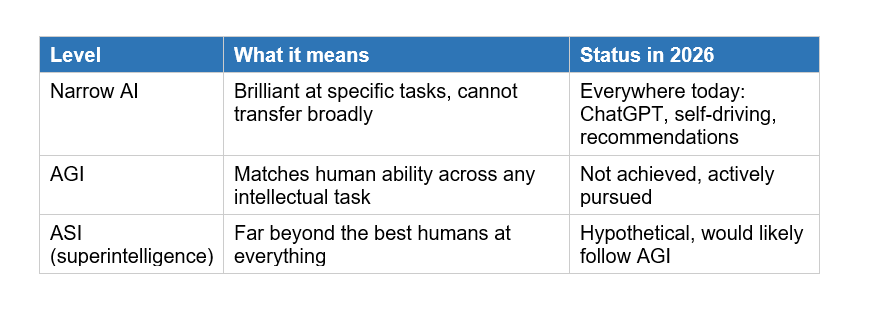
Every AI you have ever used is narrow AI. ChatGPT writes beautifully but cannot drive a car. A self-driving system reads roads but cannot write you a poem. Each is superhuman in its lane and helpless outside it. Narrow does not mean weak, it means specialized. Some narrow systems already crush human experts at their one task, which is exactly why the AGI question is confusing.
AGI would collapse those lanes into one flexible system. And ASI, artificial superintelligence, is the level beyond, a system smarter than all of humanity combined at essentially everything. Most researchers who take AGI seriously assume ASI could follow relatively quickly after, because an AGI capable of improving itself might accelerate fast. That prospect is the source of most serious AI-risk concern.
Why Today's AI Is Not AGI
Today's AI is not AGI because it is narrow: it lacks true general reasoning, real-world understanding, and the ability to reliably learn and adapt on the fly the way humans do. It can look astonishingly capable and still fail at things a child handles easily, which reveals the gap.
A few honest limitations mark the distance:
It does not truly understand. A language model predicts likely words rather than grasping meaning, which is why it can state confident nonsense without noticing.
It struggles to transfer. Skill in one area does not automatically carry to a new, unfamiliar problem the way human learning does.
It cannot reliably learn on the fly. Most systems are frozen after training and cannot genuinely learn from a single new experience mid-task.
It has no real-world grounding. It learned from data about the world, not from living in it, so its common sense is patchy.
The newest reasoning models narrow this gap on hard problems by thinking step by step before answering, and they are a real advance. But even they remain fundamentally narrow, better at reasoning within their domain, not suddenly able to flexibly handle anything a human can. Progress toward AGI is real; arrival is not.
The clearest sign of the gap is how AI fails. It is not that AI is bad, it is that it is unpredictably, non-humanly bad, acing a graduate exam and then flubbing a simple puzzle a seven-year-old solves. A truly general intelligence would not have that jagged profile. AGI means smoothing that jaggedness into reliable, transferable competence, and we are not there.
How Close Are We? The Real Expert Predictions
The honest answer is that predictions range wildly, from a few years to never, and no short-term AGI forecast from any major figure has ever been verified. In 2026, frontier-lab leaders are the most optimistic, the broader research community more cautious, and prominent academics the most skeptical.
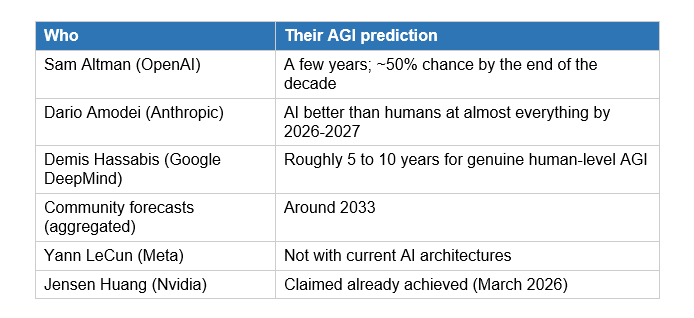
Notice the pattern. The people running the labs that would profit most from AGI give the soonest dates. That does not make them wrong, they are also the closest to the technology, but it is worth holding their optimism with a little skepticism given the obvious incentive. Aggregated community forecasts, which average many researchers, land much later, around 2033.
One sobering fact deserves emphasis: no 1-to-3-year AGI prediction from any major figure has ever come true, and several have been quietly moved forward without acknowledgment when the deadline passed. AGI has been a few years away for a while now. That does not mean it is not coming, but it is a strong reason to treat any confident near-term date as a hope, not a schedule.
The gap between lab optimism and reality is also why some people ask whether the whole AI boom is overheated. We look at that question directly in our guide on whether AI is a bubble, and the AGI-timeline debate is a big part of it.
Why Experts Can't Even Agree on the Definition
Experts cannot agree on when AGI will arrive largely because they cannot agree on what AGI is. Without a shared, testable definition, the timeline debate is almost impossible to settle, and this is the deepest problem in the whole conversation.
The disagreement is real and it runs deep. In 2026, two of the field's most influential labs could not settle on a shared framework for measuring the very thing they are both racing to build. If the builders cannot define the finish line, then claims about how close we are become almost meaningless, because everyone is measuring a different race.
This is exactly why the same technology produces wildly different verdicts. When Jensen Huang says AGI is here and Yann LeCun says it is impossible with current methods, they are not really contradicting each other about facts. They are using different definitions. By a loose definition, an AI that beats humans at many tasks might already count. By a strict one, nothing short of full human-level flexibility qualifies. Same AI, different yardsticks, opposite conclusions.
AGI does not have a clear arrival date because it does not have a clear definition. You cannot time a finish line nobody has agreed to draw.
The practical takeaway: whenever you read a bold AGI claim, the first question is not is it true, it is what definition are they using. Once you notice that everyone is quietly using their own, the endless disagreement suddenly makes sense, and you stop being confused by it.
What the Benchmarks Actually Show
The benchmarks show AI making genuine leaps on some tests while failing almost completely on others designed to require real general intelligence. This split is the clearest evidence that we have powerful narrow AI, not AGI.
Take ARC-AGI, a benchmark built specifically to test the kind of flexible, novel problem-solving that resists memorization. OpenAI's o3 model scored 87.5 percent on one version, a big jump that made headlines and had some declaring AGI near. But then ARC-AGI-3, launched in March 2026, moved to fully interactive tasks that require real-time exploration and learning. On that harder test, frontier models scored under 1 percent, while humans scored around 100 percent.
Sit with that contrast. Under 1 percent for the best AI, near 100 percent for ordinary people. On a test designed to require genuine on-the-fly general intelligence, the gap between AI and humans is not closing, it is a chasm. That single comparison is the most honest snapshot of where we actually are in 2026.
This is also a lesson in reading AI benchmarks carefully, because a high score on one test and a near-zero on another can describe the same model. Our guide on what AI benchmarks really measure explains why headline scores so often mislead, which matters enormously for judging AGI claims.
The takeaway is not that AI is unimpressive. It is that impressive-on-a-test and generally-intelligent are different things, and AGI requires the second. Current systems are superhuman on structured, quantifiable tasks and still lost on open, adaptive ones. Narrow brilliance is real. General intelligence is not here.
Should You Be Worried? An Honest Take
You should be neither panicked nor dismissive. AGI is not imminent in any confirmed way, but the pace of progress is real enough that thinking about it seriously is reasonable, not paranoid. The honest stance is calm attention, not fear and not denial.
On the fear side, the concern that gets serious researchers worried is not killer robots, it is control: if we ever build something as capable as us or beyond, making sure it reliably does what we intend is a genuinely hard, unsolved problem. That is why AGI and safety are discussed together, and why even optimistic labs invest in it.
If that risk interests you, our guide on what AI safety and alignment is explains the real concern in plain terms, without the science-fiction. It is more nuanced and more interesting than the movies suggest.
On the calm side, remember that AGI has been a few years away for years, the definition is unsettled, and the hardest benchmarks show a chasm, not a near-miss. You do not need to panic about a superintelligence next year. What is genuinely worth doing is the same thing that helps in almost any AI scenario: understand the technology, so you can judge the claims yourself instead of being swept along by whoever is loudest, whether that is a hype merchant or a doomer.
The smart response to AGI is not fear or denial. It is literacy: understand it well enough to ignore both the hype and the panic.
Frequently Asked Questions
Q: What is AGI in simple terms?
AGI, or artificial general intelligence, is an AI that could do any intellectual task a human can, across any subject, without being specially trained for each one. It is the flexible, transfer-anywhere intelligence people have, applied to a machine. Today's AI is narrow, meaning brilliant at specific tasks but unable to generalize broadly, so AGI does not yet exist.
Q: How close are we to AGI in 2026?
Nobody knows, and predictions range enormously. Frontier-lab leaders like Sam Altman say a few years (2026 to 2028), Google DeepMind's Demis Hassabis says about 5 to 10 years, aggregated community forecasts land around 2033, and skeptics like Yann LeCun say current AI cannot get there at all. No short-term AGI prediction has ever been verified.
Q: What is the difference between AGI and current AI?
Current AI is narrow: it excels at specific tasks but cannot transfer that ability to unfamiliar domains, and it does not truly understand or reliably learn on the fly. AGI would be general, matching human flexibility across any intellectual task. The difference is like a specialized tool versus a mind that can turn itself to anything.
Q: What is the difference between AGI and ASI?
AGI (artificial general intelligence) would match human ability across all intellectual tasks. ASI (artificial superintelligence) would far exceed the best humans at essentially everything. Many researchers believe ASI could follow relatively soon after AGI, because an AGI able to improve itself might advance rapidly. We have neither today; both remain goals or hypotheticals.
Q: Who is predicting when AGI will arrive?
Sam Altman of OpenAI predicts a few years with roughly 50 percent odds by the end of the decade, Anthropic's Dario Amodei suggests 2026 to 2027 for AI better than humans at almost everything, and Google DeepMind's Demis Hassabis says 5 to 10 years. Meta's Yann LeCun argues current architectures cannot reach AGI, while community forecasts average around 2033.
Q: Has AGI already been achieved?
No, by any strict definition. Nvidia's Jensen Huang claimed in March 2026 that AGI had been achieved, but this reflects a loose definition, and most researchers disagree. On the hardest tests of general intelligence, like ARC-AGI-3, frontier models scored under 1 percent versus around 100 percent for humans, showing a large remaining gap.
Q: Why can't experts agree on when AGI is coming?
Mainly because they cannot agree on what AGI is. Without a shared, testable definition, timeline predictions measure different things, so the same AI can be called AGI by one expert and far from it by another. In 2026, even the leading labs could not settle on a common framework for measuring the goal they are both pursuing.
Q: Is AGI dangerous?
Potentially, which is why researchers take it seriously. The main concern is not killer robots but control: ensuring a system as capable as or beyond humans reliably does what we intend, an unsolved problem called alignment. AGI is not confirmed to be imminent, so the sensible response is calm attention and understanding, not panic or dismissal.
Recommended Reads
The people who see through AGI hype are the ones who understand the technology under it. Five minutes a day is enough to become one of them.