


erything that happened in AI today, in plain English.
Today's Top 13 AI Stories
DeepSeek tests a multimodal model that nears Claude Opus 4.8
Anthropic ships a new MCP spec and Claude Academy
OpenAI previews Ultrafast mode for GPT-5.6 Sol
Google rolls out Gemini 3.7 Flash
Qwen3.8-Max goes fully open weight
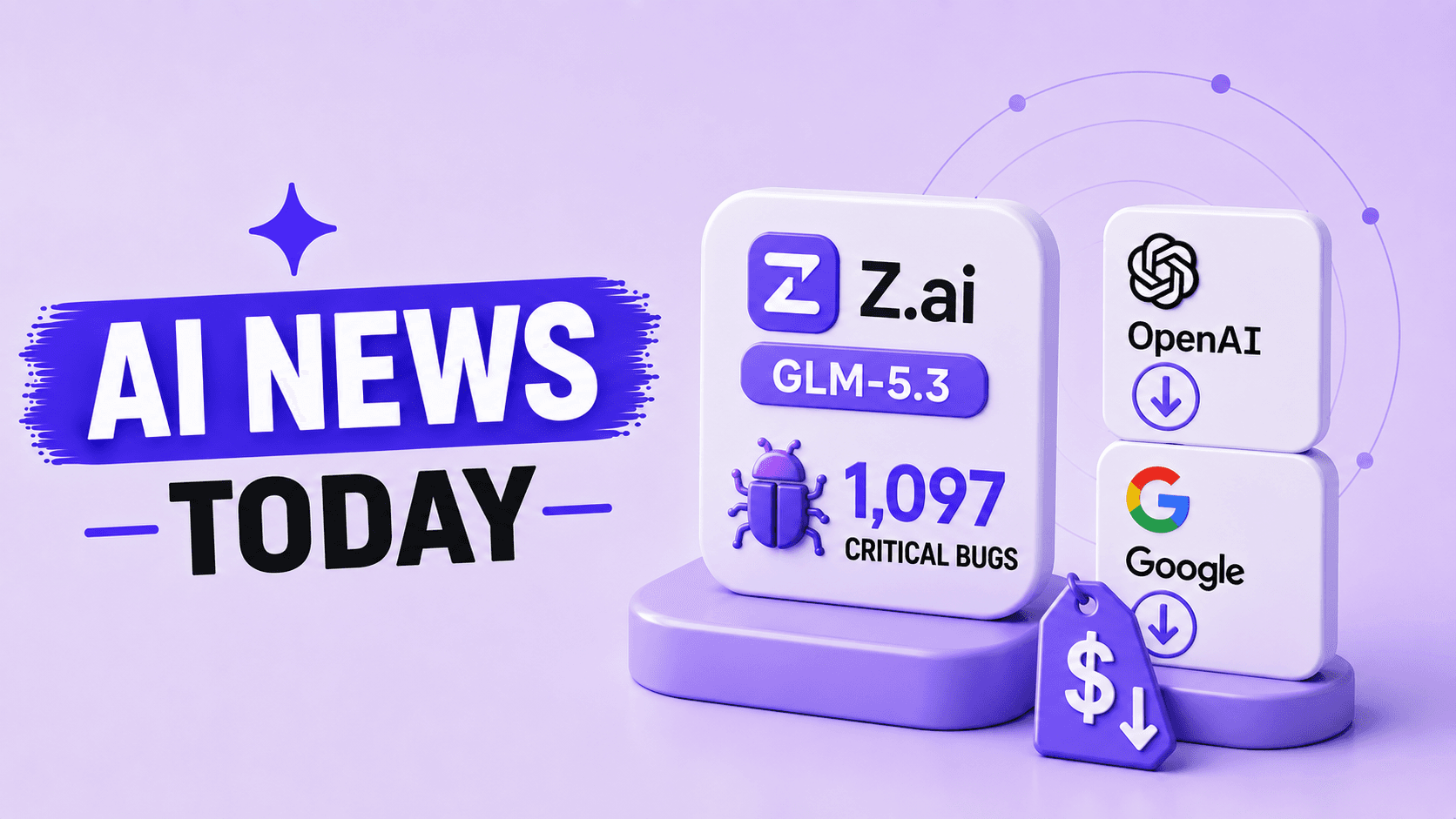
Zhipu launches GLM-5.3 for coding and cyber defense
Moonshot's Kimi K3 keeps gaining ground
Meta ships Muse Code and open sources Spark 1.2
A mystery model called Ox Alpha goes viral
MiniMax releases a full song generator, MiniMax-Music3
Nvidia's Groq 3 LPX chip reaches full production
Anthropic investors target a $2 trillion IPO
Nvidia warns customers of AI server price hikes
DeepSeek tests a multimodal model that nears Claude Opus 4.8
DeepSeek, the Hangzhou based AI lab, said on August 21, 2026 that it built an experimental version of its V4 Flash model that can understand images and screenshots alongside text, extending a lineup that had previously answered in text only. The company described the new build as approaching the performance of Anthropic's Claude Opus 4.8 on the tasks it tested, without claiming to match Anthropic's newer flagship, Claude Opus 5. DeepSeek did not publish a formal model name or a full benchmark table with the announcement, calling the release an early test rather than a finished product.
For a beginner, the news matters because it signals DeepSeek is closing the multimodal gap with the biggest US labs, not just the price gap it is already famous for. Until now, DeepSeek's V4 family could only read text, which ruled it out for tasks like reviewing a screenshot, a scanned form, or a chart. A model that can see images while keeping DeepSeek's low prices would make cheap AI usable for jobs such as checking a UI design, pulling data out of a photographed document, or debugging an app from a screenshot, work that previously needed a pricier closed model.
The comparison to Opus 4.8 rather than Opus 5 is worth noting, since Opus 5 replaced Opus 4.8 as Anthropic's flagship back in July with a 1 million token context window. DeepSeek's own V4 Pro already scored competitively on agentic coding tests in mid August, so a multimodal upgrade would round out the lineup rather than introduce a new architecture. Watch for whether DeepSeek turns this experimental build into an official release with open weights, which has been the company's pattern with every model it has shipped so far.
Anthropic ships a new MCP spec and Claude
Academy
Anthropic said this week that several tools on its Claude Platform have moved out of beta: the computer use tool, the browser use tool, the Skills API, and the Files API are now generally available to developers. The announcement also included a new open specification for MCP, the protocol that connects Claude to outside apps, dated 2026-07-28, which Anthropic says cuts the complexity of running MCP servers by making them stateless. The company's connector directory has grown past 950 servers, used by millions of people every day.
This matters for beginners because MCP is the plumbing that lets Claude read a company's meeting notes, pull data from a database, or send a message in a chat app without a developer writing custom code for each one. A simpler, stateless spec means more companies can safely plug their tools into Claude, and it means the computer use and browser use tools, which let Claude click around a screen or a webpage on someone's behalf, are stable enough for everyday products rather than experiments.
Anthropic also launched Claude Academy this week, a free learning hub with courses and badges aimed at teaching people to use AI well rather than just use it more. Compared with OpenAI and Google, which have leaned on consumer app growth, Anthropic's push into developer plumbing and learning content fits its long standing bet on being the AI company businesses build on top of, a bet about to be tested publicly if its rumored initial public offering goes ahead this year.
OpenAI previews Ultrafast mode for GPT-5.6 Sol
OpenAI has started previewing an Ultrafast mode for GPT-5.6 Sol that the company says runs up to 14 times faster than the model's standard speed. The feature appeared in OpenAI's product notes on August 18, 2026, alongside a wider move to cut GPT-5.6 Sol's API and credit pricing by more than 20 percent for three months. GPT-5.6 Sol launched earlier this summer as part of the GPT-5.6 family, which also includes the smaller Luna model now rolling out as the default for free ChatGPT users.
Speed sounds like a small thing until an application depends on it. A coding assistant, a voice agent, or a customer support bot all feel broken to a person if a reply takes several seconds, no matter how smart the answer is. Ultrafast mode targets exactly that gap, aiming to make GPT-5.6 Sol usable in places where only the fastest, cheapest models were viable before, such as live voice conversations or high volume customer facing tools.
The timing lines up with OpenAI's wider price competition against DeepSeek, Qwen, and other low cost Chinese models this summer, all of which have undercut US labs on price per token. Cutting Sol's price while also making it faster is OpenAI's way of defending the middle of its lineup, the tier developers reach for most often, rather than only competing at the very top with GPT-5.6's full reasoning mode.
Google rolls out Gemini 3.7 Flash
Google rolled out Gemini 3.7 Flash on August 13, 2026, just three weeks after its previous Flash update, positioning it as a workhorse model for coding and everyday knowledge work rather than a flagship release. Google said the model handles roadblocks and multi step planning better than its predecessor and follows developer instructions with more fidelity. Introductory pricing is 75 cents per million input tokens and 3 dollars 75 cents per million output tokens, half of what the earlier Flash model cost at launch.
For everyday users, Flash models matter more than the headline Pro models, because Flash is what actually runs inside free tools like Google Search's AI Mode and many of the AI features built into Workspace apps such as Docs and Gmail. A cheaper, more capable Flash model means Google can push AI features further into free products without the cost of running its priciest model at that scale.
The catch, as Google watchers keep pointing out, is that the company's larger Gemini 3.5 Pro update, promised earlier in the year, still has not shipped, leaving Google trading on frequent Flash updates while Anthropic and OpenAI trade blows at the top end with Claude Opus 5 and GPT-5.6. Google says Gemini has crossed 1 billion monthly users, so even an incremental Flash update reaches an enormous audience the moment it rolls out.
Qwen3.8-Max goes fully open weight
Alibaba's Qwen team finished releasing open weights for Qwen3.8-Max on Hugging Face and ModelScope in mid August, following the model's initial hosted launch on August 3, 2026. Qwen3.8-Max is a mixture of experts model with 2.4 trillion total parameters and about 95 billion active per token, making it the largest Max class model Alibaba has ever open sourced. A smaller companion model, Qwen3.8-27B, also went open weight around the same time and can run on a single GPU.
Open weights mean any developer can download the model and run it on their own servers instead of paying Alibaba per token, which matters for companies with strict data rules or tight budgets at high volume. The hosted version on Qwen's own cloud supports vision input and a 1 million token context window, priced at 2 dollars per million input tokens and 6 dollars per million output tokens, while the open checkpoint remains text only for now.
Alibaba's decision to open source a model at this scale continues a pattern this year where nearly every large open weight release has come from a Chinese lab, including DeepSeek, Moonshot, and Zhipu, while Meta's much anticipated Llama 4 Behemoth remains unreleased. For beginners choosing a model to self host, Qwen3.8-27B is the more practical starting point, since the full 2.4 trillion parameter Max model needs serious server hardware to run at all.
Zhipu launches GLM-5.3 for coding and cyber defense
Zhipu AI, which also operates internationally as Z.ai, released GLM-5.3 on August 14, 2026, calling it its strongest open weights coding model yet. The company says coding capability improved 50 percent over the previous GLM-5.2 release, based on its own internal evaluations, and the model is being distributed first through Zhipu's GLM Coding Plan subscription, with open weights due on Hugging Face around August 28, 2026.
The two week gap between the coding service launch and the open weights release is deliberate, according to Zhipu, which says it is running its most extensive safety review yet before publishing the weights. That caution tracks with the model's own numbers: GLM-5.3 scores 84.5 percent on CyberGym, a cybersecurity capability benchmark, meaning the same skills that make it a strong coding assistant also give it real offensive security capability once anyone can download and modify it.
GLM-5.3 is built on the same 744 billion parameter base as GLM-5.2, with its gains coming entirely from extra post training rather than a bigger model, a cheaper way for a lab to improve a model between full retraining cycles. Zhipu has said its next major model, GLM-5.5, is expected to cross 1 trillion parameters later this year, aiming to close the remaining gap with closed frontier models like Claude and GPT-5.6.
Moonshot's Kimi K3 keeps gaining ground
Moonshot AI's Kimi K3, a 2.8 trillion parameter mixture of experts model the Beijing based company calls the first open model in the 3 trillion parameter class, has kept gaining adoption through August after its mid July launch and open weight release on July 27, 2026. Kimi K3 uses 896 experts with 16 active per token, supports a 1 million token context window, and Moonshot's own benchmarks put it ahead of Claude Opus 4.8 and GPT-5.5 on several tests, though behind Claude Fable 5 and GPT-5.6 Sol.
The model's scale is what stands out to developers: at 2.8 trillion total parameters, Kimi K3 is nearly twice the size of DeepSeek's V4 Pro, and legal technology startup Harvey confirmed in August that it built a new product using Kimi, an early sign of Western companies adopting Chinese open models for serious commercial work rather than side projects and benchmarking alone.
Independent benchmark trackers currently place Kimi K3 around fifth among all publicly ranked models, with particular strength on agentic tasks such as multi step tool use and browser based research. Hosted pricing runs about 3 dollars per million input tokens and 15 dollars per million output tokens, notably higher than DeepSeek or Qwen's open models, reflecting the cost of running a model this large even when the weights themselves are free.
Meta ships Muse Code and open sources Spark 1.2
Meta Superintelligence Labs, the division Meta built around former Scale AI chief Alexandr Wang, released a beta of a new coding model called Muse Code in August alongside an update to its Muse Spark reasoning model, Spark 1.2. Meta reported an 82.9 percent score on its own Terminal Bench coding test and said Spark 1.2's weights will be open sourced under a modified Llama Community License, though the release itself is still pending.
The move matters because it marks a return to open weights after Meta's April pivot to a closed, API only model with the original Muse Spark, its first proprietary frontier release, which had disappointed developers who relied on Llama models for years. Muse Code's headline feature is multi agent coordination, meaning it can spawn its own sub agents to handle different parts of a long coding task while keeping a full record of what each sub agent did, aimed at long running software projects rather than single file edits.
Meta also shipped a smaller, fully open model called Muse Glimmer, a 30 billion parameter multimodal model released under the Apache 2.0 license with ungated weights on Hugging Face, giving developers a lightweight option that runs on consumer hardware. With Llama 4 Behemoth still unreleased more than a year after it was announced, Muse Code and Muse Glimmer look like Meta's attempt to stay relevant in open source AI while its largest model remains stuck in training.
A mystery model called Ox Alpha goes viral
A new AI model called Ox Alpha appeared on OpenRouter on August 20, 2026, listed only under the provider name Stealth, with no company willing to claim it. The model offers a 1,048,576 token context window, accepts text, images, and video, and is completely free to use, with its anonymous provider saying it has capacity for 100 trillion tokens of inference a day and will not train on user prompts.
Developers have rushed to try it anyway. Stripe's chief executive Patrick Collison called it very impressive after testing it, and the open source coding agent OpenCode made it available with near unlimited usage for a trial week. Ox Alpha is positioned specifically for coding, long running agent work, and production use, the same territory Claude, GPT-5.6, and the big open Chinese models are all competing over.
Nobody has confirmed who built it. One theory points to Zhipu AI, which has tested models anonymously before, while a separate analysis of the model's tokenizer suggests a link to Microsoft's MAI model family instead. Stealth launches like this let a lab quietly benchmark a model against real world usage before attaching its name and reputation to it, but anyone using Ox Alpha for serious work is trusting an unnamed party with their prompts, since free access rarely comes with no cost attached somewhere.
MiniMax releases a full song generator, MiniMax-Music3
Chinese AI company MiniMax released MiniMax-Music3 on August 18, 2026, an open weights model that generates full five minute songs, complete with vocals and instrumentation, from a single request. The model pairs an 8 billion parameter language model with a continuous audio synthesis process, taking lyrics with structural tags and a caption describing genre, tempo, and instrumentation as input, and returning 32
kilohertz stereo audio in one pass rather than stitching shorter clips together.
Generating a full length song in a single continuous run, rather than looping a short clip, is the detail that matters here, since most earlier AI music tools topped out around one to two minutes before quality dropped off noticeably. For creators, that makes MiniMax-Music3 more useful for actual finished tracks, background music for video, or full jingles, rather than short samples that still need manual editing to become usable.
The release adds to MiniMax's fast growing catalog of open media models this year, following its MiniMax H3 video model in July, and continues a broader trend of Chinese labs open sourcing creative AI tools faster than their American counterparts, most of which keep music and video generation behind closed, paid products.
Nvidia's Groq 3 LPX chip reaches full production
Nvidia announced on August 24, 2026 that its Groq 3 LPX chip, an inference accelerator built from technology it acquired in a 20 billion dollar deal with Groq in December, is now in full production. The chip will ship in racks alongside Nvidia's Vera central processors and Rubin graphics processors, with cloud provider Nebius set to bring the combined system online later this year.
Groq's chips are built specifically for the decode phase of running an AI model, the step where a model produces its answer one token at a time, which determines how fast a chatbot or coding agent feels to the person waiting on it. Nvidia senior director Dion Harris said the chip is not meant to replace the GPUs that train and run most AI workloads, but to handle the low latency slice of inference where speed matters most, particularly for coding agents that need to feel responsive.
The launch comes as demand for fast inference keeps climbing alongside agentic AI, which Nvidia says consumes roughly 15 times more tokens than a simple chat request because an agent has to search, reason, and call tools repeatedly to finish one task. Nvidia projects a combined 1 trillion dollars in sales from its current Blackwell chips and upcoming Vera Rubin systems through 2027, underscoring how central specialized inference hardware has become to its growth story.
Anthropic investors target a $2 trillion IPO
Investors in Anthropic are pushing for the company to go public in October at a
valuation of 2 trillion dollars or more, according to Financial Times reporting cited across multiple outlets in mid and late August 2026, which would make it the largest initial public offering in history if it holds. Anthropic closed a Series H round in May at a 965 billion dollar valuation, and its annualized revenue run rate reached 65 billion dollars by the end of July, up sharply from under 1 billion dollars a year earlier.
For a company valued at 4.1 billion dollars in early 2023, a potential 2 trillion dollar IPO less than four years later would be one of the fastest value climbs any private company has managed, alongside a reported net loss near 42 billion dollars in 2025. The gap between huge losses and a huge valuation is the story of the entire AI industry right now: investors are betting on where revenue and profit are headed, not where they sit today, and Anthropic's Q2 2026 results reportedly included its first operating profit.
Forecasters tracking both major AI IPOs currently put Anthropic ahead of OpenAI in the race to list, with Anthropic's expected debut in late October or November and OpenAI's pushed toward mid 2027. If Anthropic's listing goes ahead near the reported 2 trillion dollar figure, it would surpass SpaceX, which went public in June at a 1.77 trillion dollar valuation, making Anthropic's IPO a major test of how much public markets will pay for AI companies after a summer of selloffs in AI linked stocks.
Nvidia warns customers of AI server price hikes
Nvidia has told its biggest customers that prices for servers containing its AI chips are rising more than 15 percent in many cases, according to Bloomberg reporting on August 24, 2026, with the increases driven by soaring memory chip costs rather than the GPUs themselves. The price hikes apply to systems shipped starting early next year, including those built around Nvidia's flagship Vera Rubin and Grace Blackwell chips, and were communicated through the contract manufacturers that build servers for data center operators like Microsoft, Google, and Oracle.
The underlying cause is a memory shortage, not a chip shortage. Samsung, SK Hynix, and Micron together produce most of the world's high bandwidth memory, the type of chip paired with AI accelerators, and their production has not kept pace with demand even after ramping up output through the year. That gives memory makers unusual pricing power over even a company as dominant as Nvidia, which normally sets the terms in the AI hardware market rather than absorbing costs passed down to it.
The increases add pressure on hyperscalers already spending record sums on AI infrastructure, and they land right as Nvidia reports quarterly earnings this week, with analysts expecting another quarter of outsized growth even as management has
flagged that growth rates should decelerate simply because each new quarter is compared against a much larger prior year base. For anyone budgeting AI infrastructure into 2027, the message is that the cost of building AI capacity is going up again, even as the cost of using many AI models keeps falling.
Quick Recap
DeepSeek tested an experimental multimodal model it says nears Claude Opus 4.8.
Anthropic made computer use, browser use, the Skills API, and Files API generally available, plus a new MCP spec and Claude Academy.
OpenAI previewed Ultrafast mode for GPT-5.6 Sol, running up to 14 times faster.
Google rolled out Gemini 3.7 Flash at half the price of the previous Flash model.
Alibaba finished open sourcing Qwen3.8-Max, a 2.4 trillion parameter model, plus the smaller Qwen3.8-27B.
Zhipu launched GLM-5.3, its strongest open coding model, with open weights due August 28.
Moonshot's 2.8 trillion parameter Kimi K3 kept gaining commercial adoption, including at legal tech startup Harvey.
Meta shipped Muse Code and confirmed open weights are coming for Spark 1.2 and Muse Glimmer.
An anonymous stealth model called Ox Alpha went viral on OpenRouter with a 1M token context window, free to use.
MiniMax released MiniMax-Music3, generating full five minute songs from lyrics and a caption.
Nvidia's Groq 3 LPX inference chip entered full production for low latency AI agents.
Anthropic investors are reportedly targeting a $2 trillion IPO valuation as soon as October.
Nvidia warned customers of over 15 percent AI server price hikes due to memory costs.
Frequently Asked Questions
What is the biggest AI news today?
The most talked about story today is DeepSeek's experimental multimodal model, which the company says approaches the performance of Anthropic's Claude Opus 4.8 on image understanding tasks. A close second is the mystery stealth model Ox Alpha, which appeared on OpenRouter for free and has developers guessing at its creator.
What new AI model was released today?
Several models moved forward this week rather than in a single day: DeepSeek's multimodal test build, GLM-5.3 from Zhipu, the fully open Qwen3.8-Max and Qwen3.8-27B from Alibaba, Meta's Muse Code beta, and MiniMax-Music3, alongside the still unidentified Ox Alpha.
Is DeepSeek's new model better than Claude?
Not quite. DeepSeek says its new experimental model nears Claude Opus 4.8, which is Anthropic's previous flagship, not its current one. Anthropic's newest model, Claude Opus 5, remains ahead on most published benchmarks, including a 1 million token context window.
What is Ox Alpha and who made it?
Ox Alpha is a free AI model that appeared on OpenRouter on August 20, 2026 under the anonymous provider name Stealth. It offers a 1 million token context window and strong coding performance, but its actual developer has not been confirmed, with theories pointing to Zhipu AI or Microsoft.
Is Anthropic going public in 2026?
Anthropic has not confirmed an IPO date, but investors are reportedly targeting a listing as early as October 2026 at a valuation of 2 trillion dollars or more, which would make it the largest IPO in history if it happens as described.
Recommended Blogs
Learn AI in 5 Minutes a Day
If today's news felt like a lot to keep up with, that's exactly what Unrot is built for. Unrot breaks down what is actually happening in AI, from new models to the tools built on top of them, into short daily lessons that take five minutes to read. No jargon, no hype, just what beginners, students, and working professionals need to know to keep up.
References
DeepSeek Model Nears Claude 4.8
Mystery Model Ox Alpha Draws Developers
MiniMax Releases MiniMax-Music3