Nvidia's $250B OpenAI Bet: Why AI Runs on GPUs
This week, a single number stopped the tech world: 250 billion dollars. That is how much Nvidia is reportedly in talks to guarantee for OpenAI's data centers, according to a Wall Street Journal report on July 26, 2026. Some accounts put the full backing as high as 600 billion dollars once GPU purchases are included.
Most coverage treated this as a finance story, who owes whom and whether the deal survives. I want to treat it as a learning story, because underneath the eye-watering figure sits a question almost nobody stops to answer: why does artificial intelligence need this much hardware in the first place? Why is a chip company suddenly one of the most powerful players in AI, and why does building better AI keep coming down to buying more machines?
So this post does both jobs. First, what the Nvidia and OpenAI news actually says, in plain words. Then the concept every AI learner should understand because of it: why AI runs on GPUs, what training and inference really cost, and why compute became the thing the entire industry is fighting over. Understand this one idea and the next hundred AI headlines will make far more sense.
The News: What Nvidia and OpenAI Are Actually Doing
Nvidia is reportedly in talks to financially guarantee up to 250 billion dollars of OpenAI's data center spending, part of a wider arrangement that could reach 600 billion dollars in total support. It is not a cash payment. It is a guarantee, a contractual promise that Nvidia would cover OpenAI's payments if OpenAI could not, which makes it one of the largest financial pledges ever discussed between two private companies.
The money is tied to physical buildings. The reported 250 billion is linked to a data center project expected to exceed 500 billion dollars in total, including a 10-gigawatt facility being developed by SoftBank's energy division in southern Ohio. A separate 350 billion is reportedly aimed at buying the GPUs to fill those buildings. Ten gigawatts, for scale, is roughly the output of ten large power plants, dedicated to running AI.
Two cautions before anyone treats this as fact. Nothing is signed, the terms are still moving, and the Journal itself notes the talks could collapse. And the structure raised eyebrows on Wall Street for an obvious reason: Nvidia sells the chips, and Nvidia would be guaranteeing the money used to buy them. When a supplier underwrites its own customer, people start asking whether the demand is as real as it looks.
Strip away the finance and this is a story about one thing: AI now needs so much hardware that companies are making 250 billion dollar promises just to keep the machines running.
That is the thread worth pulling. Not the deal mechanics, which may change by next week, but the reason the deal exists at all. Why does software that writes essays and code need ten power plants and a quarter-trillion-dollar backstop?
The Real Question: Why Does AI Need So Much Hardware?
AI needs enormous hardware because modern AI models learn by doing an almost unimaginable number of tiny calculations, and doing them fast enough requires specialized chips running in massive numbers. The intelligence is not stored as rules a person wrote. It is baked into billions of numbers that only exist because a machine crunched through mountains of data to find them.
Recall how these systems actually work. A large language model is a giant web of numbers, called parameters, that together predict the next word. Frontier models have hundreds of billions of them. Every single word the model reads or writes runs through that entire web, which means billions of multiplications for one short reply.
Now multiply that by scale. Training a model means running those billions of calculations across trillions of words of text, over and over, adjusting the numbers each time until the predictions get good. Then serving it to millions of users means running the calculation billions of times a day, forever. Both stages are hungry, and both stages need hardware built for exactly this kind of work.
This is also why deep learning only took off when it did. The core ideas existed for decades, but the hardware to run them at scale did not. When powerful chips arrived, the same old ideas suddenly worked, and the race for more of those chips began. The hardware was the unlock, not the theory.
What Is a GPU, and Why Not Just Use a Normal Chip?
A GPU, or graphics processing unit, is a chip that does many small calculations at the same time, which is exactly what AI needs. A normal computer chip, a CPU, is built to do one complicated thing at a time very fast. A GPU is built to do thousands of simple things all at once, and AI is thousands of simple things all at once.
The classic way to picture it: a CPU is a single brilliant mathematician solving one hard problem quickly, while a GPU is a thousand ordinary students each doing one easy sum at the same moment. If your task is one hard problem, you want the mathematician. If your task is a million easy sums, which is what running an AI model is, the thousand students win by a mile.
GPUs were originally invented for video games, to draw millions of pixels at once. It turned out that the maths behind drawing pixels and the maths behind running a neural network are nearly the same shape: huge numbers of small operations happening in parallel. AI researchers noticed, borrowed the gaming hardware, and never gave it back. That accident is why a graphics company became the engine of artificial intelligence.
Nvidia's position comes from getting there first and building the software layer everyone else now depends on. Its top AI chips, like the H100 and its successors, are the default, and renting one can cost several dollars an hour, which is why a data center full of tens of thousands of them costs billions. When you hear that a company is buying GPUs, hear it as buying the raw ability to think at scale.
A CPU is one genius. A GPU is a thousand ordinary workers. AI is not one hard problem, it is a billion easy ones, so the crowd wins.
Training vs Inference: The Two Places AI Burns Money
AI spends hardware in two separate stages: training, the one-time cost of teaching the model, and inference, the forever cost of running it for users. Nvidia's deal with OpenAI is really about paying for both at a scale nobody has attempted before.
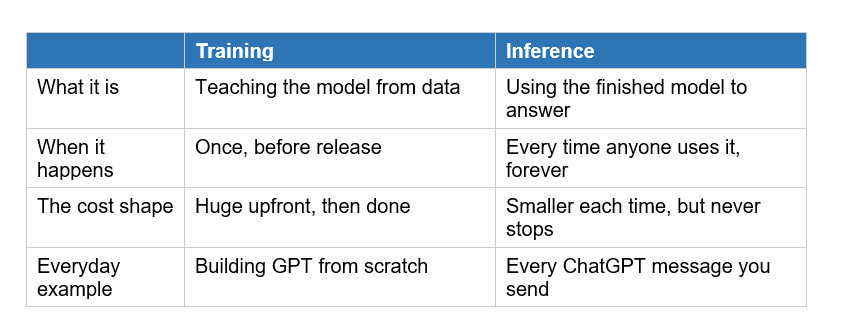
Training is the expensive headline. Teaching a frontier model can cost tens or even hundreds of millions of dollars in compute alone, and the price has grown two to three times per year for years. Our guide on how AI models are trained walks through that process step by step, but the short version is that training is where the biggest single bills land.
Inference is the quieter monster. Each individual answer is cheap, but multiply it by hundreds of millions of users sending billions of messages every day, and the running cost dwarfs the one-time training bill over time. This is why OpenAI needs ten gigawatts of data centers, not for training the next model once, but for serving the current ones to the whole world, every second, indefinitely.
Hold both in your head and the 250 billion dollar figure stops sounding insane. It is not the price of one clever training run. It is the price of the physical capacity to keep answering, at planetary scale, for years.
Why Compute Became the Whole Game
Compute, the raw amount of calculation you can do, became the central resource in AI because the industry discovered a brutal pattern: bigger models trained on more data with more compute tend to get smarter, fairly reliably. That single observation turned hardware into strategy.
For most of computing history, progress meant cleverer code. In modern AI, a huge share of progress has come from simply scaling up, more parameters, more data, more chips. That is why the companies with the most compute keep producing the strongest models, and why access to GPUs became a genuine competitive moat. If more machines reliably means more capability, then whoever controls the machines controls the frontier.
This is also why the AI world is obsessed with benchmark scores and leaderboards, because those numbers are how labs prove their expensive compute actually bought better models. If you have seen those score tables and wondered what they really measure, our explainer on what AI benchmarks are breaks them down, including why the numbers are often less trustworthy than they look.
There is an open question hanging over all of it. Nobody knows how long the pattern holds. Scaling has worked remarkably well so far, but there are early signs it may be slowing, and if throwing more compute at the problem stops producing smarter models, a lot of 250 billion dollar assumptions look very different. The entire boom rests on a bet that bigger keeps meaning better.
Is This a Bubble? An Honest Look
Maybe, and honest observers admit they cannot be sure. The case for a bubble and the case for a genuine build-out are both strong, and the truth is probably a messy mix of the two rather than a clean answer either way.
The bubble worry is real and specific here. When Nvidia guarantees the money that OpenAI uses to buy Nvidia's own chips, the demand starts to look partly self-created, a supplier propping up its customer to keep sales flowing. Circular arrangements like that have preceded past tech crashes, and Wall Street flagged exactly this concern within hours of the report. If AI revenue does not eventually justify the spending, a lot of this capacity becomes very expensive empty buildings.
The other side is just as real. Hundreds of millions of people use AI tools daily, the usage is growing, and unlike some past bubbles, the thing being built actually works and people actually pay for it. Data centers and power plants are real assets, not paper. A build-out can be both genuinely useful and temporarily overpriced at the same time, which is likely what is happening.
My honest read: the technology is real, the demand is real, and the current financing may still be running ahead of the near-term revenue. You can believe AI matters enormously and still expect some of these mega-deals to look reckless in hindsight. Both things fit. Anyone who tells you they know for certain which way it breaks is guessing with confidence.
What This Means for You as an AI Learner
Here is the good news that gets lost in the 250 billion dollar headlines: you need almost none of this to learn or use AI. The giant hardware bills are for training and serving frontier models to the world, not for a beginner building skills or a professional using the tools.
A few things to take away as a learner:
You do not need to own a GPU. Free tiers on Google Colab and Kaggle give you access to real GPUs in a browser, which is more than enough to learn on.
You almost never train from scratch. The expensive part is already done by the big labs. You use or lightly adapt existing models, which costs a tiny fraction of building one.
Understanding the hardware makes you smarter about the tools. Knowing why long AI responses cost more, or why some models are slower, comes straight from understanding compute.
The deeper point is that following AI news makes far more sense once you understand the concepts underneath it. A headline about GPUs, a launch about a faster model, a debate about which AI to use, all of it clicks into place when you know how the pieces work. The news is the surface. The concepts are the thing worth learning.
So when the next enormous AI number lands, and it will, you will not just see a scary figure. You will see what it is buying, why it is needed, and whether the story underneath actually holds up. That is the difference between consuming AI news and understanding it.
Frequently Asked Questions
Q: Why does AI need GPUs instead of normal computer chips?
AI runs on billions of small calculations happening at the same time, and GPUs are built to do exactly that, many simple operations in parallel. A normal chip, a CPU, is built to do one complex task at a time very fast, which is far slower for AI work. That parallel design is why GPUs, originally made for video games, became the engine of modern AI.
Q: What is Nvidia's $250 billion deal with OpenAI?
According to a Wall Street Journal report from July 26, 2026, Nvidia is in talks to financially guarantee up to 250 billion dollars of OpenAI's data center spending, part of a wider package that could reach 600 billion dollars. It is a guarantee, not cash, meaning Nvidia would cover OpenAI's payments if it could not pay. Nothing is signed and the talks could still fall apart.
Q: What is a GPU in simple terms?
A GPU, or graphics processing unit, is a chip that performs thousands of small calculations simultaneously. It was originally invented to draw video game graphics, where millions of pixels must be computed at once. That same ability to do many things in parallel turned out to be perfect for running AI models, which is why GPUs now power almost all artificial intelligence.
Q: Why is Nvidia so important for AI?
Nvidia makes the GPUs that most AI models are trained and run on, and it built the software ecosystem the industry depends on. Its top chips, like the H100 and its successors, are the default for AI work, so controlling GPU supply gives Nvidia enormous influence. This is why a chip company became one of the most powerful players in artificial intelligence.
Q: What is the difference between training and inference?
Training is the one-time process of teaching a model from data, which is extremely expensive but happens once before release. Inference is using the finished model to answer users, which is cheaper per use but happens billions of times and never stops. Both need heavy GPU hardware, and inference at global scale is a major reason companies need such enormous data centers.
Q: How much does it cost to train an AI model?
Training a frontier model can cost tens to hundreds of millions of dollars in compute alone, and that figure has grown roughly two to three times per year. However, this only applies to building giant models from scratch. Fine-tuning or using existing models costs a tiny fraction, which is why beginners and most businesses never face these numbers.
Q: Is the AI infrastructure boom a bubble?
It might be partly, and honest analysts admit uncertainty. The concern is that arrangements like Nvidia guaranteeing money used to buy Nvidia chips can inflate apparent demand. On the other hand, hundreds of millions of people genuinely use AI daily, and data centers are real assets. It is likely both a real build-out and somewhat overpriced at the same time.
Q: Do I need a GPU to learn AI?
No. Free services like Google Colab and Kaggle give you access to real GPUs in your browser, which is more than enough for learning. You also rarely need to train models from scratch, since you can use or lightly adapt existing ones. The massive hardware costs in the news apply to big labs building frontier models, not to learners.
Recommended Reads
• What Is a Large Language Model? (Explained Simply)
• What Is Deep Learning? The Layer Below Machine Learning
• How Are AI Models Trained? A Plain-English Guide
• What Are AI Benchmarks? MMLU and SWE-bench Explained
The scary numbers in AI news get simple once you understand what they are buying. Five minutes a day is enough to read every headline like an insider.
References
• CNBC - Nvidia and OpenAI in Talks for Up to $250
• Al Jazeera - Nvidia Plans $250bn Push for OpenAI Infrastructure