

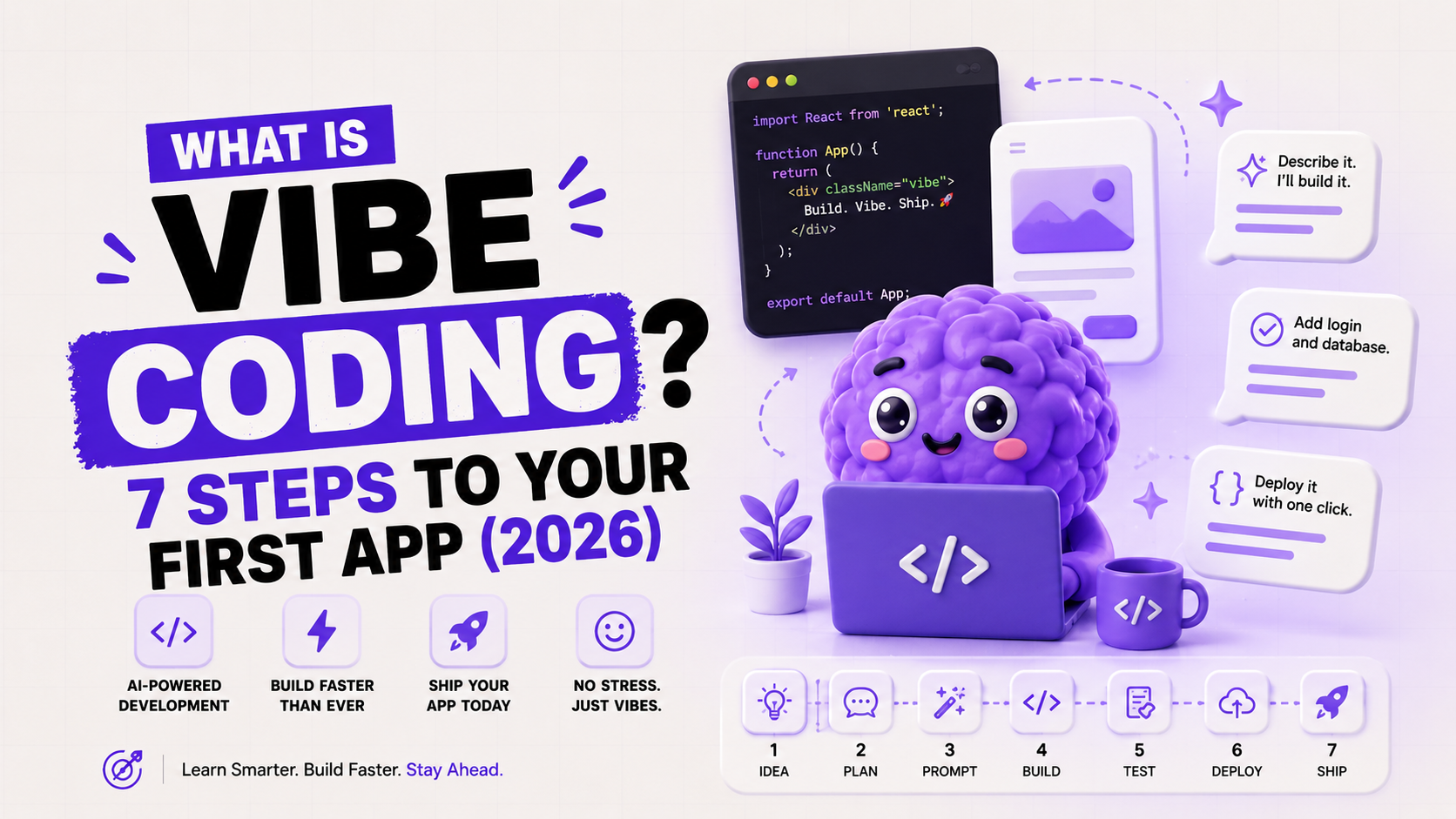
What Is Vibe Coding? Build Apps Without Writing Code
In the winter of 2025, a quarter of Y Combinator's startup batch shipped products where 95 percent of the code was written by AI. Not assisted. Written.
Vibe coding is the name for what those founders were doing: describing an app in plain English and letting an AI model turn that description into working software. The cost of building a functional SaaS product dropped from roughly 200,000 dollars to about 5,000 dollars in the process. Collins Dictionary made 'vibe coding' its Word of the Year for 2025. Indian job portals now list openings for it by name.
I have watched people who cannot write a for loop ship working products in an afternoon. I have also watched people leak their API keys to the entire internet doing the same thing. Both stories matter, so this guide covers both: what vibe coding actually is, which tools are worth your time in 2026, the exact 7 steps to build your first app, and the problems the demo videos never show you.
What Is Vibe Coding? The Plain-English Answer
Vibe coding is building software by describing what you want in natural language and letting an AI model write the actual code. You type something like 'build me a habit tracker with streaks and a dark theme', a large language model generates the files, and a live preview shows you the result in seconds. You then react to what you see and ask for changes, the same way you would give feedback to a designer.
The defining feature is what you do NOT do. You do not read most of the code. You do not memorize syntax. You do not spend three weeks learning what a React component is before you see your first button on screen. You judge the app by how it looks and behaves, and you steer with words.
Here is the one-liner worth remembering: in vibe coding, the programming language is English and the compiler is a chatbot.
That shift changes who gets to build. Product managers, teachers, doctors, shop owners, students. Anyone who can describe a problem precisely can now produce working software for it. Whether they can produce SAFE software is a separate question, and we will get to it.
Where the Term Came From (And Why It Stuck)
Andrej Karpathy, a co-founder of OpenAI and former AI director at Tesla, coined the term in February 2025. In a post on X, he described a new way of working where you 'fully give in to the vibes' and forget the code even exists. He was half-joking. The internet took it completely seriously.
The timeline after that post moved absurdly fast. Merriam-Webster listed 'vibe coding' as a slang and trending term by March 2025. Collins English Dictionary named it Word of the Year for 2025. Y Combinator reported that 25 percent of its Winter 2025 cohort had codebases that were 95 percent AI-generated. A word that did not exist in January became an industry in twelve months.
Why did it stick? Because it named something thousands of people were already quietly doing with ChatGPT and Copilot, and it gave permission to do it openly. Naming a behavior legitimizes it.
My take: Karpathy did not invent a technique that day. He invented a job description.
How Vibe Coding Actually Works: The Loop
Vibe coding works as a feedback loop with five beats: describe, generate, preview, react, repeat. You describe the app. The AI generates code. The tool renders a live preview. You react to what is wrong or missing. The AI regenerates. Every vibe coding tool on the market, from Lovable to Cursor, is a different wrapper around this same loop.
Under the hood, the AI is a large language model trained on billions of lines of public code from GitHub and elsewhere. When you ask for a habit tracker, it is not searching for one. It is predicting, token by token, what a codebase for that request should look like, usually assembling a standard stack (React for the interface, Tailwind for styling, Supabase or a similar service for the database) without you ever needing to know those names.
The skill that separates good vibe coders from frustrated ones is how they handle the 'react' beat. Beginners try to prescribe solutions: 'change line 40 to use a different function'. That almost always backfires, because they are guessing. The move that works is describing problems: 'the login button does nothing when I click it' or 'the totals are wrong when I add two items with the same name'.
Complain about symptoms. Let the AI find the cause. You do not debug a vibe-coded app line by line; you complain to it until it works. (It feels ridiculous the first time. It keeps working anyway.)
Vibe Coding vs No-Code vs Traditional Coding
Vibe coding produces real source code from natural language, no-code assembles apps from visual drag-and-drop blocks, and traditional coding means writing every line yourself. All three can ship a working product. They differ in speed, ceiling, and what happens when something breaks.
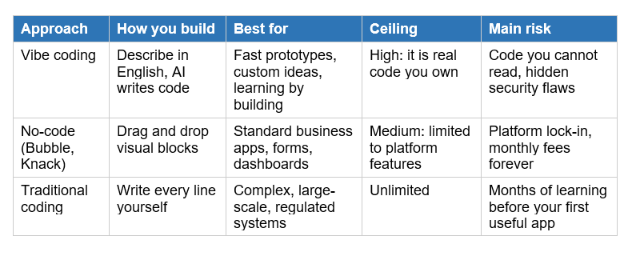
The difference people underrate is transparency. A no-code app stays editable through its visual builder forever. A vibe-coded app hands you a folder of real code, which is powerful, except that the creator often cannot read it. You own an asset you cannot inspect. Kissflow and Bubble both flag this as the core trade-off, and I think the transparency question matters more than any feature comparison.
Hot take: most 'vibe coding vs no-code' articles ask the wrong question. The real question is not which tool builds faster. It is which failure mode you can live with: being locked into a platform, or being locked out of your own code.
The Best Vibe Coding Tools in 2026
The best vibe coding tool for a complete beginner in 2026 is Lovable or Bolt.new, while developers get more control from Cursor, and Replit sits in between as the best tool for learning. All of them offer free tiers, so trying before paying costs you nothing but an email address.
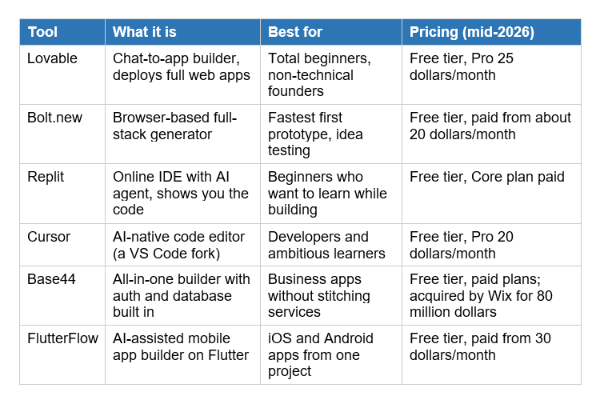
If I had to hand one tool to someone who has never coded, it would be Lovable: the gap between typing a sentence and seeing a deployed app is the smallest I have seen anywhere. If you want the AI to also teach you what it is doing, pick Replit and read what it writes. And if you already work in tech, Cursor is the one that shows up in job listings and professional workflows.
One more note: the model behind the tool matters as much as the tool. Most of these let you pick between Claude, GPT, and Gemini under the hood. Our ChatGPT vs Claude vs Gemini comparison covers those differences in detail.
How to Build Your First App: The 7-Step Method
Building your first app with vibe coding takes seven steps: pick one tool, write a one-paragraph brief, generate a first version, iterate on problems, add features one at a time, try to break it, then publish. Expect 30 to 60 minutes to a working prototype and a weekend to something you would show a stranger.
Step 1: Pick one tool and stay there
Choose Lovable if you never want to see code, Replit if you want to learn from it, Cursor if you already code a little. Then commit. I have seen more first projects die from tool-hopping than from bad prompts. Every platform has a slightly different rhythm, and you learn the rhythm by staying put for at least one full project.
Step 2: Write a one-paragraph brief
Before you touch the tool, write four things in plain English: what the app is, who it is for, the three core features, and how it should feel. Specific beats clever. Here is a real example you can adapt:
'Build a web app called StudyStreak for college students. It lets a user add subjects, log study sessions with a timer, and see a streak calendar of how many days in a row they studied. Clean, minimal design, dark mode by default, mobile friendly. No login needed for version one, store data in the browser.'
Notice what that prompt does: it names the app, the audience, exactly three features, the look, and one smart simplification (no login yet). That last part is the difference between a 10-minute build and a 2-hour fight.
Step 3: Generate the first version and just look at it
Hit generate, wait a minute or two, and resist the urge to fix everything at once. Click around. Make a list of the three most broken or missing things. The first version is never right, and that is fine; it is scaffolding, not the product. Treat version one as a sketch the AI drew to confirm it understood you.
Step 4: Iterate on problems, not solutions
Feed the AI one problem at a time, described by its symptom. Compare these two follow-ups:
• Weak: 'Fix the calendar component logic.' (You are guessing at the cause.)
• Strong: 'When I log a session after midnight, the streak resets to zero. It should count sessions before 4 am as the previous day.' (You described exactly what is wrong and what right looks like.)
The second prompt works because it carries the two things the AI cannot see on its own: your intent, and what actually happened. One problem per message. Patience here is the entire skill.
Step 5: Add features one prompt at a time
Once the core works, extend it the same way: 'add user accounts with email login', then 'add a weekly summary screen', then 'let users export their data as CSV'. One feature per prompt, test after each. Stacking five requests into one message is the most common way beginners turn a working app into a broken one.
Step 6: Try to break it before strangers do
Spend 20 minutes being your app's worst user. Type emoji into number fields. Click buttons twice. Refresh mid-save. Open it on a phone. Then run the single highest-value prompt in this whole guide:
'Review this app for security problems: exposed API keys, missing input validation, and any way one user could see another user's data. List issues by severity and fix the critical ones.'
Most vibe coding tutorials skip this step because it ruins the demo. Do not skip it. As we cover below, the data on AI-generated code security is genuinely ugly, and one prompt like this catches the embarrassing stuff.
Step 7: Publish, share, and improve from real feedback
Every tool in the table above has a deploy button that gives you a public link. Ship it, send it to five people, and fix what they actually complain about instead of what you assumed they would. Real users find problems in an hour that you would not find in a week. That loop, ship, listen, fix, is the same one professional teams run. You just got there without the four-year degree.
The Numbers Behind the Hype
Vibe coding went from a joke on X to measurable industry reality in under two years, and the adoption numbers are steep. As of mid-2026, roughly 46 percent of all new code is AI-generated, and Gartner projects that figure reaches 60 percent by the end of 2026.
• 25 percent of Y Combinator's Winter 2025 cohort shipped codebases that were 95 percent AI-generated.
• 84 percent of developers use or plan to use AI coding tools, per Stack Overflow's 2025 Developer Survey; 92 percent of US developers report daily use.
• The AI coding assistant market was 7.37 billion dollars in 2025 and is projected to hit 30.1 billion dollars by 2032, a 27.1 percent compound annual growth rate.
• The cost of building a functional SaaS MVP dropped from roughly 200,000 dollars to about 5,000 dollars for AI-first startups.
Read those numbers together and the story is simple: the barrier between 'idea' and 'working software' collapsed by two orders of magnitude, and the market repriced accordingly. What would you build if syntax stopped being the barrier? That is no longer a rhetorical question. It is a purchasing decision.
The Honest Problems Nobody Puts in the Demo
The biggest problem with vibe coding is security: Veracode's 2025 analysis found that 45 percent of AI-generated code contains security vulnerabilities, and AI-written code carries roughly 2.74 times more flaws than human-written code. One scan of 5,600 publicly deployed vibe-coded apps found more than 2,000 high-impact vulnerabilities and 400 exposed secrets, meaning API keys and passwords sitting in public view.
Why does that happen? The AI optimizes for 'works in the demo', not 'survives contact with an attacker'. It happily builds a login form that looks perfect and stores passwords in plain text. A trained developer catches that on sight. A vibe coder, by definition, is not reading the code, so the flaw ships.
Security is not the only tax. Three more show up later:
• Maintenance debt: an app you did not write is an app you cannot confidently change six months later, and AI models sometimes rewrite large chunks when you ask for small edits.
• The 80 percent wall: the last 20 percent of a real product (edge cases, performance, odd devices) is where vibe coding slows from magic to grind.
• Opaque failures: when the AI cannot fix a bug after five attempts, you have no ladder down into the code to fix it yourself, unless you have been learning along the way.
The dirty secret of vibe coding is that shipping is the easy part. Owning what you shipped is the hard part.
My rule: I would not vibe code anything that touches other people's money or medical data in 2026. Weekend projects, internal tools, portfolios, prototypes, small products with a security review? Fair game, and genuinely wonderful.
Vibe Coding in India: Jobs, Salaries, and the Window
Vibe coding is already a paid skill in India, not just a hobby. Indeed lists around 100 vibe coding vacancies, Foundit shows 79, and Internshala runs listings paying 10,000 to 99,000 rupees per month, with roles concentrated in Bengaluru, Hyderabad, Noida, Chennai, and Mumbai.
Salary data for 2026 puts freshers in AI-assisted development roles between 4.5 and 10 LPA, with strong portfolios pushing 12 to 15 LPA at product companies. AI hiring in India is projected to grow 32 percent in 2026, and the talent shortage is expected to persist into 2030. Most learners going from zero to job-ready report a three-to-six month timeline with consistent effort.
The interesting part is WHO gets these roles. It is rarely the person with the best algorithms score. It is the person who can show five shipped projects and talk about the trade-offs they hit, which is exactly what the 7-step method above produces. If you are using AI on the job already, our guide on how to use AI at work without getting in trouble pairs well with this one.
The window matters, though. Right now, 'I can vibe code' is a differentiator on an Indian resume. By 2028 it will be assumed, the way 'I can use Excel' is assumed today. Early skills pay a premium precisely because they are early.
Will Vibe Coding Replace Developers?
No. Vibe coding replaces the typing part of programming, not the thinking part, and for complex systems the thinking part is most of the job. Architecture, security, scaling, and maintenance still require engineers, which is why the same companies adopting AI coding tools are still hiring senior developers at record salaries.
What vibe coding actually does is move the job up one level of abstraction. Assembly programmers were not replaced by C; they became C programmers and built bigger things. The pattern is repeating. Developers who master AI tools compress delivery from weeks to days, and they capture that premium instead of being displaced by it.
Here is the contrarian bit: the people most at risk are not senior engineers. They are juniors whose only skill is translating tickets into syntax, because syntax is precisely what got automated. The safe ground in 2026 is either deep expertise or fast learning, and the dangerous ground is the shallow middle.
Which is why my honest advice for beginners is to use vibe coding as a learning engine, not just a shipping engine. Read what the AI generates. Ask it to explain its choices. Break something on purpose and fix it. Generate, study, break, repair: that messy cycle teaches more programming in a month than most video courses manage in six.
Frequently Asked Questions
Q: What is vibe coding in simple terms?
Vibe coding means building software by describing what you want in plain English and letting an AI write the code. You judge the result by how the app looks and behaves in a live preview, then ask for changes conversationally. Tools like Lovable, Bolt.new, and Cursor are built around this workflow.
Q: Who coined the term vibe coding?
Andrej Karpathy, a co-founder of OpenAI and former AI director at Tesla, coined the term in February 2025 in a post on X. Collins English Dictionary named 'vibe coding' its Word of the Year for 2025, and Merriam-Webster listed it as a trending term the month after Karpathy's post.
Q: Do I need to know programming to vibe code?
No. Tools like Lovable and Bolt.new are designed for people with zero coding experience and handle the technical stack for you. Knowing basic concepts helps you write better prompts and debug faster, but it is not a requirement to ship a working web app.
Q: What is the best vibe coding tool for beginners in 2026?
Lovable is the strongest pick for total beginners because it goes from a chat prompt to a deployed full-stack web app with no setup, with a free tier and a Pro plan at 25 dollars per month. Bolt.new is the fastest for quick prototypes, and Replit is best if you want to learn to code while building.
Q: Is vibe coding the same as no-code?
No. No-code platforms like Bubble use visual drag-and-drop blocks and keep everything editable inside their platform, while vibe coding generates real source code from natural language prompts. Vibe coding has a higher ceiling because you own actual code, but that code can be hard to maintain if you cannot read it.
Q: Is vibe coding safe for real products?
Not by default. Veracode's 2025 research found 45 percent of AI-generated code contains security vulnerabilities, and one scan of 5,600 vibe-coded apps found over 2,000 high-impact flaws plus 400 exposed secrets. Always run a security review prompt, keep API keys out of your code, and avoid vibe coding apps that handle payments or sensitive data without an expert review.
Q: Will vibe coding replace software developers?
No. It automates the typing part of development, while architecture, security, and maintenance still require engineering judgment. Gartner projects 60 percent of new code will be AI-generated by the end of 2026, yet demand for developers who can direct these tools is rising, with AI hiring projected to grow 32 percent in 2026.
Q: Is vibe coding a good career skill in India?
Yes, and the window is early. Indian job portals list dozens of vibe coding roles, freshers in AI-assisted development earn 4.5 to 10 LPA in 2026, and strong portfolios reach 12 to 15 LPA at product companies. Most beginners become job-ready in three to six months of consistent practice.
Recommended Reads
• 10 AI Tools Every Professional Should Know in 2026
• What Is a Large Language Model? (Explained Simply)
• How to Use AI at Work (Without Getting in Trouble)
• How to Learn AI in 30 Days: Free Day-by-Day Plan
Vibe coding rewards people who understand AI, not just people who own the tools. Five minutes of AI learning a day compounds faster than you think.
References
• What is vibe coding, exactly? (MIT Technology Review)
• Vibe coding explained (Google Cloud)
• What is vibe coding? (GitHub)
• What is vibe coding? (Replit)
• Security in vibe coding (Checkmarx)
• Vibe coding security risks (IBM Think)